Aug. 30, 2013
Biologist visits Canadian Arctic to research shorebirds
Share this story
Fletcher Smith, a research biologist with the Center for Conservation Biology, a collaboration of Virginia Commonwealth University and the College of William and Mary, served a six-week stint this summer in the Canadian Arctic operating a shorebird base camp on the Mackenzie River Delta with the Canadian Wildlife Service.
The camp is part of both the Arctic Shorebird Demographic Network (ASDN) and the Arctic Program for Regional and International Shorebird Monitoring (Arctic PRISM). The overarching objectives of these programs are to measure demographic parameters of breeding shorebirds, such as adult survivorship and productivity, to estimate population size and trends in Arctic shorebirds. This information is extremely difficult to gather for shorebirds, and the network of sites gathering this information spans the entire Arctic.
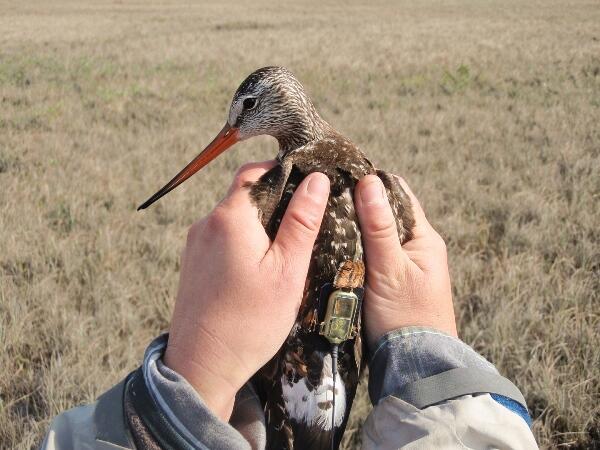
The focal species in the Mackenzie River Delta include red-necked phalarope, semi-palmated sandpiper, pectoral sandpiper and whimbrel. During the 2013 season, the Mackenzie Delta crew found and monitored more than 100 shorebird nests, captured and banded nearly 100 shorebirds, deployed all six satellite transmitters on whimbrels and Hudsonian godwits, and deployed 15 geolocators on semi-palmated sandpipers, adding up to a successful season by any measure.
The collaborative satellite tracking project has provided useful information to conservation. Prior to the tracking of the Mackenzie River Delta whimbrels, very little was known about the broader life cycle of these birds. A whimbrel named “Hope” was the only previous connection from the Atlantic Coast stopover areas to the Mackenzie Delta. “Hope” was tagged in Virginia and migrated to the Mackenzie Delta for four breeding seasons, using Virginia as a staging ground both in spring and fall migrations.
During the 2012 breeding season, four whimbrels were tagged in the Mackenzie Delta, and all four migrated to eastern staging grounds before wintering in Brazil. The three whimbrels tagged in 2013 appear to be taking the same route, flying from the Mackenzie Delta to Atlantic Canada. Two of the whimbrels tagged this year staged in Atlantic Canada and then undertook a nonstop 4,500-mile flight to northern South America where they will spend the winter. One of the whimbrels remains in Newfoundland.
No Hudsonian godwits have ever been satellite tagged, so the movements of these birds will be particularly interesting to scientists involved in the study. All three Hudsonian godwits are currently staging along the shores of the Hudson Bay/James Bay. The whimbrels and godwits can be tracked at Wildlifetracking.org.
Subscribe for free to the weekly VCU News email newsletter at http://newsletter.news.vcu.
Subscribe to VCU News
Subscribe to VCU News at newsletter.vcu.edu and receive a selection of stories, videos, photos, news clips and event listings in your inbox.