Oct. 7, 2026
Professor Kendall Buster unveils a botanical-inspired sculpture in South Africa
Share this story
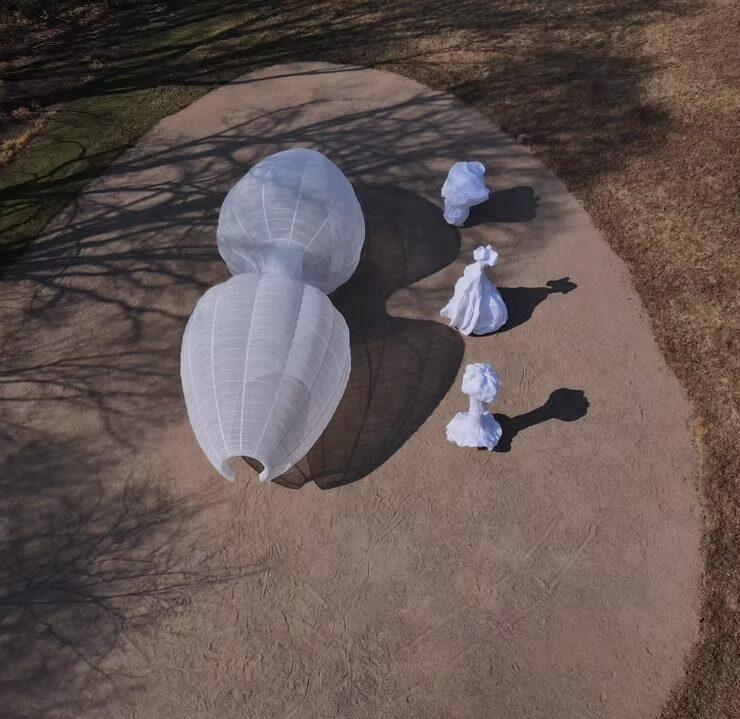
The video opens with three mysterious figures slowly moving in the open space of a field. As the camera pans skyward, a cloud-like hourglass structure appears in the background.
Seconds tick by, the perspective alternating between the sculpture’s interior and exterior, capturing the graceful movements of the three figures, a hazy view of the world above, and the expanse of the surrounding landscape.
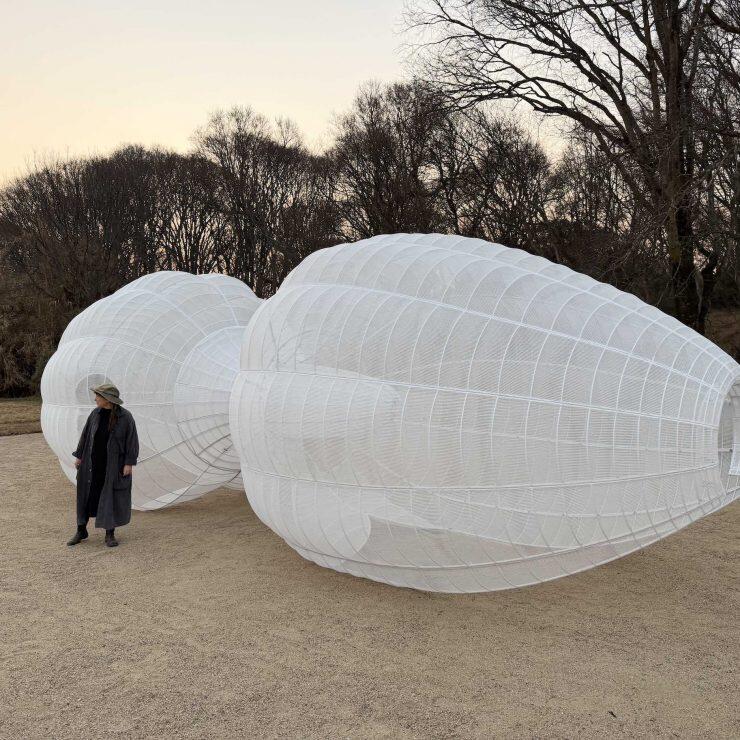
Created by the collaborative group DearRibane, the video features “Calyces,” the latest project from sculptor Kendall Buster, a professor of fine arts at Virginia Commonwealth University, and her longtime collaborator, South African artist Siemon Allen. Buster recently earned the prestigious honor of being named one of the 12 newest members of the National Academy of Design, a highly selective 200-year-old organization with a total membership of roughly 450.
Equally inspired by the monumental and the microscopic, Buster’s sculptures — which have appeared in galleries across the U.S. and abroad — operate as scale models for imaginary places and converse with the particulars of built environments.
Now, Buster is shifting her gaze to the outside world. Set at NIROX sculpture park, “Calyces” offers both a mysterious distant view from across the vast open landscape of South Africa and a close-up, intimate experience through its accessible interior chambers.
“For a long time, I’ve been committed to sculptures that are both object and architecture,” said Buster, who works in the Sculpture and Extended Media Program in the School of the Arts. “They invite you in. There’s something wonderful about a piece that you don’t just walk around, but can go inside. That brings you in to explore.”
In collaboration
The roots of “Calyces” can be traced back decades, when Buster and Allen first started working together. They first explored a similar concept in 1997, which they installed in an old train station in Berlin. More recently, they revisited the idea in an exhibition for an alternative space in Washington, D.C.
“We were excited to further explore how such a form might be expanded in response to an open landscape,” Buster said of “Calyces,” which measures approximately 30 feet by 10 feet. “When we committed to doing this — the bending, welding, screening and assembly on that scale and in such a short timeframe — we knew it would be pretty intense.”
Despite the long development history of the concept, the execution of the large-scale sculpture took place over just six weeks during an artist residency at NIROX. Located on the banks of the Blaauwbankspruit River and adjoining the Kkatlhamphi Private Nature Reserve, NIROX features cultivated lawns, arbors, fields, waterways and wetlands, and a sculpture garden with more than 60 permanent and long-term installations.
“Residencies can be incredibly generative, and they’re all different,” Buster said. “Some are primarily about fellowship with other creative folks while others are about making art with particular equipment and facilities. NIROX is special because it was both an opportunity to meet artists and writers from around the world but also provided a fully equipped large workshop in a beautiful environment.”
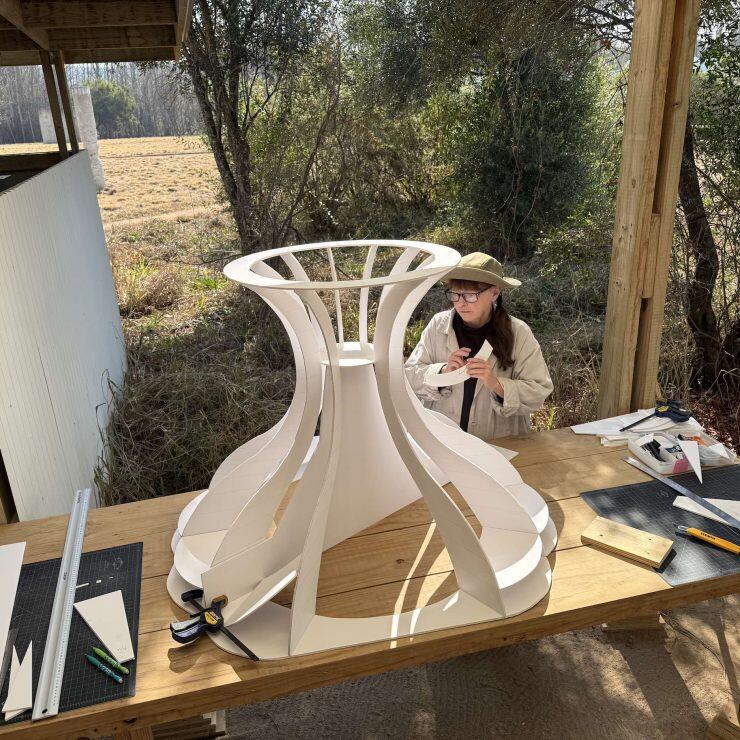
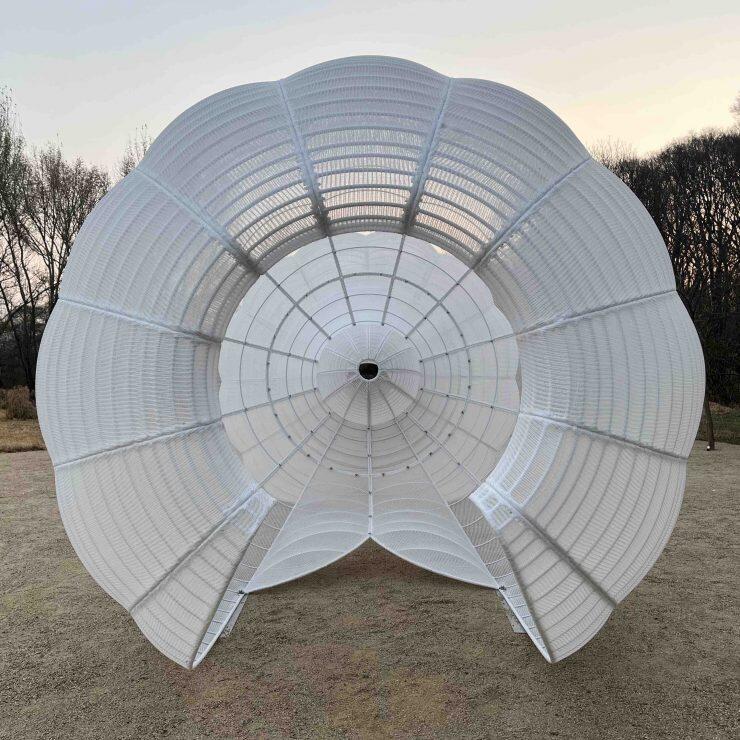
Often working well into the night, Allen and Buster built the steel frame, which was then powder coated to have a bright white surface. After hand-sewing a translucent screening of African shade cloth onto each section, they then assembled the orange peel-like sections on site with hundreds of tiny nuts and bolts.
Far from their home studios in RIchmond — and the fabrication assistants and equipment they’re accustomed to working with —Buster and Allen turned to local sources, such as a nearby farm offering powder coating services and agricultural shade-cloth manufacturers in Cape Town. A friend from Johannesburg and a former assistant who now lives in Pretoria came to pitch in with screening, and a fellow artist who lives and works in Cape Town participated in the complex assembly.
“It was very organic,” Buster said, “and took a lot of faith that we would find what we needed. But I have to say, the people at NIROX and the friends who showed up to support us were amazing.”
As part of the residency, Buster and Allen were also encouraged to engage with the local community. Visitors to NIROX were able to see their work in progress, from Buster’s foamcore model-making that took place at an outdoor section of the studio to the welding and screening of the large steel structure.
Some were fascinated by the engineering, others by the welding and sewing involved. Many were especially curious about Buster’s use of agricultural shade cloth — a netting material not commonly seen in the U.S., but found throughout South Africa.
By the time visitors returned to see the final installation, they were often surprised to see how the heavy steel frame had transformed.
“It went from this gun-barrel steel skeletal form — a heavy, metal, industrial thing — to something ephemeral that seemed as if it could float away,” she said. “It looked so light, it’s almost like a dirigible or a hot air balloon.”
In conversation
During a previous residency at NIROX in 2018, Buster met artist and designer Manthe Ribane of the collaborative group DearRibane, who explores the intersections of fashion, movement, photography and video. A creative dialogue ensued and culminated in an invitation to return in 2026 and continue the conversation. DearRibane responded to the patterns generated for the sculpture to craft a series of sculptural garments that echoed the volume, texture and architectural language of Buster’s forms, translating her sculptural language onto the body.
“It was wonderful to have the opportunity to work with artists in a different discipline,” Buster said. “We had so many wonderful conversations about how my sculptural process has such a kinship with clothing construction. For a long time, I’ve thought of my sculptures as vessels or sites of enclosure, and it was exciting to think about how, in a lot of ways, they’re also like garments.
“DearRibane also created a video that captured the movement and action framed by the sculpture in a dreamlike way. The sculpture became a part of the narrative they spun, with mysterious creatures moving in and out and around the piece. It opened up another story of what the sculpture might be in the imagination.”
In reality
Buster’s sculptures typically engage with architecture and building interiors — a response to the ceilings, atriums and compressed spaces that contain them. Many can be found mounted to ceilings, floating delicately above viewers.
With “Calyces,” the surrounding environment seems limitless and resonates with the biomorphic feel of the work. The park’s 300-hectare garden is surrounded by a 1,000-hectare nature preserve — a wilderness of hills and valleys populated with local game and birds.
The DearLand site is tucked away in a corner of the park, a gravel area surrounded by a curved treeline. Buster describes it as amphitheater-like, with a quality of light that allows viewers to look through the screening into the expanse of sky above.
“What’s so beautiful about the site is that when you discover the sculpture from a distance you see what appears to be an enormous botanical form and you’re not really sure about the scale,” she said. “As you get closer, you can perceive it in its entirety, and then you realize that you can enter the work physically. That this object will embrace you. Once you go inside there are sight lines and if you look through in certain ways, it frames other viewers and bits of the landscape.”
Now back home in Richmond, Buster said the residency experience gives her a renewed relationship with her students — many of whom are also exploring new ideas, facing technical challenges in their execution, and taking risks to pursue work outside their comfort zones.
“At VCUarts, those of us who are teachers are also passionate practitioners,” she said. “It’s a gift to have this residency experience and to then bring that back to my students. And to be in another country, another region of the world, working with creatives who are in a different field from me — that broadens it even more. It affirmed the importance of making space for interdisciplinary exchanges.
“Many people think of research, service and teaching as separate, but to me, they’re all completely entangled.”
This story was originally published on the School of the Arts website.
Subscribe to VCU News
Subscribe to VCU News at newsletter.vcu.edu and receive a selection of stories, videos, photos, news clips and event listings in your inbox.