Sept. 10, 2009
New high-tech equipment at Nanomaterials Characterization Center to attract material scientists along the East Coast
Share this story
Trying to create a plastic film that resists bacterial growth for use in a hospital room is no easy task. It takes an ultra-meticulous hand to tailor very specific surface properties so that the plastic repels or kills the bacteria on contact. That’s why material scientists rely on some extremely sophisticated equipment.
High-tech microscopes, X-ray photoelectron spectrometers and other technologies equipped to fabricate structures on the nano-scale are used to analyze and manipulate the characteristics such as surface, size and shape of a material.
These are just a few of the new tools that scientists at Virginia Commonwealth University and nearby universities now can access. In the past year, VCU has received two National Science Foundation grants totaling more than $1.5 million to expand its capabilities for research in materials science – a field where chemists, engineers or physicists can change, manipulate or tailor the surface, size or shape of a particular material to create new ones or improve upon older ones.
Through the support of these grants, VCU has acquired the high-tech equipment needed to advance research in nanoscale technology. The new equipment is housed in the Nanomaterials Characterization Center, a multiuser facility where researchers from both VCU campuses, as well as other universities along the East Coast — will be able to use state-of-the-art instrumentation for nanomaterials characterization. Additional instrumentation was acquired through $1 million in state funds from the Higher Education Equipment Trust Fund.
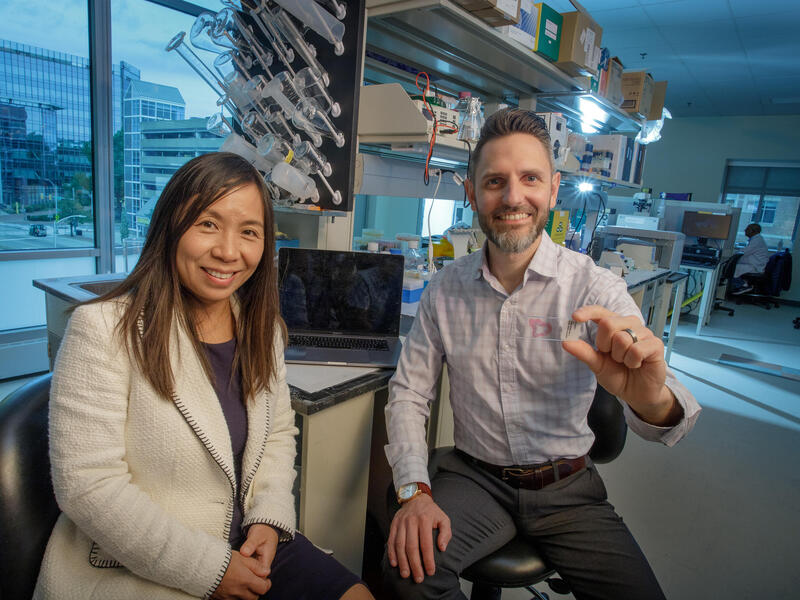
“We have created a user center, and we’re hoping that the center will essentially be a one-stop shop for researchers working in materials science,” said Everett Carpenter, Ph.D, professor of chemistry and director of the center. “Acquiring these instruments has catapulted VCU to a world class center equipped with some very cutting edge equipment.”
Principal investigators for the National Science Foundation awards are Carpenter and Massimo Bertino, Ph.D., professor in the Department of Physics.
The School of Engineering also received funding from the state Higher Education Equipment Trust Fund for the purchase of a new scanning electron microscope, as well as a second scanning electron microscope as a donation from Altria for the facility.
The center is a collaborative effort between the Departments of Chemistry, Physics and School of Engineering.
For more information, visit www.nano.vcu.edu.
Subscribe to VCU News
Subscribe to VCU News at newsletter.vcu.edu and receive a selection of stories, videos, photos, news clips and event listings in your inbox.