April 29, 2026
Puerto Rico’s forests recovered in unexpected ways post-Hurricane Maria, VCU research finds
Share this story
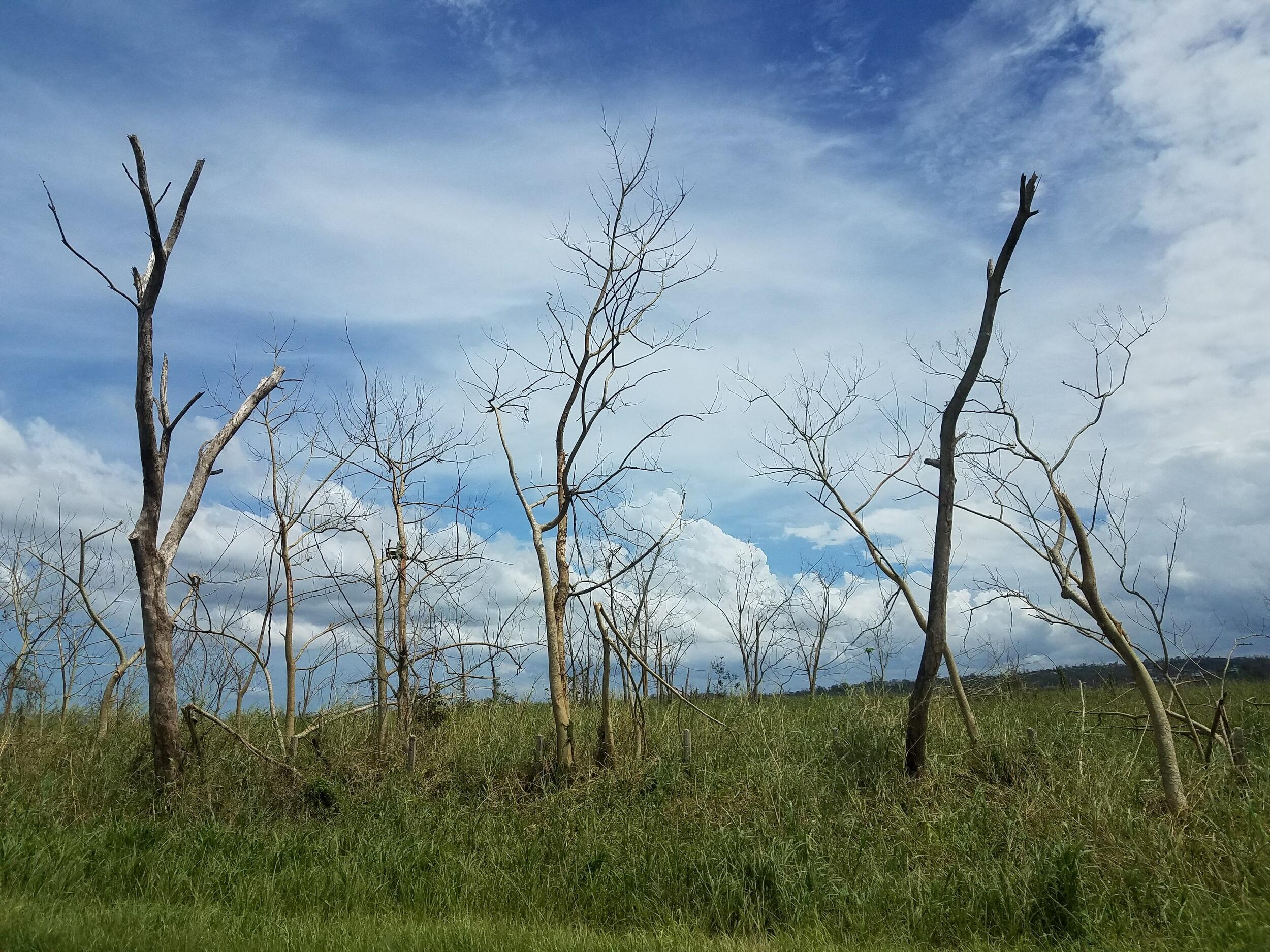
When Hurricane Maria made its ferocious landfall on the U.S. territory of Puerto Rico in September 2017, the loss extended beyond several thousand human lives: The damage to the island’s natural ecosystems, including its iconic rainforests and tropical dry forests, was catastrophic.
For Catherine Hulshof, the destruction was both personal and professional. Hulshof, Ph.D., is now an associate professor of biology at Virginia Commonwealth University, but at the time, she was a new faculty member at the University of Puerto Rico. When the forests were decimated by the storm, so were her experiments.
Like many of her colleagues, Hulshof had to start asking completely new questions about the island’s forests.
“We had to 180-degree pivot after losing everything during the hurricane,” said Hulshof, who is based in VCU’s School of Sustainability and Life Sciences in the College of Humanities and Sciences. “It was such a chaotic time.”
That pivot led to a new study by Hulshof and her co-authors. And while Puerto Rico’s forests are green again today, their recovery led the researchers to new opportunities: by studying extreme environments, they may be able to understand how unusual ecosystems, like some of Puerto Rico’s forests, will respond as the world warms.
“It shows that there are lots of Earth systems, lots of forests and habitats, that are not just adapted to stress but thrive in what we think are stressful environments,” Hulshof said.
Recovery from the ground up
In their study, recently published in the Journal of Vegetation Science, Hulshof and her colleagues found unexpected answers when they looked into how different tropical soil types influenced plant recovery after Hurricane Maria. Contrary to their hypotheses, Puerto Rico’s nutrient-poor forests recovered faster than its lush rainforests, while the rainforests were more resistant to initial damage from the storm than expected.
Two types of soil form the backbone of Puerto Rico’s forests, supporting a combined 30% of the island’s forest cover. One type is serpentine soil, made primarily of weathered rocks that are high in heavy metals and low in essential nutrients. The other is karst, made of weathered marine sediment.
The serpentine forests contain both dry forests – they can go without rain for up to eight months – and wetter forests, whose trees are shorter than those found in the island’s typical rainforests. Plants in these serpentine forests are used to poor soil and a lack of water, either due to low rainfall or high soil drainage.
“The species there are used to stress, are adapted to stress, have growth strategies to tolerate stress,” Hulshof said.
That’s in contrast to Puerto Rico’s dense rainforests, including popular El Yunque National Forest, which grow on nutrient-rich volcanic soils.
Rebounding in different ways
In the study, Hulshof and her co-authors sampled plant and soil traits – nine months after Hurricane Maria – across one volcanic rainforest and one serpentine forest mountain gradient, and compared them to data collected pre-hurricane by the U.S. Department of Agriculture. They also analyzed satellite photos of the forests both five years before and five years after the hurricane, looking for changes in greenness across the two forest types.
“There are no leaves, no leaves at all. And you can see this on the satellite,” Hulshof said, describing Puerto Rico directly after the hurricane. “It goes from a completely green, lush island to completely brown.”
The researchers had two expectations for serpentine forests: that they would be more resistant to the storm’s initial impacts than the island’s rainforests, given their general stress tolerance, but that they would also recover more slowly due to their sluggish growth patterns.
Instead, they found the opposite on the second point: The serpentine forests had indeed been more resistant initially to storm impacts, but they actually recovered faster than would be expected, based on statistical models of the forests’ soil and leaf traits.
Ecologists tend to think of these weird soils or extreme harsh environments as outliers. But we calculated that more than half of Earth’s land surface can be considered an extreme environment.
Catherine Hulshof
The rainforests also turned out to be more resistant than expected to Maria’s impact, nine months after landfall. That could be because the hurricane caused widespread defoliation of the rainforest, and iron – an essential component for photosynthesis – from those decaying leaves quickly returned from the soil to the vegetation.
“You lose all your leaves, but if you’re able to absorb the nutrients back, it might help you recover and have enough nutrients stored to produce new leaves,” Hulshof said. “You can see that turnover of leaves and nutrients, and that connects with the human experience of seeing no leaves at all on the vegetation.”
A world of extremes
The results mirror previous research that found that serpentine forests are more adaptable to climate change than rainforests, as well as Hulshof’s past research on extreme environments and ecotones, or the edges of ecosystems.
“Ecologists tend to think of these weird soils or extreme harsh environments as outliers,” she said. “But we calculated that more than half of Earth’s land surface can be considered an extreme environment.”
The work also feels like a fitting parallel to her career, said Hulshof, who moved from Puerto Rico to Virginia to join VCU in 2018.
“My career has been one of multiple crises: the hurricane, the pandemic,” she said – and, “having a baby before tenure.”
Subscribe to VCU News
Subscribe to VCU News at newsletter.vcu.edu and receive a selection of stories, videos, photos, news clips and event listings in your inbox.