March 20, 2026
‘Smart fabrics’ are an ideal fit for Christina Tang
Share this story
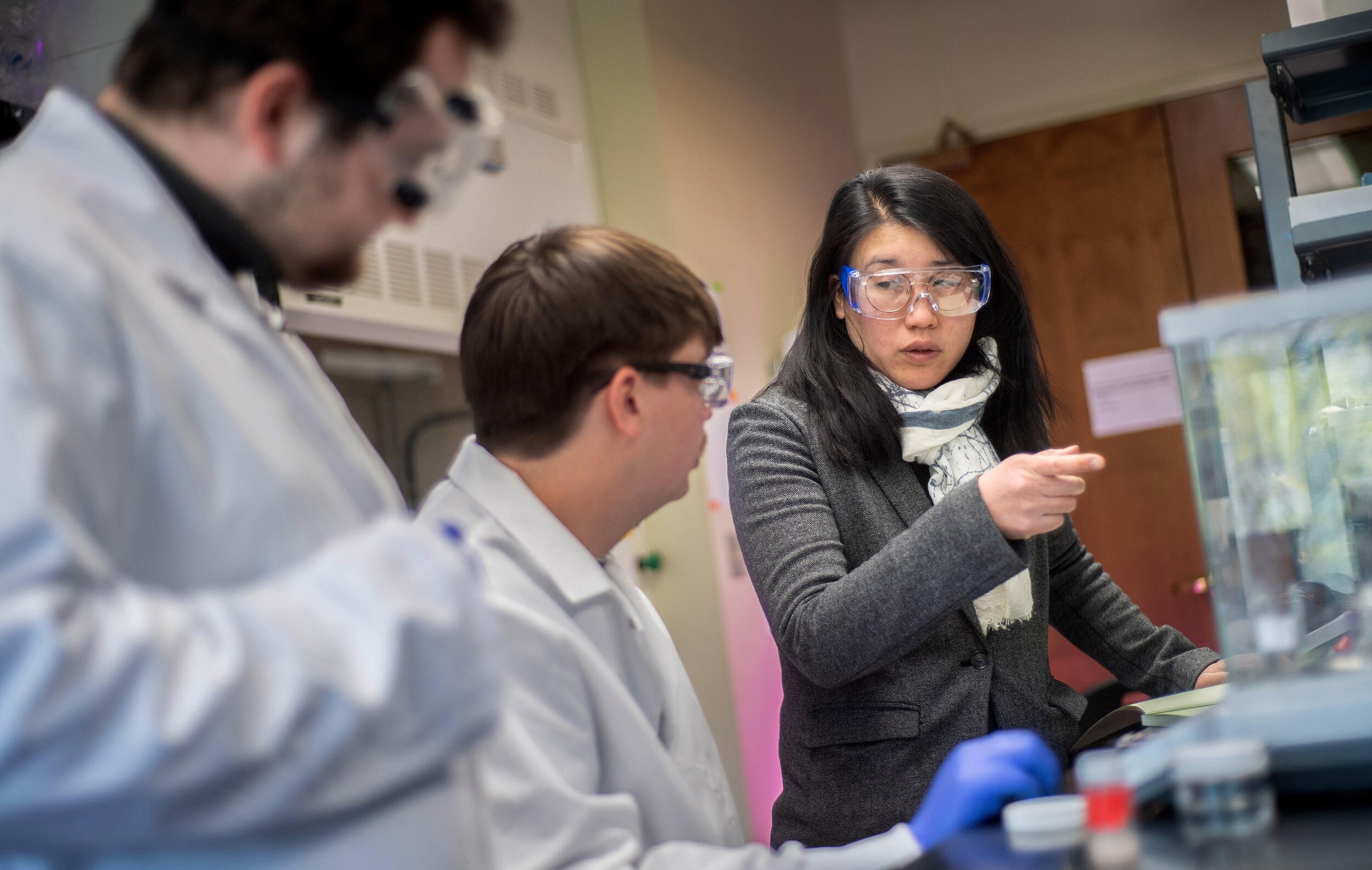
What if your clothes could tell if you’re hot or cold? What if you wore a bandage that could monitor how fast you’re healing? And could invisibility cloaks from “Harry Potter” be real? At Virginia Commonwealth University, Christina Tang has an eye for fashion and a mind for science.
Tang, Ph.D., an associate professor and researcher in the College of Engineering, specializes in “smart fabrics,” which truly combine form and function. Imagine a shirt that changes from blue to red based on temperature.
“The color change is to enable additional capabilities, such as camouflage, human motion detection, damage indicators, temperature indicators, etc.,” said Tang, who is exploring – in the Department of Chemical and Life Sciences Engineering – how fabrics can incorporate materials and sensors that serve biomedical or other purposes.
“By leveraging our knowledge of materials and processing, we are interested in what other useful properties we could potentially develop.”
VCU News rolled up its sleeves and reached out to Tang, who joined VCU in 2015, for further insight.
First, tell us something amazing about smart fabrics at the moment.
They do seem a little bit like science fiction, but invisibility cloaks are getting closer to reality.
Really? Invisibility cloaks?
The technology is established for “stealth” aircraft – they are designed to avoid detection by reducing reflection/emission of radar, infrared radio, frequency, etc. Products such as Quantum Stealth have been developed using arrays of lenticular lenses that bend light around an object so that it appears to disappear. For an invisibility cloak, by controlling the reflection from the fabric, it can be designed to mimic/blend in with the natural surroundings.

Now take us into your lab. Give us another relatable example that ties in directly to what you’re doing.
Did you know that a single pair of jeans can use up to 3,800 liters of water in its lifetime? This high demand is due to, in part, growing the material — cotton — and also the dying process to add color. My research focuses on achieving colored fibers and textiles from nanostructures inspired by nature. Using wax derivatives, we have fabricated structures that show color when applied to textiles, and the color changes with temperature or strain.
What are potential uses of such smart fabrics?
Imagine these examples: smart masks with color indicators for proper fit or fever detection, bandages that monitor wound healing, thermal comfort — cooling fabrics that draw heat away from the body.
The fibers used in smart fabrics are created from liquid crystals. What exactly is a liquid crystal, and how do you process it?
A liquid crystal is a unique material – it has properties like a liquid, but its molecules are well-organized. To achieve color, the molecules are organized into a helical pattern like a Slinky. The color that you see depends on the size of the helix — like if the Slinky is squeezed or stretched.
We process our materials by self-assembly: The components build a picture or pattern without instructions. On a molecular scale, this is like throwing all the pieces of a puzzle into the air and then landing in the solved puzzle.
What is the biggest challenge in translating your research from the lab to the real world?
Our research is performed in a controlled environment, and the materials we work with are sensitive to the environment — by design. A major challenge in applying the materials we are creating is understanding and predicting processing and performance when the scale is larger or the materials are used in harsh environmental conditions.
Subscribe to VCU News
Subscribe to VCU News at newsletter.vcu.edu and receive a selection of stories, videos, photos, news clips and event listings in your inbox.