Sept. 17, 2026
Space Camp challenges VCU students to find human applications for NASA tech
Share this story
Imagine being nervous to start classes at a new graduate program and, within your first week, you find yourself presenting to NASA professionals about new use cases for space technology – tech that you just found out existed.
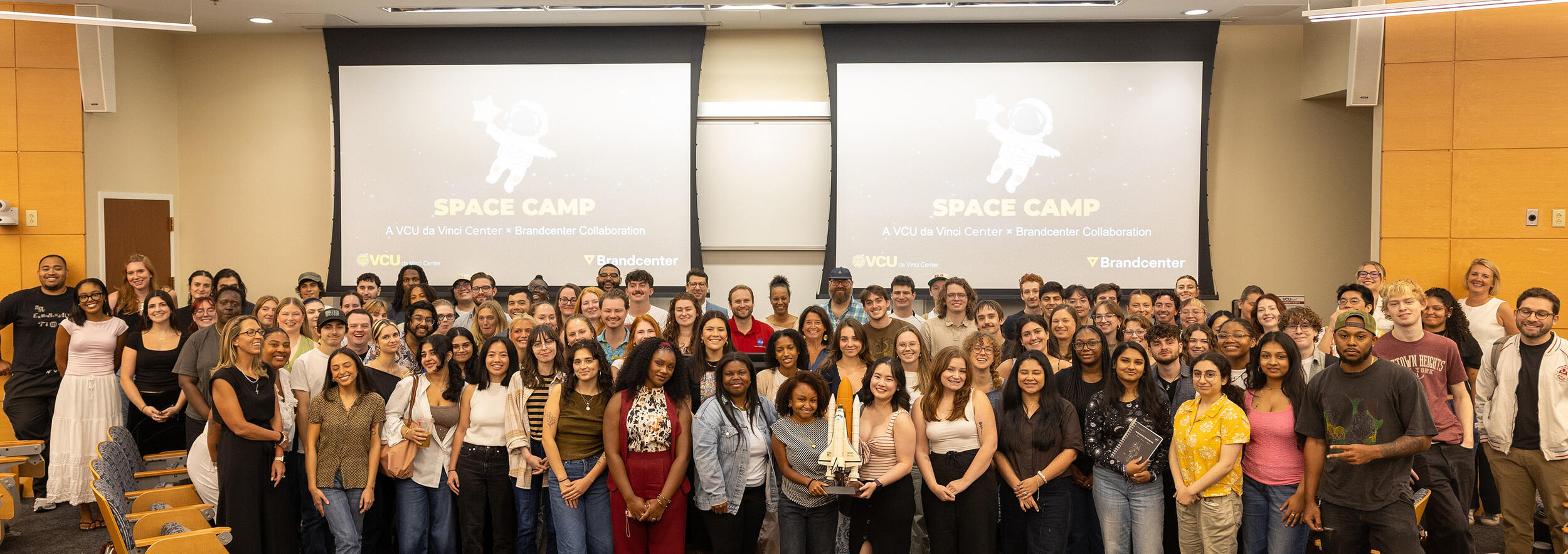
That’s exactly the situation the Virginia Commonwealth University Brandcenter’s newest students found themselves in last month at the NASA Space Camp Design Jam, a one-day collaboration and sprint that brought together VCU Brandcenter, the VCU da Vinci Center for Innovation and NASA Langley Research Center. Brandcenter’s new cohort, alongside VCU College of Engineering students and alumni from the da Vinci Center’s Master of Product Innovation program, were challenged to explore how NASA technologies could solve unexpected problems here on Earth.
The experience brought together technology, design thinking and creativity, giving students a crash course in how to take something highly technical, turn it on its head to find new ideas, and present those ideas to a full room.
First-year Brandcenter strategy student Anika Gorham describes presenting to NASA as “a bit of a fever dream. I kept looking over at them sitting in the audience, thinking they were professors or other school-affiliated personnel. Then my brain would recalibrate and say, ‘Oh wait no, no that’s NASA. You’re presenting to NASA right now.’”
From space tech to human opportunity
Students began the day hearing from professionals working at NASA’s Langley Research Center in Virginia. Research aerospace engineer Derrick Seubert talked about NASA’s plans for the next phase of lunar exploration and gave examples of the technology his team develops for humans to use on missions. Technology transfer specialist Katrina Young explained the process of moving NASA-developed technology into the hands of entrepreneurs and companies.
NASA has an extensive portfolio of patented technologies that can be licensed for commercial use, opening the door for companies to take technologies developed for NASA missions and build new products, services and applications around them.
That’s where the Design Jam comes in. Patent mining is essentially the process of looking through existing patents for new ways to use existing technologies. For the students, that meant looking at NASA technology in completely new ways.
Three NASA-developed technologies
Teams were given one of three NASA technologies, each originally developed to address a very specific space challenge. Their mission was to find unexpected applications while working through four key objectives:
- Translate technical capabilities into human-centered opportunities.
- Build compelling brand and market narratives.
- Prototype early product or service concepts.
- Present commercialization pathways.
Mission 1: Flexible lightweight radiation shielding – A thin, flexible coating that blocks radiation and can be sprayed or melted directly onto fabrics such as cotton, nylon, Kevlar or polyester.
Mission 2: Optical concentration sensor for liquid solutions – A tiny optical sensor that precisely measures how concentrated a liquid solution is. Its original application? The space station’s toilet.
Mission 3: Composite joint connector – A structural joint or connector designed to handle stress from multiple directions at once, unlike most joints that are designed to handle stress primarily along a single line.
Design thinking
Before teams started developing their concepts, Ashley Wenger, program manager for the da Vinci Center, introduced students to design-thinking, the essential ability to combine empathy, creativity and rationality to meet users’ needs and business success.
Wenger gave a practical example of patent mining with a humble object: a paper clip. Students were asked to brainstorm 100 alternative uses for the office supply staple. Responses ranged from nose-picker to tiny catapult to a stick-and-poke tattoo needle.
The point illustrated wasn’t to find the “right” answer. It was to get students thinking beyond what something is and toward what else it could be.
Wenger walked students through the stages of design thinking and got them thinking about their technology assignment:
- Ideate – Quantity over quality. Bold beats cautious. Constraints drive creativity.
- Define – Fall in love with the problem (not the solution).
- Empathize – Identify key stakeholders. Analyze needs for extreme users. Create empathy maps to investigate your stakeholders.
- Prototype – Quickly and scrappily! Build to explore, not to perfect.
- Test and implement – Test early and often, turning guesses into growth.
Creativity in Practice
Over the course of the sprint, teams moved from brainstorming to defining problems, developing concepts and thinking through what a real product or service could look like.
The goal wasn’t simply to come up with a clever idea. Students were challenged to translate technical capabilities into human-centered opportunities, build compelling brand and market narratives, prototype early product or service concepts and identify potential paths toward commercialization.
Ramy A. Rahimi, Ph.D., senior advisor for research and innovation and academic partnerships liaison at the NASA Langley Research Center, left students with two pieces of advice that helped to frame the challenge:
First: A well-defined problem is half of your solution. Is it important? Is it urgent? Who needs it? And could the resulting idea become something people would actually use? Or even a viable business?
Second: NASA technology should only be a part of your solution, not where it ends. NASA patents are available for others to develop, so what can you add to the technology to create something new and make your idea stand out?
At the end of the day, teams pitched their concepts to judges representing NASA, Brandcenter and the da Vinci Center, and award winners were chosen in a variety of categories.
Subscribe to VCU News
Subscribe to VCU News at newsletter.vcu.edu and receive a selection of stories, videos, photos, news clips and event listings in your inbox.