May 4, 2007
Study finds correlation between bile duct obstruction and ductal cancer, suggests new way to target, test drug therapy
Share this story
The American Society for Investigative Pathology
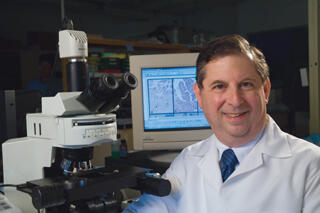
A Virginia Commonwealth University researcher has presented findings that show a correlation between bile duct obstruction and ductal cancer.
Alphonse E. Sirica, Ph.D., M.S., chair of the VCU School of Medicine's Division of Cellular and Molecular Pathogenesis in the Department of Pathology, investigates the cellular and molecular mechanisms of various liver diseases and liver cancers in particular. He is working toward developing treatment strategies for bile duct cancer, or cholangiocarcinoma.
On April 29, Sirica presented findings of a recent study at Experimental Biology 2007 in Washington, D.C., which was part of the scientific program of the American Society for Investigative Pathology.
Sirica and his colleagues found that when bile duct cancer cells were placed in the liver of animals with bile duct obstruction, they grew more rapidly than identical cells placed in animals without bile duct obstruction. In fact, half the total liver mass of the rats with bile duct obstruction became replaced by cancer cells within three weeks compared to only 16 percent of that of animals without bile duct obstruction.
Perhaps even more important, the cancers metastasized outside the liver only in the animals with bile duct obstruction. This also frequently occurs in human patients with advanced bile duct cancer.
Bile ducts are tubes that carry bile, a liquid secreted by the liver that contains cholesterol, bile salts, and waste products, from the liver to the gallbladder and small intestine. Bile duct obstruction has long been known to be present in both malignant and nonmalignant liver disease, such as in jaundice, however, before this study the direct effect of such obstruction on bile duct cancer cell growth and aggressiveness had not been previously investigated.
Some 3,500 new cases of cholangiocarcinoma are diagnosed annually in the United States. Survival rates remain dismally low because most patients have advanced disease at the time of diagnosis and, as a result, are poor candidates for the best treatment currently available, surgical resection. Although there are some known risk factors for the disease, such as primary sclerosing cholangitis, the causes of most cases remain unknown and the cellular and molecular changes that accompany the disease have not been well understood.
According to Sirica, these new findings are highly significant for two reasons.
They establish an important correlation between bile duct obstruction and bile duct cancer, suggesting growth regulatory mechanisms that could be highly significant in the progression of the cancer and that could become good molecular targets for drug therapy.
In addition, they establish a unique preclinical model of how bile duct cancer progresses that can be used to rapidly test and evaluate novel molecular treatment strategies.
This study is part of ongoing work in Sirica’s laboratory aimed at identifying altered growth factor signaling pathways in cholangiocarcinoma that may be exploited as potential molecular targets for therapy.
Sirica’s co-authors for the Experimental Biology 2007 presentation are Zichen Zhang, Ph.D.; Toru Asano, M.D.; Xue-Ning Shen, Ph.D.; Deanna J. Ward; and Arvind Mahatme, M.D.
Support for the work came from the National Cancer Institute, National Institutes of Health.
Subscribe to VCU News
Subscribe to VCU News at newsletter.vcu.edu and receive a selection of stories, videos, photos, news clips and event listings in your inbox.