Oct. 14, 2026
U.S. Pacific Territories serve as a research station for VCU students
Share this story
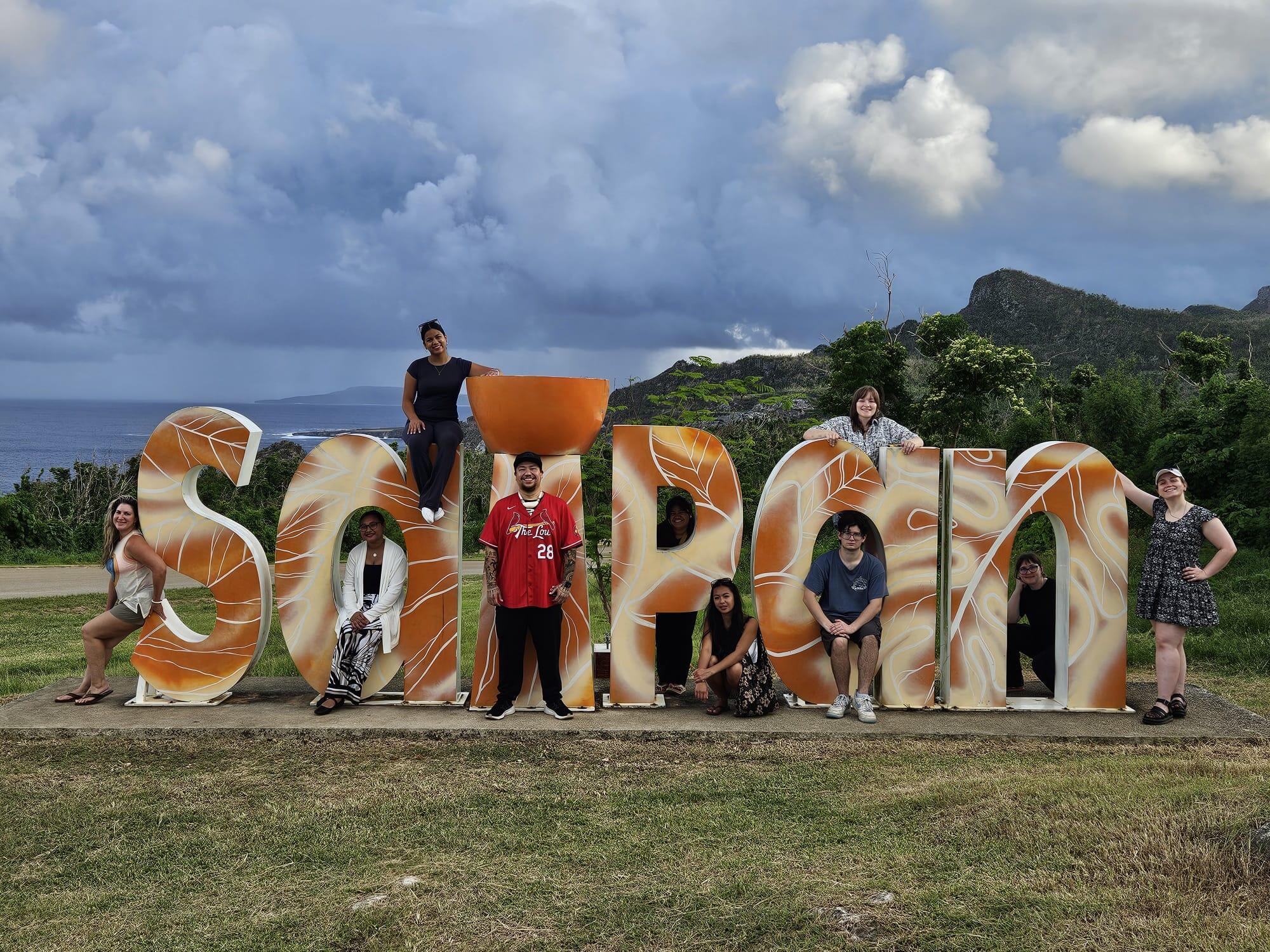
The two U.S. territories are far from the mainland – and far off the radar for most Americans – but Guam and Saipan provided direct insight this summer for a handful of Virginia Commonwealth University students, who explored governance and environmental issues framed by natural disasters.
Andrea Simonelli, Ph.D., an associate professor of political science in the College of Humanities and Sciences, led a research field project to the U.S. Pacific Territories through VCU’s Institute for Sustainable Energy and Environment, which supports students and faculty in pursuing scientific, technological, policy and social justice solutions that address climate and energy issues.
In the northwestern Pacific Ocean, roughly 1,500 miles east of the Philippines, the Mariana Islands are a crescent-shaped archipelago. Guam sits at the southern edge, and to the north, Saipan is the capital of the Commonwealth of the Northern Mariana Islands. Both are still recovering from devastating typhoons in recent years, and with limited U.S. resources, many residents remain without electricity.
“Congress has control of the islands. At any point, Congress can step in and make decisions for them. They don’t have free rein to run themselves,” Simonelli said. “Their representative to Congress is a nonvoting member, so if that member wants to get something done for Guam or the Northern Marianas, they need to petition and convince other sitting members of Congress to support their needs."
Simonelli brought five students to Guam and Saipan to research U.S. territorial governance and its impact on the local environment. The visit followed a semesterlong course this past spring, in collaboration with the University of Guam, through which each VCU student was paired with a UoG student to conduct research with local perspective.
In Guam and Saipan, each student-pair decided on a research topic, including disaster relief and recovery, clean energy, military impacts, deep-sea mining and food security. Natural disasters can hit the territories much harder than the U.S. mainland, which has heightened a commitment to renewable energy.
“Guam and the Northern Marianas have much higher aspirations for clean energy than most states do, which I thought was interesting, and actual solid plans on how to get there in ways that most of our states don’t,” Simonelli said. “We think of them as vulnerable outposts, but there’s advocacy that they’re doing for themselves on items that we’re not even doing here.”
During the summer field project, VCU student Ava Mariano researched the impacts of the typhoons Mawar, which hit Guam in 2003, and Sinlaku, which hit Guam and Saipan this past April.
“Everyone’s willing to talk to you, and very friendly and nice,” said Mariano, who noted the recent disaster’s particular impact on Saipan and its struggle to recover. “I could tell that it was a shell of what it used to be. They haven’t really recovered compared to Guam, and you could see that just walking around. It was super empty in one of the most touristy spots.”
Mariano and the other VCU and UoG students interviewed citizens, government officials and workers in impacted industries such as agriculture and fishing.
“I was really interested to find out how much people are willing to talk about it, even though it can be sensitive,” Mariano said of issues related to governance and recovery. “I think that one of the most enlightening things of the whole trip was that people there want someone to listen.”
In addition to the VCU students, Simonelli was joined for the field project by Mary Strawderman, a research assistant and Ph.D. candidate in the L. Douglas Wilder School of Government and Public Affairs.
“Coming to Guam and Saipan after two back-to-back typhoons and seeing how people are still recovering … I think was important for the students to see,” Strawderman said. “There were a lot of reasons why it showed that being there in person to collect the data was truly really important – not just to be able to get interviews to talk to people, but to see how people live and what impacts they face in their daily lives.”
She added that she and some students were stuck overnight on the small island of Tinian after a storm prevented their propeller plane from returning to their base. She called it a lesson in the realities of field work.
“The students get to see what research really is like. It can be messy,” Strawderman said. “They have to work with things, figure things out as they go, or pivot.”
With the students now back in Richmond, they continue to assess data they collected and will draft summaries of their findings – with an eye toward highlighting the realities, needs and lessons learned in the U.S. territories.
Subscribe to VCU News
Subscribe to VCU News at newsletter.vcu.edu and receive a selection of stories, videos, photos, news clips and event listings in your inbox.