March 3, 2026
VCU marks 20 years of the Emerging Leaders Program
Share this story
Dozens of students and alumni gathered recently to celebrate the 20th anniversary of Virginia Commonwealth University’s Emerging Leaders Program, a selective one-year scholarship program designed to help first-year students develop into strong leaders on campus and beyond.
Since its launch in 2006 by the Division of Student Affairs, approximately 800 students have taken part in the Emerging Leaders Program, gaining skills, confidence, connections and friendships. Each year, 60 first-year students participate in the program, along with 12 second-year students who serve as mentors and two third-year students who serve as program co-directors.
“The program has consistently aligned itself with a curricular approach to student affairs, intentionally connecting learning outcomes, mentorship and assessment practices in ways that support holistic student development,” said A.D. Gabriel Driver, coordinator of the Emerging Leaders Program. “Its emphasis on emotional intelligence, inclusive leadership, resilience and relational learning reflects a strong commitment to preparing students not just to lead but to lead with authenticity and empathy.”
The program aims to develop leaders who are not only skilled in theory and technique but also grounded in the values of community, empathy and service.
“The VCU Emerging Leaders Program stands out because it builds more than leadership skills – it builds community. Through mentorship across class years and intentional spaces for reflection, students explore their values, strengths and leadership identities,” said Rebecca Halligan, director of the Office of Student Leadership and Engaged Learning. “In doing so, we create an environment where assumptions can be challenged and dialogue can be meaningful. ELP’s successes can be seen through the program alumni who hold leadership positions across campus, choose to serve in their communities and continue to maintain the ELP relationships built long after they graduate VCU.”
Helping to shape students’ leadership styles

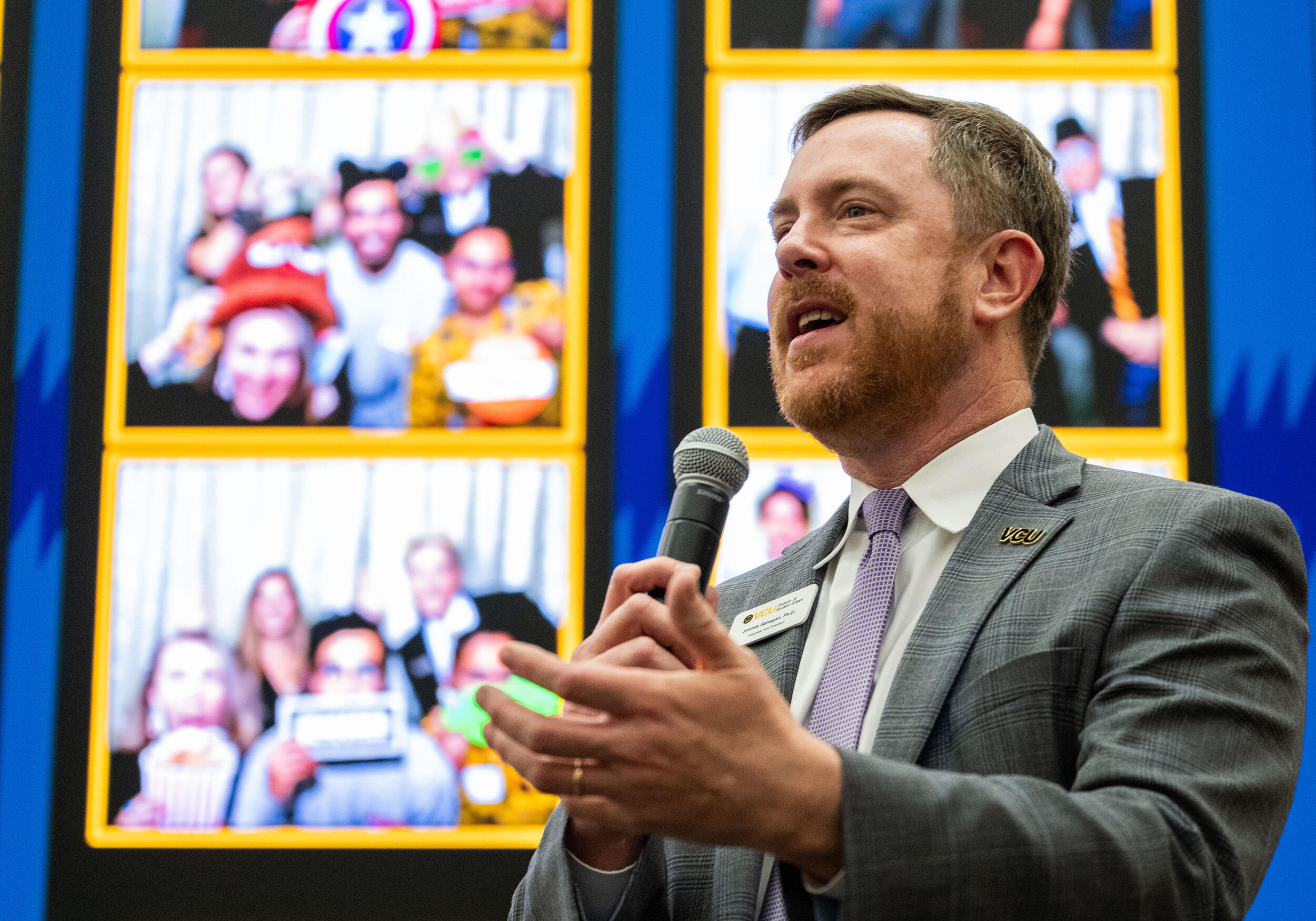
On Feb. 25, students, staff and alumni came together for a reception in James Branch Cabell Library to honor the program’s legacy and look ahead to the next 20 years.
“Participating in the VCU Emerging Leaders Program was a transformative experience,” said Hayley Pottle, who graduated in 2017 and has built a career in international development, strategic communications and digital transformation. “It helped me discover my leadership style, challenged me to learn from diverse perspectives and taught me how to grow not just as an individual but as a leader within a team and community. The relationships and mentorship I gained were invaluable.”
First-year students who participate in the fall and spring semester receive $1,500 in scholarship funds, and they reside in a living-learning community with other Emerging Leaders Program participants. The first-year students receive mentorship from second-year students, as well as additional support from third-year co-directors and staff.
Participants take a spring semester course, Principles of Leadership, which provides an overview of the theories, models and perspectives of the field of leadership studies.
Participants also must complete 20 hours per semester for leadership and community service engagements, providing thousands of cumulative volunteer hours to the VCU and Richmond communities.
Emerging Leaders Program Student Directors Shawn Watson and Inayah O’Neil, both junior computer science majors in the College of Engineering, encouraged future VCU students to apply to the program.
“ELP has shaped my leadership style, who I understand myself to be, and has given me invaluable skills that I would have never gotten anywhere else. ELP is also a community; I met my current friend/roommate, my partner and many other friends during my time in ELP,” O’Neil said.
Watson added that the program provides opportunities to grow as a leader and learn more about yourself.
“My experience with ELP has been nothing short of a learning experience,” he said. “From being a mentee as a freshman, trying to find my footing at VCU, to now being a student director and being an architect of the program, the learning never really stops. I have gained more of a sense of self – being able to make more informed decisions for myself, and being able to help others create their own way of living out their lives.”
Key to the program’s success over the years has been its focus on mentorship, specifically its “Appreciative Advising/Mentoring Model” that prepares participants to thrive within the program and to take on greater leadership responsibilities beyond it. The leadership development trajectory unfolds across four progressive stages:
- Self-Awareness and Reflection: Participants begin by exploring their leadership identity, often with limited clarity on their strengths and growth areas. Through guided reflection with a mentor, they develop the ability to articulate these elements, building a foundation for intentional growth.
- Application of Leadership Theories: As they advance, participants begin translating theory into practice, navigating real-world scenarios such as group dynamics, conflict resolution and collaborative decision-making. Peer mentors help them adapt theoretical models to fit diverse contexts.
- Interpersonal Skills and Peer Influence: Leadership becomes increasingly relational. Participants refine their ability to communicate effectively, listen actively and foster trust. These are skills that enable them to influence peers and create positive team environments.
- Independent Leadership and Mentoring: In the final stage, participants are more likely to step confidently into leadership roles, often serving as mentors themselves. They demonstrate autonomy, strategic decision-making and the ability to inspire and guide others.
A launchpad for lifelong leaders
Pottle, the 2017 graduate who currently works at the World Bank Group, said ELP showed her the power of being mentored and mentoring others.
“Since completing the program, I’ve continued to invest in mentorship across my career and graduate studies, carrying forward the ELP commitment to developing leaders who uplift underrepresented communities locally and globally,” she said.
Brendan Hood, director of marketing and partner relationships at VCU Development and Alumni Relations, participated in ELP as an undergraduate at VCU, graduating in 2015 with a degree in marketing and again in 2019 with an MBA. He said ELP was a launchpad that taught him how to navigate a large, complex institution like VCU. And it gave him the confidence as a student to pursue leadership opportunities with campus organizations, and eventually including the Office of the President at VCU.
“The Emerging Leaders Program provided the initial spark that connected me to a lifelong community of mentors and peers,” Hood said. “It was a program that constantly challenged me and rewarded my growth, ultimately making me a more capable leader by the time I completed it. Most importantly, it taught me that leadership is about people and grace. I walked away understanding that being a leader and being a human go hand in hand.”
ELP, Hood said, enabled him to contribute to the community and to grow as a leader.
“Whether we were volunteering on campus or working on a small project to increase the number of trashcans in an alley behind Shafer Court Dining Center, we walked away knowing we made a tangible difference for current and future Rams,” he said. “It taught us that leadership isn’t always about grand gestures. Instead, it is about leaving the place and its people better than you found them.”
Looking ahead, Driver said he anticipates the Emerging Leaders Program will continue to grow and evolve to meet the needs of student leaders.
“The future appears centered on integrating new learning tools and technologies, broadening access to a more diverse participant base and strengthening community partnerships and service-learning opportunities,” he said. “There is also a clear emphasis on sustainability — ensuring that the program continues to evolve through ongoing assessment, strategic partnerships and alignment with broader student affairs goals. If these directions continue, ELP has the potential to become not only a leadership development program but a model for experiential, community-based leadership education.”
Subscribe to VCU News
Subscribe to VCU News at newsletter.vcu.edu and receive a selection of stories, videos, photos, news clips and event listings in your inbox.