Nov. 6, 2007
VCU Qatar hosts Islamic Art Symposium
Share this story
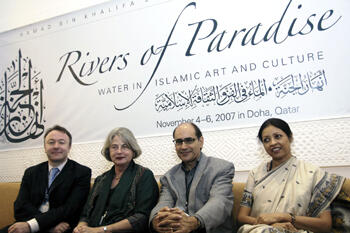
Virginia Commonwealth University School of the Arts in Qatar hosted scholars from around the world at the Second Biennial Hamad Bin Khalifa Symposium on Islamic Art from Nov. 4-6.
This year’s symposium, which was titled “Rivers of Paradise: Water in Islamic Art and Culture,” examined the role of water in Islamic lands from southern Europe to South Asia. Topics ranged from water supply and distribution to its role in religion and popular culture, from the earliest times to the present, from the Iberian Peninsula to Southeast Asia.
Sheila S. Blair, Ph.D., and Jonathan M. Bloom, Ph.D., shared holders of the Hamad Bin Khalifa Endowed Chair of Islamic Art at VCU, organized the symposium. Blair and Bloom are widely recognized as being among the leading scholars of Islamic art in the world.

“This symposium is a wonderful opportunity to bring together the scholars and the general public to explore various aspects of the art and architecture of the Islamic lands,” Bloom said. “All too often academics speak only to the other academic in a language that ordinary people cannot readily understand. This symposium is a major exception since it brings together a stellar roster of scholars from around the world who are not only great experts in their respective disciplines but also engaging speakers who can communicate what they know to a broad audience.”
The symposium serves as an important contribution to Qatar’s cultural efforts and aims to stimulate a wider awareness of the artistic marvels of Islamic civilization. Islamic art has long fascinated the Western audience and remains a popular subject, as scholars continue to debate whether it is meant to provide only visual delight or contains deeper meaning.
The symposium’s setting of Education City in Doha, Qatar, was fitting. Doha is one of the fastest growing centers of Islamic art in the Middle East. Several museums are in development in the city, including the Museum of Islamic Art, which is designed by the renowned architect I.M. Pei.
“We are extremely proud to be hosting a symposium of this caliber here at VCU Qatar,” said Allison Vanstone, dean of VCU Qatar, at the event’s outset.
Those attending the symposium represented a diverse group of cultural and professional backgrounds. More than 450 people registered online for the event, and many others registered at the event itself. Audience members included ambassadors, heads of local businesses, alumni and professors, among many others.
The symposium’s 12 speakers represented nine different countries and included art historians, archaeologists, conservators, architects and curators. They spoke on such topics as the archaeology of urban water systems, water scarcity and landscaping in the Islamic world, water traditions in the South Asian landscape and early medieval Islamic rock crystal seals.
“In selecting the speakers, we looked for a range of scholars to address this global issue,” Blair said. “Some are senior scholars, others are relatively young, but all are experts in their respective fields.”
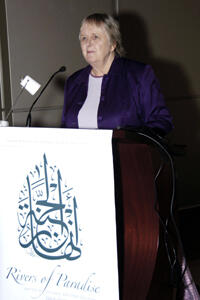
The keynote speaker of the symposium was Carole Hillenbrand, professor of Islamic History and head of Islamic and Middle Eastern Studies at the University of Edinburgh. Hillenbrand, a recent recipient of the King Faisal Prize for Islamic Studies, spoke on “Gardens Beneath Which River Flows: The Significance of Water in Classical Islamic Culture,” which examined various aspects of the role of water in the medieval Islamic world. Hillenbrand’s address shed light on the use of water in the daily lives of medieval Muslims, both in religious and non-religious contexts.
VCU School of the Arts, which co-hosts the symposium with VCU School of the Arts in Qatar, received more than 300 applications from 62 countries for the symposium’s available fellowships. Applicants represented four continents (Africa, Asia, Europe and North America) and ranged from graduate students in their early 20s to senior scholars in their 60s and 70s. The 15 recipients selected for the fellowship were citizens of Algeria, Bangladesh, Egypt, Indonesia, India, Iran, Russia, Spain, Sudan, Turkey, Yemen and the United States. Fellows received full funding to attend the symposium.
The symposium will be held in 2009 on VCU’s campus in Richmond, Va.
Subscribe to VCU News
Subscribe to VCU News at newsletter.vcu.edu and receive a selection of stories, videos, photos, news clips and event listings in your inbox.