Oct. 10, 2007
VCURES researchers target the immune system to improve survival of victims who have suffered severe traumatic shock
Share this story
Virginia Commonwealth
University researchers hope to improve the survival of severely injured
soldiers and civilians with the discovery that a naturally occurring
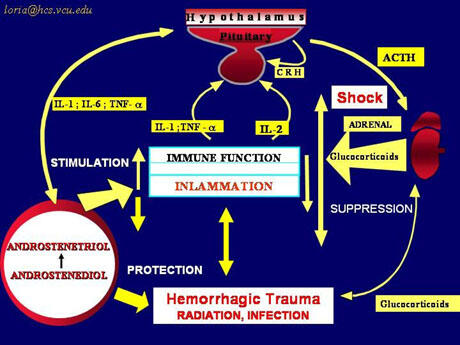
hormonal agent known as androstenetriol has a very powerful effect on
the immune system.
Just minutes after a traumatic episode
resulting in injured tissue and massive bleeding, the immune system
responds by entering a state of uncontrolled inflammation that wreaks
havoc on the body. The inflammation can damage multiple organs causing
them to fail, eventually taking the life of the injured.
Roger Loria, Ph.D.,
a professor of microbiology, immunology, pathology and emergency
medicine at the School of Medicine, together with colleagues in the VCU Reanimation Engineering Shock Center,
report that androstenetriol enhances the body’s existing immune
capabilities and enables the body to resist lethal insults such as
infections, radiation poisoning, and now, traumatic hemorrhagic shock.
“Immune
disruption is a major component of the shock response in trauma and
hemorrhage. Restoring the balance of the immune response early after
injury greatly reduces the damage and injury caused by shock trauma and
hemorrhage and leads to improved survival,” Loria said.
“Our
findings show that androstenetriol has the potential to be used to
provide an immune shield after trauma and blood loss following
accidents, surgery, and battle field injury,” he said.
Loria and
his colleagues showed for the first time that a single injection of
androstenetriol was associated with a significant increase in survival
even after major blood loss up to about 55 percent to 60 percent in a
rat model. The study was published in the September issue of the
Journal TRAUMA® Injury, Infection, and Critical Care
Furthermore
androstenetriol’s properties may provide significant protection from
secondary infections following severe traumatic shock.
“This
is a very simple and cost-effective intervention which could be carried
out by field paramedics or combat medics. By naturally enhancing the
body’s immune system, it is likely that patients would recover much
faster and be a less risk for lethal complications,” Loria said.
For
more than 25 years, Loria has investigated immunological changes
following traumatic/hemorrhagic shock, including interventions with
androstene derivatives. The research focuses on the pathogenic and
immunological responses following virus infections, particularly human
enteric viruses. His other work centers on immune up-regulation
following infections, cancer and radiation.
The next step for
Loria and the VCURES team will be to extend this work to human clinical
trials to determine if androstenetriol is safe and effective for use in
humans.
This work was supported by a grant from the Office of Naval Research.
Along
with Loria, VCURES researchers, Andreea C. Marcu, M.D., Kristin E.
Paccione, R. Wayne Barbee, Ph.D., Robert F. Diegelmann, Ph.D., Rao R.
Ivatury, M.D., Kevin R. Ward, M.D., contributed to this work.
Subscribe to VCU News
Subscribe to VCU News at newsletter.vcu.edu and receive a selection of stories, videos, photos, news clips and event listings in your inbox.