Dec. 14, 2012
Aboard a Floating Laboratory
Share this story
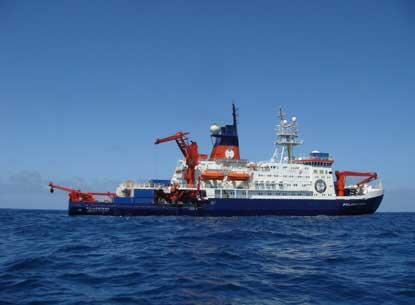
A German research vessel named the Polarstern set on a course for the first leg of its 25th campaign to the Antarctic during the fall of 2008. Aboard the floating laboratory was an international team of 35 researchers, including three from Virginia Commonwealth University, who were geared up to study the smallest forms of life found in the Atlantic Ocean and to learn how these microorganisms may leave a fingerprint of their metabolic activities in the open ocean carbon pool.
Now, four years later, some of the data and information gathered from the journey has been translated into a research paper identifying thousands of individual components in dissolved organic carbon. The findings were published recently in the journal Biogeosciences.
Marine dissolved organic matter represents one of the largest active pools of organic carbon in the global carbon cycle. The pool of dissolved organic carbon (DOC) exceeds the amount of carbon stored in living marine animals, plants and bacteria – some three billion tons – by a factor of about 200. The majority of DOC in the oceans is originally formed from CO2 by algae and land plants during photosynthesis. The DOC resulting from this organic material is directly released into the water by marine algae and during the degradation of these organisms.
The team, led by researchers from the Alfred Wegener Institute for Polar and Marine Research in the Helmholtz Association in Germany, included VCU researchers, as well as biologists, chemists and geologists hailing from Germany, Croatia, China, France, India, Denmark and the United States.
They reported on how biomolecular tracks are left behind by everything in the sea. The scientists were able, for the first time, to identify thousands of individual components in DOC in the course of a single measurement using an ultra-high resolution mass spectrometer housed at the Helmholtz Zentrum Munchen in Germany. They learned that DOC contains a molecular fingerprint that can allow scientists to read which bacteria or types of phytoplankton were once within the same body of water.
S. Leigh McCallister, assistant professor of biology in the VCU College of Humanities and Sciences and the VCU Center for Environmental Studies and an affiliate faculty member in the VCU Rice Center, was at sea for about 28 days from Germany to Cape Town, South Africa. She contributed to the report and provided the carbon age of samples from the oceans and was influential in designing the framework for the study. McCallister was joined by Annie Stuart, a master’s student in the VCU Environmental Studies Program, and Amy Jenkins, a Ph.D. student in VCU Life Sciences.
The VCU team studied the role of DOC in the global carbon cycle, examined microbial diversity in the Atlantic Ocean and determined the biological and environmental factors influencing variations in microbial community structure.
“We hope our findings may help us understand how DOC is cycled in the open ocean,” explained McCallister, who co-led the VCU portion of the research.
“To this day, we do not know how much organic carbon reaches the sea from land nor how much is produced in the ocean itself. In addition, it remains a mystery as to why not everything is biodegraded.”
Using an interdisciplinary approach, the team closely examined the detailed molecular characteristics of dissolved organic matter in the Atlantic surface ocean and related the data to different climatic, hydrographical, biological and meteorological factors.
“The oceanic DOC pool is one of the largest active reservoirs of carbon on earth,” McCallister said. ‘Previously climate change research paid little attention to its storage capacity despite the fact that it sequesters carbon dioxide for periods of 3,000 years – the average age of our sample material” said McCallister.
“The goal was to achieve a high spatial resolution data set for the characterization of the sources and driving processes of dissolved organic matter from the North to the South Atlantic.”
The VCU team measured the radiocarbon age of various pools of DOC to determine its residence time in the ocean. Further, samples were taken along the entire transect for bacterial abundance and production to examine the metabolic response of bacteria to changing DOC sources and molecular characteristics.
Lastly, samples were taken for high throughput DNA sequencing technology to assess microbial diversity and function across the climatic zones.
Other VCU investigators who contributed to the work include Rima Franklin, Ph.D., assistant professor of environmental biology in the VCU Department of Biology, and Maria C. Rivera, Ph.D., assistant professor in the VCU Department of Biology. Franklin co-led the team with McCallister, but remained at VCU during the 2008 expedition.
McCallister and Franklin will travel to Germany later this month to participate in a four-day workshop with collaborators to work on future manuscripts and scientific collaborations.
The research is supported by the Alfred Wegener Institute for Polar and Marine Research and International Census of Marine Microbes.
Subscribe to the weekly VCU News email newsletter at http://newsletter.news.vcu.edu/ and receive a selection of stories, videos, photos, news clips and event listings in your inbox every Thursday.
Subscribe to VCU News
Subscribe to VCU News at newsletter.vcu.edu and receive a selection of stories, videos, photos, news clips and event listings in your inbox.