Aug. 25, 2011
Alternative Nation
Share this story
When Marjolein de Wit, M.D., M.S., was looking for a way to improve her quality of life, the answer was simple: she would make her life less complicated. Her first step? Not relying on her car every day.
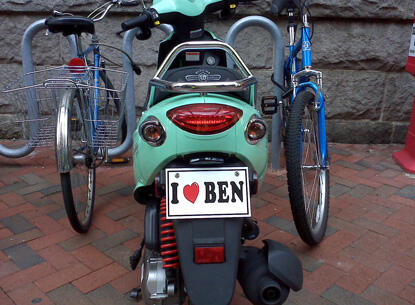
Like a growing number of people, de Wit, associate professor of medicine, doesn't drive to work. Instead, she opts for an alternative mode of transportation. In her case, a scooter.
"I ride a 50 cc mint green scooter to work. I get 100 miles per gallon," de Wit said. "I fill up a tank for under $4. If I give the cashier $4, I get change back."
The advantages of using alternative transportation extend beyond the monetary. For de Wit, her choice helped relieve stress, while helping the environment to boot.
"It's fun, less stressful. I feel the breeze while commuting. I don't feel isolated by the environment because of glass surrounding me," she said. "I don't have to deal with parking issues as I always have front row parking. I get front row parking every day!"
De Wit is not alone.
Robert Andrews, academic advisor for Decision Sciences and Business Analytics, walks, while Kenneth Kendler, M.D., professor of psychiatry and human and molecular genetics, bikes to work nearly every day. And recent alumnus Brantley Tyndall and student Klaas Versluys bike almost everywhere.
For Versluys, biking to school is just part of a green lifestyle.
"I try to be as 'green' as possible," the campus sustainability intern said. "I recycle everything, take short showers, never use plastic water bottles, and as often as possible I remind my roommates to do the same. Cycling provides me with a solid workout every day, plus I'm getting around where I need to go. What could be better?"
Tyndall, who graduated in May and now serves as sustainability assistant in the VCU Office of Sustainability, said the reasons he travels by bike are almost too many to list.
"To start, not having a car and its long list of associated costs saves me literally thousands of dollars every year. Secondly, I lost 30 pounds during my first year of commuting by bike; now I move, breathe and sleep better than ever," he said. "Another reason I choose to bike is that doing so is a lot of fun! I can be in less of a rush, smell the outside air, and explore the city in a much more vibrant way than I ever could driving.
"Finally, and most importantly, biking makes Richmond a more livable city because it emits zero carbon dioxide and particulate air pollutants, reduces urban noise and traffic congestion, and takes the frustration out of parking and parking tickets."
Even commuters, who live too far away to bike or walk to campus, have options. For instance, David H. Cooper, a Williamsburg resident, still saves money on gasoline and vehicle wear-and-tear by van-pooling with eight others.
"I would recommend to anyone who has not tried a van-pool to give it a try," said Cooper, director of Facilities Services. His van-pool "takes eight vehicles off the road that would normally be traveling back and forth from Richmond to Williamsburg daily. It saves many gallons of additional fuel, takes the emissions of these eight additional vehicles out of the picture daily and helps the environment. Our round trip is about 100 miles per day. … That is 4,000 miles per week that we are not adding additional air pollution and purchasing fuel.
VCU Parking and Transportation offers a free parking pass for groups of three or more full-time employees interested in car-pooling, said Rebecca Jones, marketing and public relations manager for Business Services. Besides saving on gas and parking, each individual in the car-pool receives six free parking deck exit passes a year in case they need to drive separately for any reason. (Jones herself car-pools to work.)
While the environmental and economic advantages are obvious, most agree that using an alternate means of travel is downright pleasant compared with driving.
For those in the van-pool, "when it is not your turn to drive, it gives you time to read, make phone calls and even take a nap," Cooper said. "It's a great way to travel while you help the environment and save some money."
For others, such as Tyndall, bicycling is the only way to travel. "My backup mode of transportation is another bike," he said, adding that it's not difficult. "At the end of the day, life’s a little more enjoyable."
And using a scooter has indeed made De Wit's life less complicated.
"It has eliminated my stressors and has allowed me much more freedom to be part of the community," she said. "I see more people, talk with more folks, feel much more part of my community."
For more information on VCU Parking and Transportation Services' Go Green Programs, visit http://www.bsv.vcu.edu/vcupark/GoGreen.htm. For more information on campus green initiatives, visit http://www.vcugoesgreen.vcu.edu. For a guide to living green, visit http://www.vcugoesgreen.vcu.edu/pdf/green_guide_to_living.pdf.
Subscribe to VCU News
Subscribe to VCU News at newsletter.vcu.edu and receive a selection of stories, videos, photos, news clips and event listings in your inbox.