May 12, 2008
Concept phase of da Vinci Center project unveiled: Operating table for Third World Countries for $500
Share this story
Da Vinci clip #1
Da Vinci clip #2
Da Vinci clip #3
Da Vinci clip #4
Da Vinci clip #5
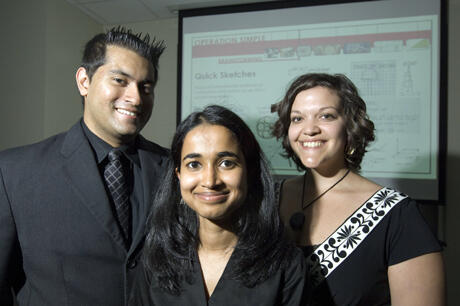
Virginia Commonwealth
University student Seule Kabir, a native of Bangladesh, has seen
firsthand the lack of resources that doctors face in developing
countries. In particular, the need for an affordable operating table
struck her as a common thread that ran through the hospitals of her
home country.
For optimal results in surgery, patients should
be on a raisable, movable and partitioned operating table. However, a
standard operating table can cost anywhere from $5,000 to $30,000, a
price that leaves most hospitals in Bangladesh with just one table to
accommodate their surgical schedules.
In response, Kabir, a
graduate student in biomedical and mechanical engineering, and two
fellow graduate students, Hitesh Patel from the VCU School of Business,
and Jennifer Farris from Interior Design in the VCU School of the Arts,
have developed a concept for reducing the prohibitive cost of operating
tables in economically disadvantaged parts of the world.
The
project, “Operation Simple: The $500 Operating Table for Developing
Countries,” last week became the first to be publicly unveiled by VCU’s
da Vinci Center for Innovation in Product Design and Development, a
program that brings together students from VCU’s schools of
Engineering, Business and the Arts.
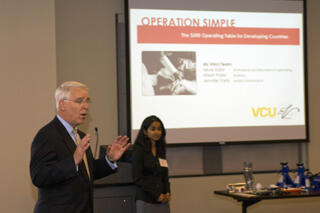
Russell
Jamison, Ph.D., dean of the VCU School of Engineering, provided
background on the da Vinci Center to the audience, which included James
Neifeld, M.D., the chair of surgery in VCU’s School of Medicine;
Michael Sesnowitz, Ph.D., dean of the VCU School of Business; and
representatives from Stryker Corp., a manufacturer of medical
equipment, including operating room tables.
The center poses the
question, “What can the da Vinci Center do within its scope to address
problems of societal need both in the United States and globally?”
Jamison said.
“From those conversations came the beginning of
an idea of doing something in developing countries in which technology
and design and business could perhaps create a game changer in the
lives of individuals in these countries,” he said.
Kabir,
Patel and Farris spent the spring semester designing a prototype table.
The team’s research included Kabir visiting with hospital
administrators in Bangladesh to better determine their specific needs.
The
engineering for the table that the team conceived includes hydraulics,
a gimbal and a pawl and ratchet hinge. From a design perspective, it
would use readily available commercial products to facilitate movement
and flat packaging for ease of shipping and assembly. The recommended
business model would be a hybrid similar to that of furniture mass
producer IKEA, ultimately featuring a suite of add-on features for the
tables.
Phase II of the project, scheduled for the fall
semester, will involve developing the engineering aspects of the table
to ensure that it can support 300 pounds — the industry standard. Phase
III, in spring 2009, will focus on production and marketing of the
table.
Subscribe to VCU News
Subscribe to VCU News at newsletter.vcu.edu and receive a selection of stories, videos, photos, news clips and event listings in your inbox.