April 14, 2026
Father-son engineering duo invents electricity-generating shoe
Share this story
Advaith Atulasimha was on a hike with his family a few years ago when he started to worry about getting lost. No one in the group had cell phone reception, and though they turned around before dark, he wondered what could have happened if they hadn’t.
“If you’re lost in the middle of the forest, where there’s no cell phone tower, you’re kind of off the grid,” said Advaith, now an eighth-grade student at Moody Middle School.
But that worry gave Advaith – who was only 10 years old at the time – an idea: What if he had a tracker that didn’t need cell service, and that wouldn’t run out of battery?
Luckily, he had an important resource to help him do more than just wonder about the question. His father, Jayasimha Atulasimha, Ph.D., is a professor of mechanical and nuclear engineering in Virginia Commonwealth University’s College of Engineering.
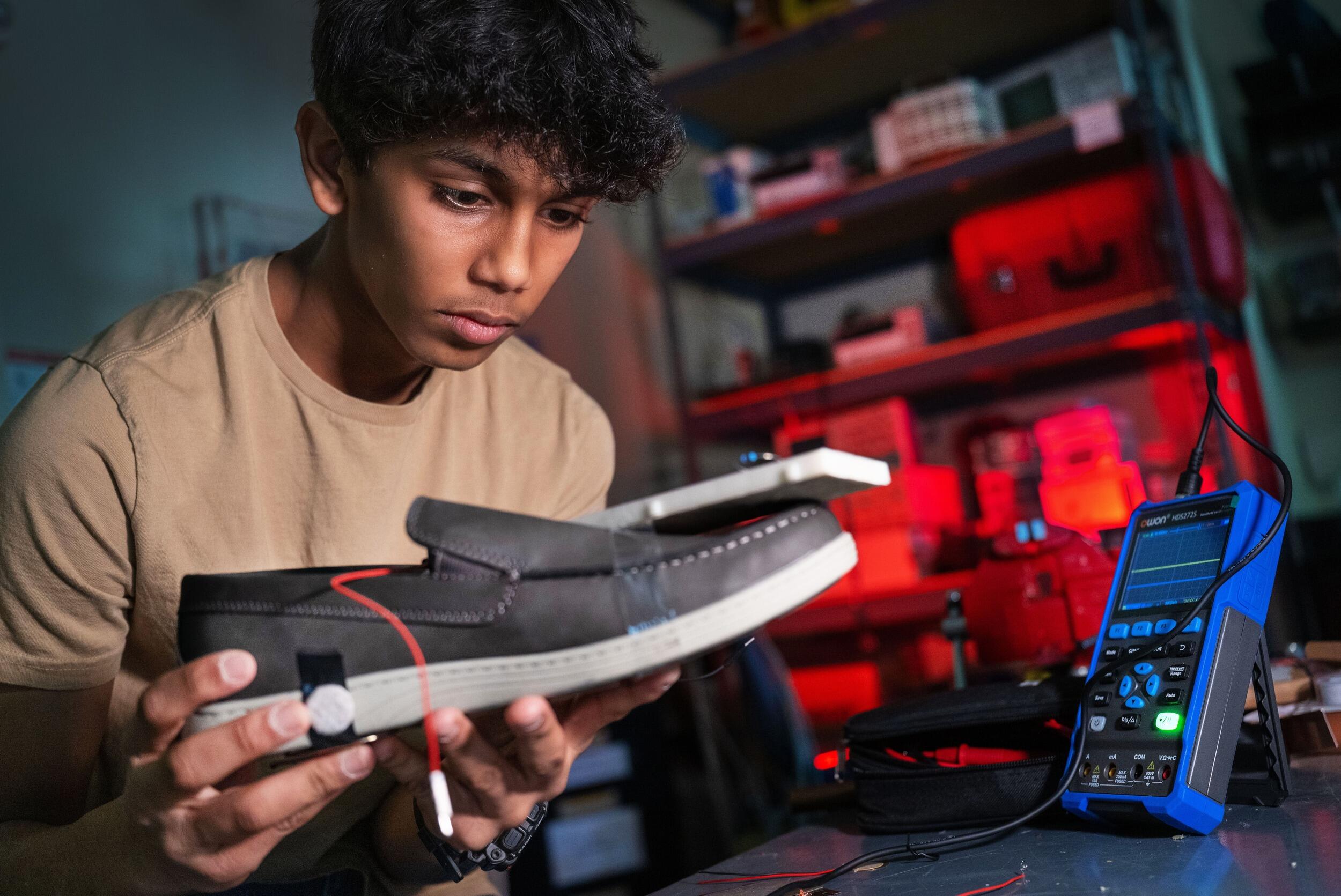
Now, the duo has created a prototype of a shoe that generates small amounts of electricity as its wearer walks – enough to power a small GPS device. The pair sees several uses for the technology beyond tracking down lost hikers: Parents could use the shoes to track their young children, and family members of those with memory loss could keep an eye on their loved ones.
Atulasimha thought that guiding Advaith through the initial research process could be a good learning experience for his son.
“My vision is to play more of a supportive role, so that he gradually steps into a role where he could integrate and lead the project,” he said. “So that in the future, whether he works further on this project, or takes up another – because his interests may change – he has that basic skillset on research and how he would go about doing it.”
He also had an idea for how to get started. Atulasimha introduced Advaith to piezoelectric devices, which create electricity when pressed. And though Atulasimha doesn’t normally work with large piezoelectrics – he primarily studies nano-scale magnets and their uses in computing – his colleague Karla Mossi, Ph.D., is an expert.
The Atulasimhas and Mossi found that while other researchers had attached piezoelectric devices to shoes in the past, they didn’t generate enough electricity to be useful. But the team didn’t need much electricity – just enough to power a small GPS device sending out intermittent location updates.
Advaith began to experiment with piezoelectrics with the help of Mossi, a professor and associate chair of mechanical and nuclear engineering at VCU, testing the energy-generating and storing abilities of the devices.
First, Advaith tested several configurations and sizes of the devices to find out how much energy the shoes could produce. But the shoes don’t just need to make energy – they need to store it as well, in a simple electronics part called a capacitor, which Advaith is learning to solder onto the piezoelectric devices.
“For someone who’s so young, he knows little details – like is this circuit in series? Is it in parallel?” Mossi said. “I thought it was very good to let him go and let him fly. It is his work, and that’s the impressive part because of his age.”
The next step is to keep the energy from leaking back out of the capacitor over longer periods of time. Then, the Atulasimhas will add GPS capabilities to the shoes, which should have enough power to send out location information every 15 minutes, alternating between shoes.
And although Advaith has already won an award at the Virginia Junior Academy of Science’s annual science fair, the pair hopes to take their invention further. Last year, they filed an invention disclosure with the help of VCU TechTransfer and Ventures that gave them a year to create a prototype of the device. To increase the shoe’s commercial potential, Advaith is hoping to garner interest for the invention from major footwear companies.
But whatever happens, the father and son agreed, the project will have been a valuable learning experience.
“Working with both my dad and Dr. Mossi has been really fun,” Advaith said. “I came into this project knowing what a piezoelectric is, but not knowing the technicalities of filing a disclosure and understanding literature.”
And he can take that knowledge – both of electronics, and of research in general – into high school next year.
“Like any project, it had lots of setbacks,” Advaith said. “But I tried to find ways to overcome them.”
Subscribe to VCU News
Subscribe to VCU News at newsletter.vcu.edu and receive a selection of stories, videos, photos, news clips and event listings in your inbox.