March 11, 2026
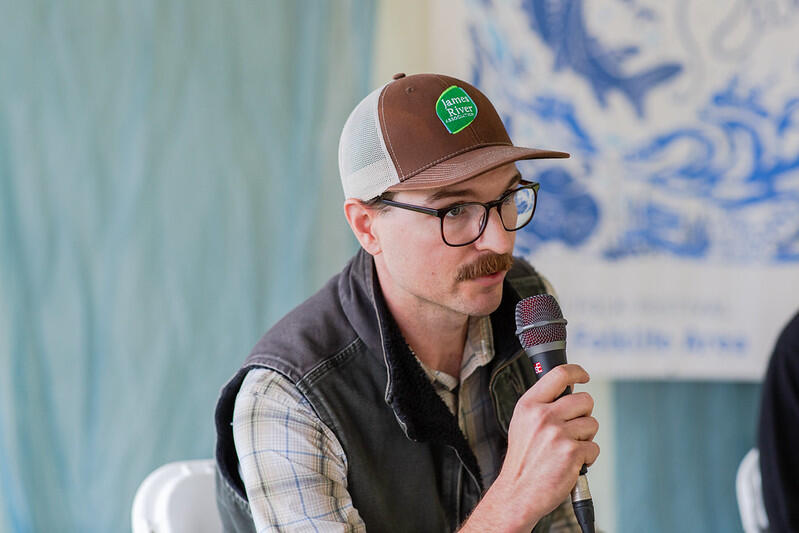
Meet-a-Ram: Thomas Dunlap is a voice for the James
Share this story
Meet-a-Ram is an occasional VCU News series about the students, faculty, staff and alumni who make Virginia Commonwealth University such a dynamic place to live, work and study.
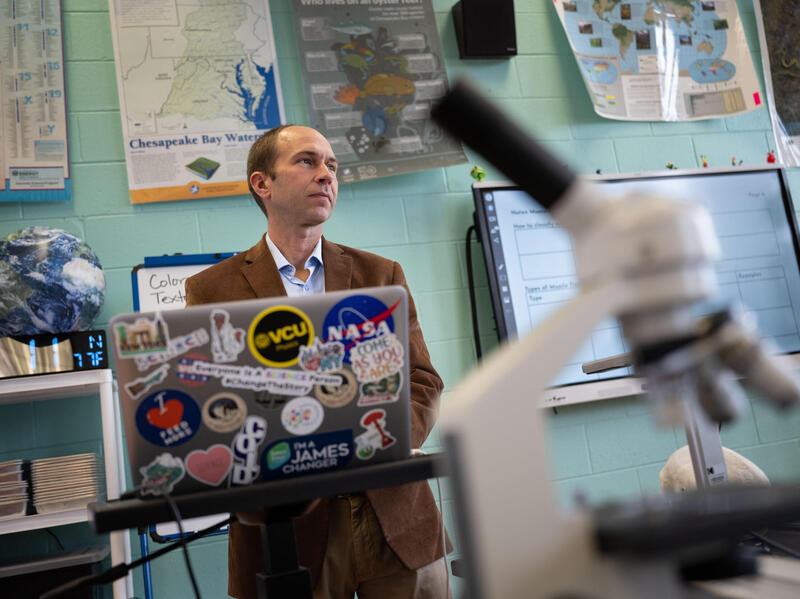
Growing up in Colorado, Thomas Dunlap had an early love of the mountains. When his family moved to the East Coast – and he experienced the ocean for the first time – his passion for the natural world expanded. Now he shares it by protecting one of Virginia’s historic treasures: the James River.
Dunlap serves as riverkeeper with the James River Association, a nonprofit conservation organization that supports the river’s health and its connection to communities. He earned two degrees at what is now Virginia Commonwealth University’s School of Life Sciences and Sustainability, part of the College of Humanities and Sciences – a bachelor’s in environmental studies in 2011, and a master’s in biology in 2014 – and he interned with the JRA during his studies.
The James is known as America’s founding river – Jamestown was settled along its banks in 1607 – and its 340-mile path runs through the heart of Richmond. Dunlap works to protect its watershed for generations to come, by protecting the James from pollution and educating Virginians about being its stewards.
Here, Dunlap shares insight into his life, his work and how VCU shaped his efforts.
What drew you to VCU to pursue environmental studies?
My family was living in Virginia at the time, and I transferred to VCU from UNC Wilmington in North Carolina. The ability to get in-state tuition and the benefits of going to an urban university – while spending time around a quality natural resource like the James River – was really appealing to me.
I benefited from more than just being a student. In RecWell’s Outdoor Adventure Program, I was one of the student staff, which was really impactful. So was being an undergraduate and graduate researcher. I learned some really important skills and made professional connections that continue to aid me in the work I do today.
Speaking of OAP, you must have a great memory to share.
I recall coming back from a weekend trip and getting stuck in a snowstorm on top of the mountain that separates West Virginia from Virginia. We weren’t sure if we were going to have to sleep in the van – with the 16 of us in it sitting on the top of the mountain – or if we were going to make it back to our friends and family! We did make it back somehow that day, and that was just like a pretty powerful bonding experience.
You also noted VCU being an urban university. Has that experience framed your perspective?
I like to think that maintaining the open-mindedness that can be fostered by going to an urban university like VCU motivated me. I spent the first half of my professional career so far working directly with the farming community on clean water and best management practices on the landscape. While there’s no VCU course about talking to farmers about science, I think that you get the opportunity to work with so many diverse folks at a place like VCU, and each one of those interactions itself is an excellent learning experience.
Give us the big picture of a riverkeeper’s duty.
The primary goal of the riverkeeper is to speak for the river that can’t speak for itself. We’re a river conservation organization, and the riverkeeper fights for clean water and for the communities that live in the James watershed and along the river. The people who live, work or recreate along the James – I’m the champion for those folks, for the natural resource, for the threatened and endangered species or other wildlife that use it as essential habitat.
The James serves as a drinking water resource for a third of Virginians, and my day-to-day work could include serving as the tip of the spear for regulatory and legislative work that the James River Association does to protect clean water in the watershed and elsewhere throughout the commonwealth.
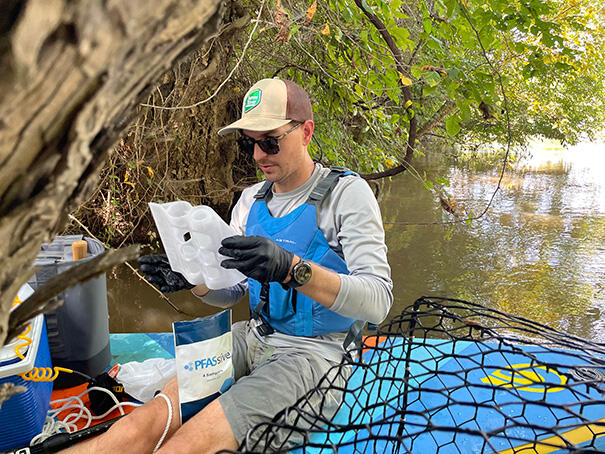
And your work often intersects with community engagement, right?
I oversee a volunteer program where I train individuals to identify different types of pollution – and not only report them to me as the riverkeeper, but also report them to the appropriate agencies. And sometimes I’m helping our education team with their work across the watershed. We have three river education centers: one in Lynchburg, one here in Richmond on Dock Street and one in Williamsburg. We also have two floating classrooms: one near Presquile National Wildlife Refuge in Chesterfield County, where we have a 40-foot pontoon boat, and a similarly sized deadrise vessel in Hampton. I might work with our education team on curriculums, presentations and community conservation programs.
What’s your why?
As a small child growing up in rural Colorado, I had these indelible experiences that impressed upon me the value of our natural resources. When my family moved to the East Coast, I was introduced to an entirely different environment. For so many folks, it’s not that people don’t care – it’s just not part of their daily calculus.
Through my undergraduate and graduate experiences, I found that I could take complex concepts and bring them out into the real world – to farmers, or people who just want to fish on the river, or maybe even to the people who don’t have a direct relationship to the water but they flush a toilet in the city of Richmond and they’re part of our combined sewer system that has a dramatic impact on our watershed in the James.
I get the pleasure of being able to fight for these resources and fight for people who care about these things – and for people who don’t know that they care about these things, but they might value them, or their future generations might value them, even more than we do today.
A longer version of this Q&A originally appeared on the School of Life Sciences and Sustainability website.
Subscribe to VCU News
Subscribe to VCU News at newsletter.vcu.edu and receive a selection of stories, videos, photos, news clips and event listings in your inbox.