May 18, 2007
Nemo’s song
Share this story
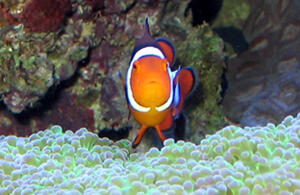
Michael Fine, Ph.D., professor in the Virginia Commonwealth University Department of Biology, together with lead investigator Eric Parmentier, Ph.D., a professor at the University of Liege, Belgium, has discovered a unique sound producing mechanism in the clownfish Amphiprion clarkii.
This mechanism is unlike any sound-generation system known in animals. Fine said it shows an important evolutionary change in clownfish, as the functional movement seems to have derived from the feeding mechanism.
“This shows how a structure can be modified to assume a new behavioral function,” he said.
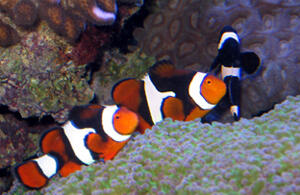
Clownfish are members of the damselfish family, the largest, most ubiquitous family in coral reefs. No other family uses this sound mechanism, showing this is an adaptation that rose out of the family.
Popularized by the movie “Finding Nemo,” clownfish use sounds, described as “chirps” and “pops,” in mating and defending their sea-anemone home against other fish.
The researchers found that a pair of ligaments connecting the lower jaw to the tongue causes the jaws to close forcefully. The sounds are then produced by the collisions of the front teeth and the resulting vibration.
Researchers observed the fish’s movements in a tank using a camera and X-ray that took 500 images per second. They also examined the anatomy of the jaw structure.
Fine said this is just the first step to understanding the mechanism.
“This is new really cool stuff but there’s still a lot we don’t understand,” he said. Fine said the field of fish acoustics has been understudied, mainly because humans can’t hear well under water.
“There’s a whole acoustic world down there that we aren’t privy to,” he said. “There’s all kinds of really interesting behavioral interactions that take place with pheromones, chemical communication, visual communication and acoustic communication. It’s just sort of fun to see how animals signal each other.”
These findings were published in the May issue of Science.
Subscribe to VCU News
Subscribe to VCU News at newsletter.vcu.edu and receive a selection of stories, videos, photos, news clips and event listings in your inbox.