Feb. 23, 2026
Exploring the bladder and the brain, John Speich helps engineer multidisciplinary research
Share this story
John Speich knows what you’re thinking when you hear the term mechanical engineering. “Steel, aluminum or plastic – the typical substances,” he said.
“But if you’re an engineer, you’re a problem solver,” said Speich, Ph.D., a professor in Virginia Commonwealth University’s College of Engineering. “And there are all kinds of problems – in areas like business and medicine – beyond the traditional areas of mechanical engineering.”
Case in point: the human bladder.
“When I tell students about how I came to be involved in bladder biomechanics,” Speich said, “I tell them, you will always keep learning throughout your entire career.”
For Speich, that career now spans a quarter-century at VCU, which he joined in 2001. Since nearly the beginning, he has helped bridge VCU’s academic and medical campuses in exploring an extremely common condition – overactive bladder, which causes sudden urges to urinate and can be hard to control. More than 30 million American adults are estimated to have overactive bladder.
Speich and his collaborators are working to find noninvasive methods to characterize and diagnose overactive bladder, with the goal of allowing doctors to precisely match patients with the most effective treatments. It wasn’t quite the path he expected his career to take.
His doctorate from Vanderbilt University had focused on robotics, and in VCU’s Department of Mechanical and Nuclear Engineering, he figured he would continue developing his work for use in surgery and rehabilitation. But in 2003, he fielded a call from Paul Ratz, Ph.D., a professor and researcher at the VCU School of Medicine.
“Before I started working with Dr. Ratz, I had never even heard the words neurourology or urodynamics. Now, Neurourology and Urodynamics is the name of the journal I publish in the most.”
John Speich
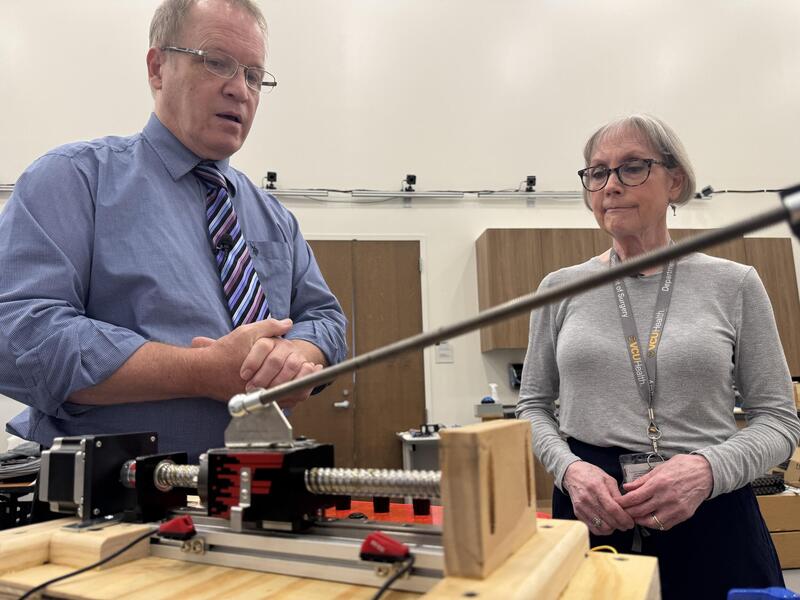
Ratz was seeking some robotics repair assistance – he was using a small robotic lever to stretch tiny strips of bladder muscle and rings of artery, trying to determine how different chemical compounds changed the properties of the muscle. Speich recognized the method as a form of mechanical engineering.
He and Ratz quickly began working together, and now nearly all Speich’s research focuses on the bladder.
“Before I started working with Dr. Ratz, I had never even heard the words neurourology or urodynamics,” Speich said. “Now, Neurourology and Urodynamics is the name of the journal I publish in the most.”
Today, Speich collaborates on bladder biomechanics with two other doctors at the School of Medicine. Adam Klausner, M.D., is a urologist and the interim chair of the new Dorothy A. Pauley Department of Urology. Linda Burkett, M.D., is a urogynecologist in the Department of Obstetrics and Gynecology – and before medical school, she earned her bachelor’s degree in biomedical engineering from the VCU College of Engineering.
A number of students across the College of Engineering and School of Medicine have also aided in their research.
Speich’s primary research involves ultrasound and near-infrared spectroscopy, a noninvasive technology that uses light to measure tissue oxygenation and brain activity. He and his team are working to pinpoint the brain’s role in overactive bladder – and determine whether the brain or the bladder is the primary cause of an individual’s sudden urge to urinate.
“There are a lot of potential causes of overactive bladder. Some people may have more than one cause,” Speich said. “Individual responses to these treatments vary – what works well for one patient may not work at all for the next. We want to give doctors better tools for quantifying information about their patients so they can make better decisions and more optimized treatments.”
Through research grants, including a National Institutes of Health grant from 2015 to 2025, Speich has made a number of notable findings.
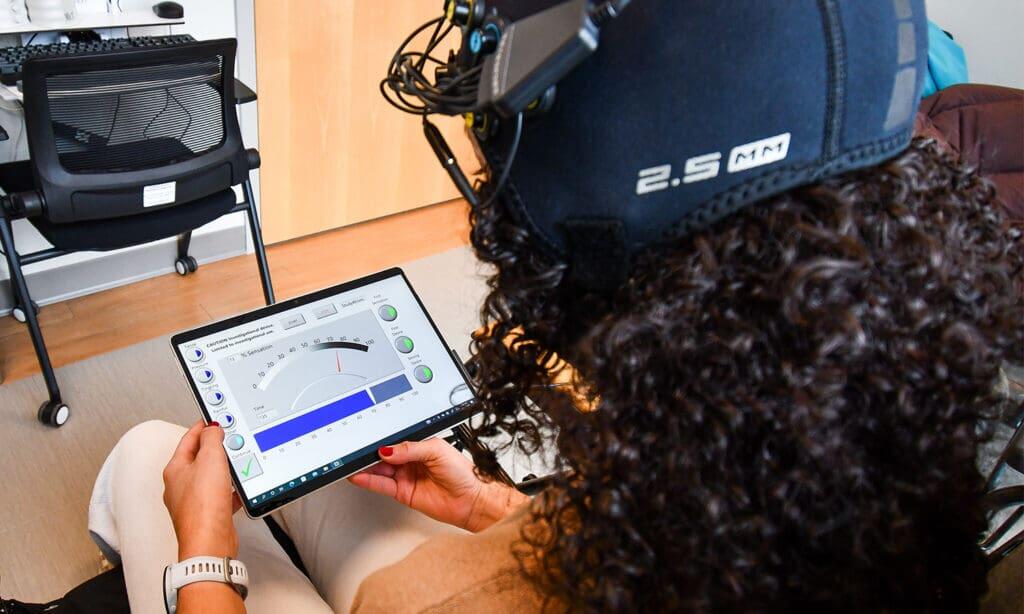
His team has closely examined the bladder’s dynamic elasticity, investigating the biomechanical mechanisms that allow the bladder muscle to fill and expand. And in the “bladder or brain” focus, Speich and his team developed a tool called a sensation meter to help determine what an individual is feeling as their bladder is filling over time.
The patient uses a slider bar on a touch screen to adjust their perception of bladder fullness sensation. The device allows time, bladder volume, bladder pressure and other parameters to be plotted as a function of sensation.
Speich’s focus may be far from what he envisioned a quarter-century ago when arriving at VCU. But his trajectory is itself a compelling lesson that Speich shares with his students – who, as he did, will continue to learn throughout their emerging careers.
“You never know,” he said, “where you’re going to end up.”
A version of this story was originally published on the College of Engineering website.
Subscribe to VCU News
Subscribe to VCU News at newsletter.vcu.edu and receive a selection of stories, videos, photos, news clips and event listings in your inbox.