April 5, 2012
Physiology Professor Goes Back to Third Grade
Share this story
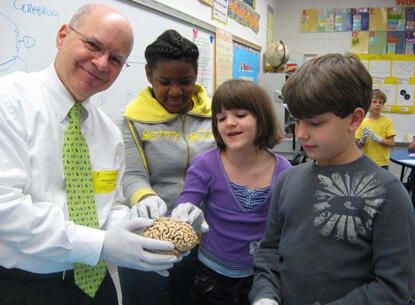
For nearly three decades, Richard M. Costanzo, Ph.D., professor of physiology and biophysics in the VCU School of Medicine, has made an annual trip from VCU's MCV Campus to third grade science classrooms.
This year, March 8 marked his 29th year of getting kids excited about science and, specifically, neuroscience. "I bring in props, including a human brain in a jar, and give an age-appropriate lesson, which for third grade is mostly about the five senses," Costanzo said. "I also work in concepts about nutrition, like healthy food builds a better and smarter brain, and about safety, wear helmets and seat belts to protect your brain from injury."
This year's trip took him to Goochland County's Randolph Elementary School. This was just his eighth year at RES, but his tradition got its start back in 1983 when his own children were in third grade. After his children moved on, "the third grade teacher invited me back each year, and I have continued to do this for third graders every year since. When my wife and I moved to Goochland, I contacted Randolph Elementary and they were interested in having me continue the tradition at their school."
In recent years, educators have increased efforts encouraging students to pursue careers in science, technology, engineering and math disciplines, the so-called STEM fields. Costanzo's yearly commitment was a forerunner to many formalized programs that have sprung up more recently.
About 20 years ago, for example, the Society for Neuroscience and the DANA Foundation started Brain Awareness Week as an international effort to educate the public about neuroscience. Since then, Costanzo has timed his visits for March to coincide with Brain Awareness Week, which this year was marked March 12-18.
A number of other School of Medicine faculty members make school visits including Anatomy's Ruth Clemo, Ph.D., and Otolaryngology's Kelley Dodson, M.D. This kind of outreach supports VCU's Quest for Distinction priorities of becoming a national model for community engagement and enhancing efforts to attract diverse K-12 students to health-related careers.
While Costanzo doesn't know what has become of the hundreds of students over the years who've marveled at the brain in a jar, he does occasionally get stopped by children who recognize him as "that guy with the brain." And he knows of at least one student who has gone on to earn a medical degree - interestingly, a student from the very first third-grade classroom he visited. "So who knows," Costanzo said, "there may have been others who eventually became physicians or scientists?"
Costanzo's commitment to future scientists has been honored by the medical school repeatedly, most recently in 2010 with its Distinguished Mentor Award. Known for his ability to develop a personal connection with students and support them as they grow into a higher level of professional performance and accomplishment, Costanzo has advised on nearly 40 graduate student thesis committees in addition to maintaining over 30 years of grant funding from the National Institutes of Health.
Subscribe to VCU News
Subscribe to VCU News at newsletter.vcu.edu and receive a selection of stories, videos, photos, news clips and event listings in your inbox.