Jan. 8, 2009
Service-learning art education students teach residents of assisted-living facilities
Share this story
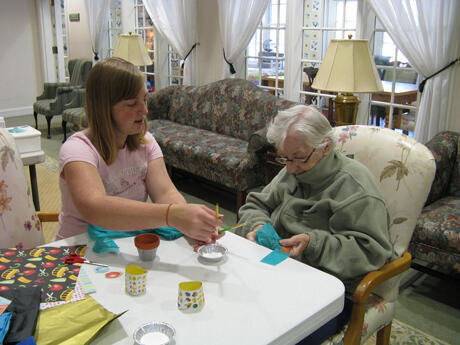
Donna Miller, a junior at VCU, was unsure at the outset of the service-learning project her art education class was scheduled to undertake at two local assisted-living facilities. However, any reluctance disappeared soon after her first visit to the Southerland Assisted Living Place in Midlothian. She began to look forward to her time with the facility residents each week.
“I would leave every time with a gratifying feeling,” Miller said. “I felt like I had done something for the world that day, contributed something important to the community.”

Miller was one of 40 VCU students participating last fall in the outreach, which was directed by Min Cho, Ph.D., assistant professor of art education. The students visited Southerland and Chestnut Grove Senior Community in Richmond once a week – half the class was assigned to Southerland and half to Chestnut Grove – providing guidance and instruction in a range of art activities. Students worked with two units at each facility – one for general residents and one for those with dementia.
“The elderly need continuous opportunities to be active for mental and physical reasons,” said Diane Denny, executive director of Southerland. “With the VCU students and through art, (Southerland residents) had a chance to reminisce, share their life experiences and express their feelings.”
The program started in the spring of 2007 after Denny contacted Cho for help, believing that Southerland residents with symptoms of dementia would benefit from the creative outlet that art provides. Research has indicated that keeping the brain active and stimulated can improve the quality of life for people with dementia. Cho set up an initial program that spring with three students. It has grown to 40 students.
The experience of working with older adults can be eye-opening for students accustomed to designing art education strategies for much younger students. Cho says that children’s cognitive and gross motor skills are growing, but the elderly’s same set of skills are declining. This makes for starkly different teaching challenges.
Miller and other participating students learned to gauge the seniors’ abilities and level of interest in each activity and to understand the best ways to motivate and encourage them.

Projects often evoked memories in residents, and VCU students capitalized, shaping activities that catered to those memories. For instance, when a female resident one week was reminded of an old pet dog, a discussion about animals ensued between students and residents. Subsequently, students encouraged the residents to create pieces inspired by past pets. In another project, residents created memory boxes about their families.
“We were always looking for opportunities to start a conversation,” Miller said. “As much as we could, we really wanted to get to know them.”
Patty Haber, activities director at Chestnut Grove, said the students’ commitment to the project was apparent. The residents’ art work was displayed at a closing event, and students arranged a slide presentation, designed an invitation for the event for families and friends and produced a certificate that was presented to each participating resident.
“There is something to say about the young and the old having a special connection,” Haber said. “My residents looked forward to their weekly visits with the students and couldn’t wait to be engaged into their new art lesson. The students were well-prepared, knowledgeable and effective with their projects. They worked closely with the residents, helping them with different techniques, making them feel very comfortable and showing them they really cared.”
Cho said the project reminds students that art “is not just for K-12 students – it’s for everyone. Their participation in this service-learning project reinforces the notion to me, that service learning is a powerful learning pedagogy that helps students learn academic skills, while providing a needed service to the community.”
“One very important thing it did for them is increase their understanding of empathy,” Cho said. “They are going to need that if they want to be teachers. They will need that ability to put themselves in their students’ shoes. You have to be patient, understanding and very, very sensitive to people of different backgrounds.”
Cho is also encouraged by the acceptance of service-learning among the School of the Arts faculty, particularly the Art Education department.
“Dr. Sara Wilson McKay (assistant professor of art education at VCU) taught a service-learning course exploring art education and young children working with the Head Start Program at Richmond Public School's Adult Career Development Center,” Cho said. “And Dr. Pamela Taylor (associate professor and chair of the art education department) created a partnership between a Richmond school and our department using service-learning methodologies. Service-learning keeps our teaching and research grounded and relevant. It’s the reason why I teach.”
Subscribe to VCU News
Subscribe to VCU News at newsletter.vcu.edu and receive a selection of stories, videos, photos, news clips and event listings in your inbox.