April 21, 2006
The Nanocomputing Revolution:
Share this story
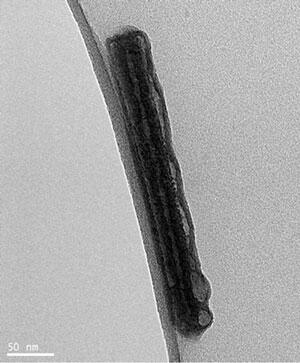
Imagine if all the information contained in the Library of Congress could be easily packed on the head of a pin. That’s just one of the possibilities in the rapidly growing field of nanocomputing, where engineers are developing techniques to create technical tools small enough to work at the atomic level. It promises to revolutionize electronics — creating smaller, smarter, faster computers, sensors and other devices.
At the Virginia Commonwealth University School of Engineering, Supriyo Bandyopadhyay, Ph.D., and Koray Karahaliloglu, Ph.D., both faculty members in the Department of Electrical and Computer Engineering, are already making important advances in this field. Together with their research team, they have been among the first to develop and test simple, nanoscale, nonlinear resistors made to electrically interact with each other in a way that mimics the functioning of the human brain.
The team has shown that these resistor circuits, known as artificial neural networks, can recognize and process images and patterns, remember data and associate them with particular contexts. In addition to performing all these complex tasks, the researchers observed that these circuits perform them quickly and efficiently. Last year, the National Science Foundation awarded a $1 million grant to the VCU group and collaborators at the University of Michigan and UCLA to continue their work in this field.
“In the last five decades, transistors that are used for the circuitry of most computers have become increasingly complex and difficult to fabricate. Progress in electronics may slow to a standstill unless we can find alternate routes to building computers that bypass the need for transistors,” said Bandyopadhyay. “Our research is one of very few and the first alternate route to computation in the nano-world.”
Bandyopadhyay is presenting this ongoing work of artificial neural networks, and an area of research known as quantum computing, at the Virginia Nanocomputing Research workshop in Blacksburg, Va., on May 10. The workshop, hosted by Virginia Tech, will provide an opportunity for researchers, faculty and graduate students from across the commonwealth to share the latest developments in nanocomputing research and to initiate potential collaborative efforts to advance research in the state.
“The circuits we have created are chemically self-assembled, which means we can literally “grow” computers in a beaker rather than rely on a multi-billion dollar semiconductor foundry to fabricate,” said Bandyopadhyay, who helped organize the workshop.
According to Bandyopadhyay, by using nanoscale components researchers have the ability to pack a large number of devices within a very small area. The devices themselves are just billionths of a meter; and trillions of them can be packed into an area the size of a postage stamp. Furthermore, they consume very little energy when they process data.
Bandyopadhyay said that the current method of making computers — and most electronic circuits — is based on transistors. He said that transistor-based circuits have already reached a point of sophistication where further significant improvements are unlikely. He added that with time, transistor based circuits will no longer be economically viable.
“The electronics revolution is fueled by a simple rule known as Moore's Law, which states that the number of transistors on a chip will double every 18 months. That prediction is beginning to show signs of failure,” he said.
The Virginia Nanocomputing Research workshop is sponsored by the National Science Foundation, the Institute of Critical Technologies and Applied Sciences, and the Bradley Department of Electrical and Computer Engineering at Virginia Tech.
Researchers from VCU, Virginia Tech, the University of Virginia, and Duke University will present their work.
Subscribe to VCU News
Subscribe to VCU News at newsletter.vcu.edu and receive a selection of stories, videos, photos, news clips and event listings in your inbox.