March 5, 2026
Rare earth elements, joint pain and addiction treatment are highlighted in VCU faculty research receiving new awards
Share this story
As demand accelerates for electric vehicles, renewable energy systems and advanced electronics, a quiet bottleneck has emerged far upstream: the separation of rare earth elements. These minerals are essential to modern technology but notoriously difficult, expensive and environmentally harmful to extract.
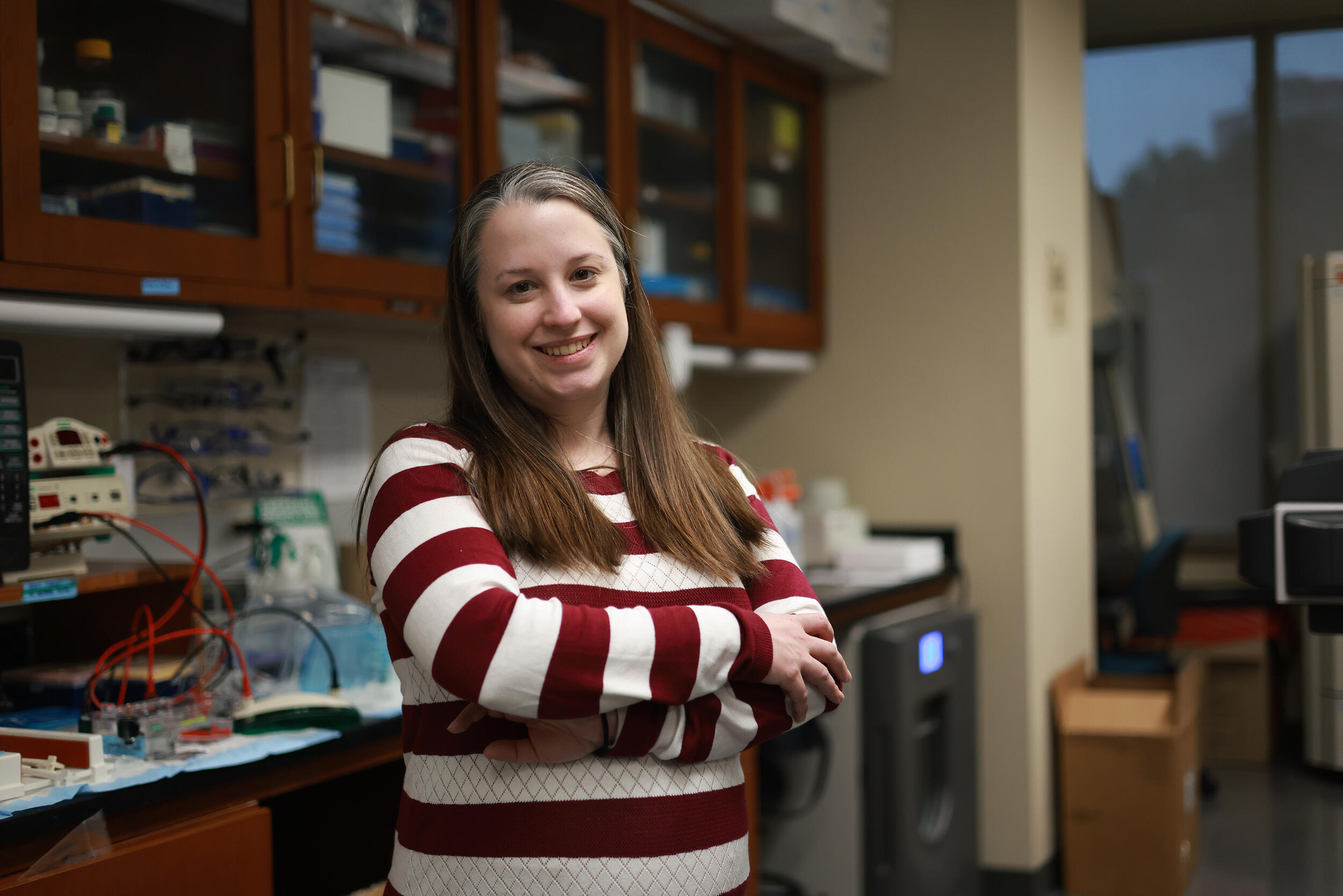
In Virginia Commonwealth University’s College of Engineering, Leah Spangler, Ph.D., an assistant professor in the Department of Chemical and Life Science Engineering, is developing a different approach. With support from VCU TechTransfer and Ventures’ Commercialization Fund, Spangler and her team are advancing S824, a synthetic (“de novo”) protein that is engineered to selectively bind rare earth elements while ignoring more common metals found in mining and industrial waste streams.
Spangler’s project is one of five VCU faculty-led research projects to receive new support from Commercialization Fund awards, a twice-yearly funding opportunity that aims to accelerate development of campus projects to improve their chances of being licensed and brought to market.
A cleaner separation method for rare earths
While the S824 protein is made from the same amino acid building blocks as natural proteins, its structure — and therefore function — is deliberately engineered rather than shaped by evolution.
“It’s kind of like an engineering approach to biology,” Spangler said.
That control matters. Rare earth elements are chemically similar to one another and often co-mingled with metals like copper, zinc and calcium. Traditional separation methods rely on hundreds of solvent-heavy processing steps that generate significant toxic waste and make domestic production economically and politically challenging.
S824, by contrast, binds selectively to certain rare earth elements while rejecting those other metals — and it does so in water, at room temperature, without harsh chemicals.
“It’s just a much cleaner way to separate them out,” Spangler said.
Early experimental results suggest S824 is particularly effective at capturing higher-value rare earths such as terbium, dysprosium and gadolinium, which are critical for magnets, electronics and clean-energy technologies. Just as importantly for commercialization, the protein remains stable under acidic conditions similar to those found in real-world mining waste streams, where many proteins would simply fall apart.
This is where VCU TechTransfer and Ventures’ support is critical. “The Commercialization Fund is helping us move to the next stage: taking our protein out of a test tube and actually showing how it can perform in an industrial environment,” Spangler said.
Over the next year, Spangler’s team in the College of Engineering will evaluate S824 in chromatography-style columns, similar in concept to a water filtration system. These tests will measure how efficiently it captures rare earths, how many times it can be reused and what the economics look like at scale.
“The big goal is to be able to do rare-earth separation domestically, because right now, most of that separation happens overseas,” Spangler said.
Such a turnkey solution could be licensed and co-developed with mining suppliers, e-waste recyclers or materials manufacturers seeking cleaner, domestic sources of critical minerals. That commercial trajectory is already taking shape: With guidance from TechTransfer and Ventures, Spangler recently co-founded a startup, BioRe-Element Technologies, to advance the technology toward market adoption.
“I had no experience with entrepreneurship or commercialization,” Spangler said. “I’ve learned a lot, but it’s been really fun and exciting, too.”
Advancing ideas from lab to marketplace
Other Commercialization Fund awardees are working toward scalable solutions to joint pain, next-generation technologies in addiction treatment, advanced therapeutic devices and rapid testing for an underdiagnosed disease.
Together, these projects reflect the breadth of innovation moving through VCU’s commercialization pipeline and the university’s growing emphasis on pairing research excellence with translational outcomes.
“These awards are about more than funding experiments,” said Ivelina Metcheva, Ph.D., VCU’s assistant vice president for innovation and head of TechTransfer and Ventures. “They’re about helping researchers ask the next set of questions — the ones that determine whether an idea can scale, attract partners and ultimately reach the people who need it.”
That bridge between discovery and deployment is reinforced through partnerships across Central Virginia’s innovation ecosystem.
“When academic breakthroughs are paired early with commercialization expertise, they move faster and with greater clarity,” said VCU Vice President for Research and Innovation P. Srirama Rao, Ph.D. “VCU’s Commercialization Fund is doing exactly that: turning promising research into actionable solutions. We are excited to see what these innovators will do with this infusion of new capital.”
Additional Commercialization Fund awards
Here are summaries of the four additional VCU faculty-led projects that received awards in the latest funding cycle:
Project: Targeting joint fibrosis at its source
Fund recipient: Barbara D. Boyan, Ph.D., professor, College of Engineering, and executive director, VCU Institute for Engineering and Medicine
Arthrofibrosis is a painful, often debilitating condition in which excessive scarlike tissue forms inside a joint following surgery or injury. It limits mobility, drives repeat surgeries and contributes to long-term disability for millions of patients annually, yet there is no reliable way to prevent it once it begins.
Boyan’s team is developing a way to interrupt the body’s fibrotic response early, before excess collagen builds up inside the joint. The approach uses lipid nanoparticles — tiny, engineered carriers — to deliver microRNAs, which regulate inflammation and collagen production, to joint cells.
The nanoparticles are designed to be delivered using ClickGel, an injectable hydrogel already licensed by Richmond-based Pascal Medical Corp. This combination allows a single injection to remain in the joint space long enough to meaningfully influence healing, without restricting motion.
If successful, the platform could improve outcomes following procedures such as ACL repair and total knee arthroplasty. The same delivery strategy could eventually be adapted to treat fibrotic conditions in other tissues, including the heart.
______________________________
Project: Longer-lasting treatment for opioid use disorder
Fund recipient: Qingguo Xu, D.Phil., professor, Department of Pharmaceutics, School of Pharmacy
As opioid use disorder continues to drive overdose deaths despite the availability of effective medications, Xu is collaborating with Matthew Banks, Ph.D., a professor in the School of Medicine’s Department of Pharmacology and Toxicology, to advance a new, long-acting injectable therapy designed to address persistent challenges.
The innovation centers on norLAAM, an active metabolite of LAAM (Levo-alpha-acetylmethadol), that may offer greater potency at opioid receptors with fewer cardiac risks. The project pairs norLAAM with biodegradable polymer microparticles that allow the drug to be released gradually over weeks or months from a single injection.
By reducing the need for daily dosing or frequent clinic visits, the approach aims to improve treatment adherence — one of the foremost barriers to long-term recovery. Early proof-of-concept studies in animal models have demonstrated sustained therapeutic effects from a single dose.
Through this project, Xu’s team plans to generate safety and pharmacokinetic data to position the therapy for future clinical translation. He hopes the technology provides a scalable, retention-focused solution to fill a critical gap between existing treatments for opioid use disorder.
______________________________
Project: Wearable vibration technology for personalized neurological therapy
Fund recipient: Daeha Joung, Ph.D., associate professor, Department of Physics, College of Humanities and Sciences
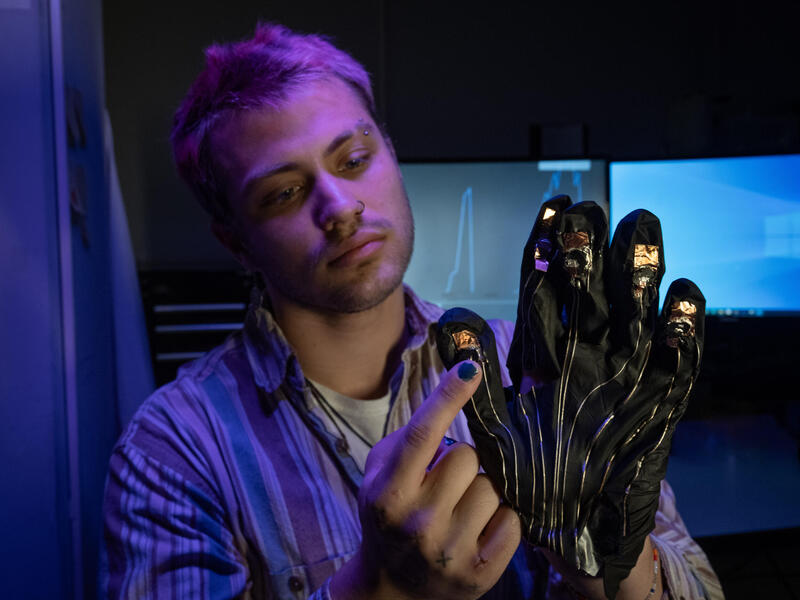
Many vibration-based therapeutic devices for people with Parkinson’s disease and other neurological disorders are bulky, rigid, power-hungry or uncomfortable for extended use. Joung’s innovation replaces those constraints with compact, flexible electromagnetic vibration actuators that can be comfortably worn against the skin and embedded directly into clothing or accessories.
The system combines low-power tactile actuators (tactors) with built-in pressure sensor devices, allowing the device to monitor vibration intensity in real time. This is especially important in neurological rehabilitation, where the therapeutic benefit depends on delivering stimulation that is strong enough to influence motor pathways but within safe and comfortable limits.
Joung’s team aims to develop a system that feels less like a medical device and more like everyday apparel, while still delivering clinically meaningful results. Beyond Parkinson’s care, the technology has pathways to commercialization in rehabilitation devices, prosthetics, assistive wearables and immersive VR/AR interfaces, offering industry partners a scalable, energy-efficient alternative to today’s haptic solutions.
______________________________
Project: Rapid diagnostic technology for Babesiosis
Fund recipient: Richard Marconi, Ph.D., professor, Department of Microbiology and Immunology, School of Medicine
Long at the vanguard of Lyme disease research, Marconi is developing a diagnostic technology to address a growing public health challenge: Babesiosis, an underdiagnosed tick-borne disease that can lead to severe, sometimes life-threatening illness.
Current diagnostic tools rely on PCR testing, blood smear analysis or specialized laboratory assays — approaches that are often expensive or impractical. Marconi’s innovation focuses on a peptide-based diagnostic antigen derived from Babesia surface proteins that reliably detects antibodies during the early stages of infection.
Marconi’s team will refine the technology by identifying the most immunoreactive regions of critical Babesia surface proteins and combining them into a single chimeric peptide antigen. This approach enables the development of scalable diagnostics compatible with standard ELISA platforms as well as rapid, point-of-care lateral flow tests.
Marconi already boasts an extensive track record in chimeric epitope technology, leading to licensed vaccines and diagnostic products. Now, the Babesiosis diagnostic platform is well-positioned for licensing to human and veterinary diagnostics companies seeking faster, more accessible tools for tick-borne disease detection.
Subscribe to VCU News
Subscribe to VCU News at newsletter.vcu.edu and receive a selection of stories, videos, photos, news clips and event listings in your inbox.