July 7, 2004
VCU Computer Engineering students win international airplane competition
Share this story
A group of Computer Engineering students from Virginia Commonwealth University's School of Engineering have captured the top prize in an international unmanned aircraft competition, besting several institutions with more established aerospace engineering programs.
The Student Unmanned Aerial Vehicle competition took place at Webster Field in St. Inigoes, Md., an annex of the Patuxent River Naval Air Test Center that is headquarters for the Naval Air Systems Command (NAVAIR).
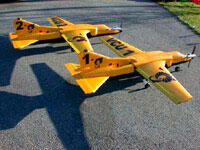
The VCU students, seniors Abhishek Handa, Jeffrey Quinones, Kevin Van and Brittiany Wynn, entered a radio-controlled plane that was formerly an Army target drone, fashioned to resemble a Soviet-era MIG 27 fighter. It was donated by the Aviation Advanced Technology Directorate at Ft. Eustis and modified by the students to fly itself to preprogrammed coordinates using the Global Positioning System. The students also built a second, identical plane as a backup.
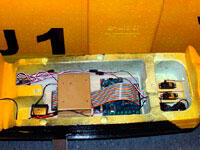
"Whereas the other groups used an off-the-shelf autopilot system for their flight control system, the VCU students designed the flight control system and data gathering system for their Unmanned Aerial Vehicle from scratch," said Dr. Robert H. Klenke, the team's faculty advisor and an associate professor in VCU's Department of Electrical Engineering.
The students had to submit a technical paper on their plane, give a technical presentation to the judges at the competition, and complete the flying portion of the competition. The flying portion consisted of navigating, autonomously, to six "waypoints" spread across Webster Field, and identifying "targets" at each waypoint. The results were judged based on the correct flight path of the vehicle, the speed and resolution with which the targets could be identified, and additional information provided about each target, such as size, type of vehicle and target heading. The VCU group correctly identified all of the targets, including a "bonus" target, provided all the additional information on each target, and completed the tasks in just 20 minutes - 10 minutes faster than any other group.
They took first place, winning $5,000, plus the $500 prize for best flight.
"We were very impressed with the talent on their team and the quality of their work," said Rick Greer, a NAVAIR communications engineer and one of the judges.
The VCU team beat eight other teams from Istanbul Technical University in Turkey, Cornell University, North Carolina State University, Mississippi State University, Texas A&M, University of Texas at Arlington, Santa Clara University and Polytechnic University of New York.
The second annual event, organized by the Association for Unmanned Vehicle Systems International, is designed to stimulate and foster interest and careers in unmanned aerial vehicles. Sponsors included Boeing, Northrop Grumman, MicroPilot, the Johns Hopkins University Applied Physics Laboratory, ARINC Engineering Services and BAI Aerosystems.
Subscribe to VCU News
Subscribe to VCU News at newsletter.vcu.edu and receive a selection of stories, videos, photos, news clips and event listings in your inbox.