May 19, 2003
VCU engineering students build t-bucket roadster for graduation project
Share this story
About a dozen mechanical engineering students at Virginia Commonwealth University who graduated May 17 now know how to build an automobile. But they didn't learn how to build just any car; they made a high-performance t-bucket roadster from scratch.
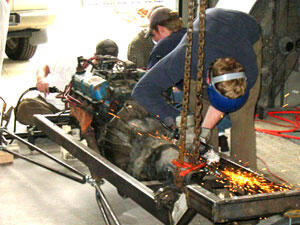
For their final semester project, the students built the "street-rod" around the engine of a 1964 Ford Galaxy sedan and the rear end of an old Ford Thunderbird, using new and recycled automotive parts. A machine shop in VCU's School of the Arts served as their garage. "Until now, these students had never been in a machine shop," said Daniel P. Cook, Ph.D., their professor. "Mechanical engineers have to know how to fabricate things and this type of hands-on experience can make recent engineering graduates more marketable when they are out looking for their first job."
The project was funded, in part, by a $4,000 grant from the university. The students bought parts to build the roadster and plan to raffle it off to help fund next year's project.
"Building the roadster was a lot of fun for them, so the students may not have realized they were actually learning something," said Cook. Through hands-on experience, the students learned how to build an engine and apply their knowledge of thermodynamics, heat transfer, materials fabrication and fluid flow.
One lesson the students learned was that not everything goes according to plan. Delays in ordering parts, organizational issues and other unexpected problems cost them a couple of months. "We should have ordered the parts earlier and made more efficient use of our workers," said student Rusty Whitehead of Hopewell, Va., who will go to the University of California at Berkley to pursue his doctorate. "Also, the mounts on the engine weren't aligned perfectly with the vehicle frame, so that took a couple of weeks to straighten out."
Some of the students were disappointed that the roadster wasn't finished by the end of the semester, but to Cook and Blake Huff - who runs the VCU Department of Sculpture's machine shop, where the work was performed and co-taught the class - that wasn't the point. "The main purpose of the class was for the students to learn how to design and build something and that is exactly what they did," Cook said. "To me, that makes the class a success."
Many mechanical engineers are in the auto industry and those who aren't must know how to build what they design. "I probably won't need to use a lathe machine in my job," Whitehead said, "but knowing how to use one will help me design machines that can be produced more efficiently."
Subscribe to VCU News
Subscribe to VCU News at newsletter.vcu.edu and receive a selection of stories, videos, photos, news clips and event listings in your inbox.