Jan. 30, 2007
VCU honors state lawmaker’s work in creating the Alzheimer’s and Related Diseases Research Award Fund
Share this story
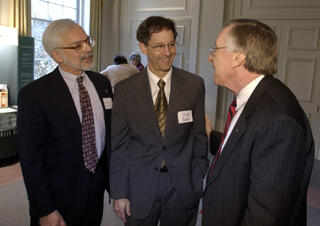
For the past 25 years, the Alzheimer’s and Related Diseases Research Award Fund, or ARDRAF, has made a huge difference in supporting medical and behavioral research into the causes and cures of dementia.
Virginia Commonwealth University leaders recently recognized the state lawmaker who introduced the original bill creating the fund. Del. Kenneth Plum, D-Fairfax, successfully sponsored the legislation creating ARDRAF during the 1982 General Assembly session.
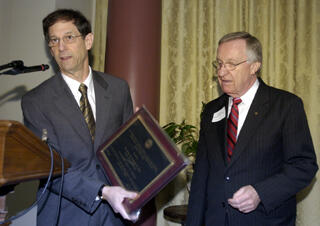
Plum was recognized Jan. 24 during the Legislative Breakfast of the Virginia Center on Aging at Virginia Commonwealth University.
Sheldon Retchin, M.D., CEO, VCU Health System and VCU vice president for Health Sciences, presented Plum with a plaque recognizing his critical role and celebrating the program.
“ARDRAF’s many practical results include clinical tools to help physicians diagnose dementia, Web-based help for family caregivers, therapeutic interventions for persons with Alzheimer’s, improved drug regimens and a search-and-rescue protocol used around the world to find lost and confused wanderers with dementia,” Retchin said.
VCU’s Virginia Center on Aging has administered ARDRAF since its inception, overseeing the application review process. To date, ARDRAF has awarded 105 small grants totaling $1.6 million, which in turn brought in over $16 million from non-Virginia sources.
Edward F. Ansello, Ph.D., director of the Virginia Center on Aging, said Virginia researchers have been quite successful in parlaying small grants into bigger pools of research money.
“The key is that Virginia researchers need pilot data, initial research results, to be successful in convincing the big resources like the federal government and foundations to award them major research grants,” he said. “ARDRAF provides state money in very small amounts — averaging about $15,000 a year — which Virginia researchers use to investigate promising leads into the causes, consequences, and treatments of dementia. With key basic findings in hand, they are often able to obtain large competitive grants from the major resources.
“The Alzheimer’s and Related Diseases Research Award Fund is the most productive, state-based initiative of its type in the country, and it all began here 25 years ago,” Ansello said.
Subscribe to VCU News
Subscribe to VCU News at newsletter.vcu.edu and receive a selection of stories, videos, photos, news clips and event listings in your inbox.