Nov. 29, 2005
VCU students team with dining services and Aramark to donate more than $10,000 to the victims of Hurricane Katrina
Share this story
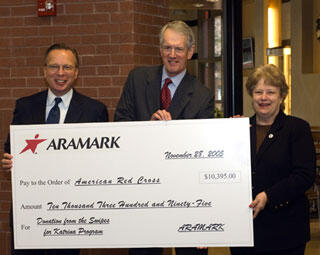
Virginia Commonwealth University and campus food service provider Aramark have presented a check to the American Red Cross on behalf of VCU students who donated more than $10,000 to provide relief to the victims of Hurricane Katrina.
VCU students turned unused meal credits into donations that totaled $10,395 between Sept. 19 and Sept. 29. The money was handed over at a ceremony on Monday.
VCU Dining Services, Aramark and the Office of the Dean of Student Affairs collaborated to set up “Swipes for Katrina.” This allowed students participating in a university meal plan to scan or swipe their pre-loaded student identification cards and make a donation as easily as they would pay for lunch or dinner. Students made donations electronically, transferring the value of meals on their university meal plan into a special fund designated for Hurricane Katrina victims. Donations were capped at five meal swipes per student.
“We are very proud of the way VCU students have responded to provide assistance during this national tragedy,” said Reuban B. Rodriguez, associate vice provost and dean of student affairs. “Before the call went out for this program, and even before the general university call for assistance, students were vigorously emailing me about how they could be a part of an effort to provide relief to the victims of Katrina.”
“Students donated as many as five of their meals from the VCU dining plan,” said Diane Reynolds, director of business services at VCU.“ The ‘Swipes for Katrina’ program was an ideal fit for our department, and we are happy to have been able to help make this donation possible.”
Students already were familiar with using their cards to pay for their meals, so transferring meal credits into donations was fairly seamless. Ed Gutauskas, Aramark’s regional operations director, said VCU and Aramark have a history of working together for common goals. He also said he was proud of the role Aramark’s employees had in the success of “Swipes for Katrina.”
“Whether it is institutional growth, community involvement, renovation of dining facilities or construction of new dining facilities, we always have the university’s goals, mission and vision in mind,” Gutauskas said. “This donation today is a perfect example of the wonderful things we can accomplish together.”
“Ten thousand dollars is so much money and will help so many people,” said Kathleen Burke Barrett, CEO, Greater Richmond Chapter of the American Red Cross. “Thank you for such a wonderful gift. Please relay to all the students our sincere gratitude. I want to thank the entire university, including the VCU Health System.”
The check was presented through VCU’s employee-directed Commonwealth of Virginia Campaign. VCU and the VCU Health System’s combined CVC is part of an annual giving program for all units of state government. Because “Swipes for Katrina” has designated the Red Cross as recipient for the contribution, the CVC will deposit 100 percent of the money donated to the Red Cross.
“VCU students have come through in a big way in their display of concern and compassion for the victims of Hurricane Katrina,” said Paul W. Timmreck, senior vice president for finance and administration, and chair of the combined VCU and VCU Health System CVC. “I also want to acknowledge the resourcefulness of VCU Business Services, Aramark and the Office of the Dean of Student Affairs who worked together to create an easy and effective process that allowed students to make a difference.”
In the aftermath of Hurricane Katrina, VCU enrolled 35 students displaced from colleges in the area damaged by the storm. Last month, employees of the VCU Health System contributed $134,000 – including a $50,000 matching donation from VCU Health System administration. University employees donated $13,000. Also in October, VCU students and others collected more than 4,400 children’s books for the residents of Moss Point, Miss.
Hurricane Katrina struck the Gulf Coast region of the United States on Aug. 29 and is considered the most expensive natural disaster in U.S. history.
Subscribe to VCU News
Subscribe to VCU News at newsletter.vcu.edu and receive a selection of stories, videos, photos, news clips and event listings in your inbox.