Aug. 7, 2026
VCUarts undergrad explores the camera as a tool of truth, perception and deception
Share this story
In today’s era of Photoshop and AI, it is increasingly common to look at a photo and ask: Am I seeing the truth? But the question has roots in the history of photography, and Emma Flory is spending the summer with her eye trained on the camera’s past as well as the present.
The rising senior at Virginia Commonwealth University, who is majoring in art education in the School of the Arts, was inspired by a photography course she took last fall. The notion of an “all-seeing eye,” and the perception of its inherent objectivity, led Flory to develop a summer research project in which she is exploring the history of the camera as an optical instrument and its relationship to impartiality.
Supported by VCU’s Undergraduate Research Opportunities Program, Flory is delving into both traditional darkroom techniques as well as digital photographic methods, examining the processes through which a photograph is made and, importantly, how it can be altered.
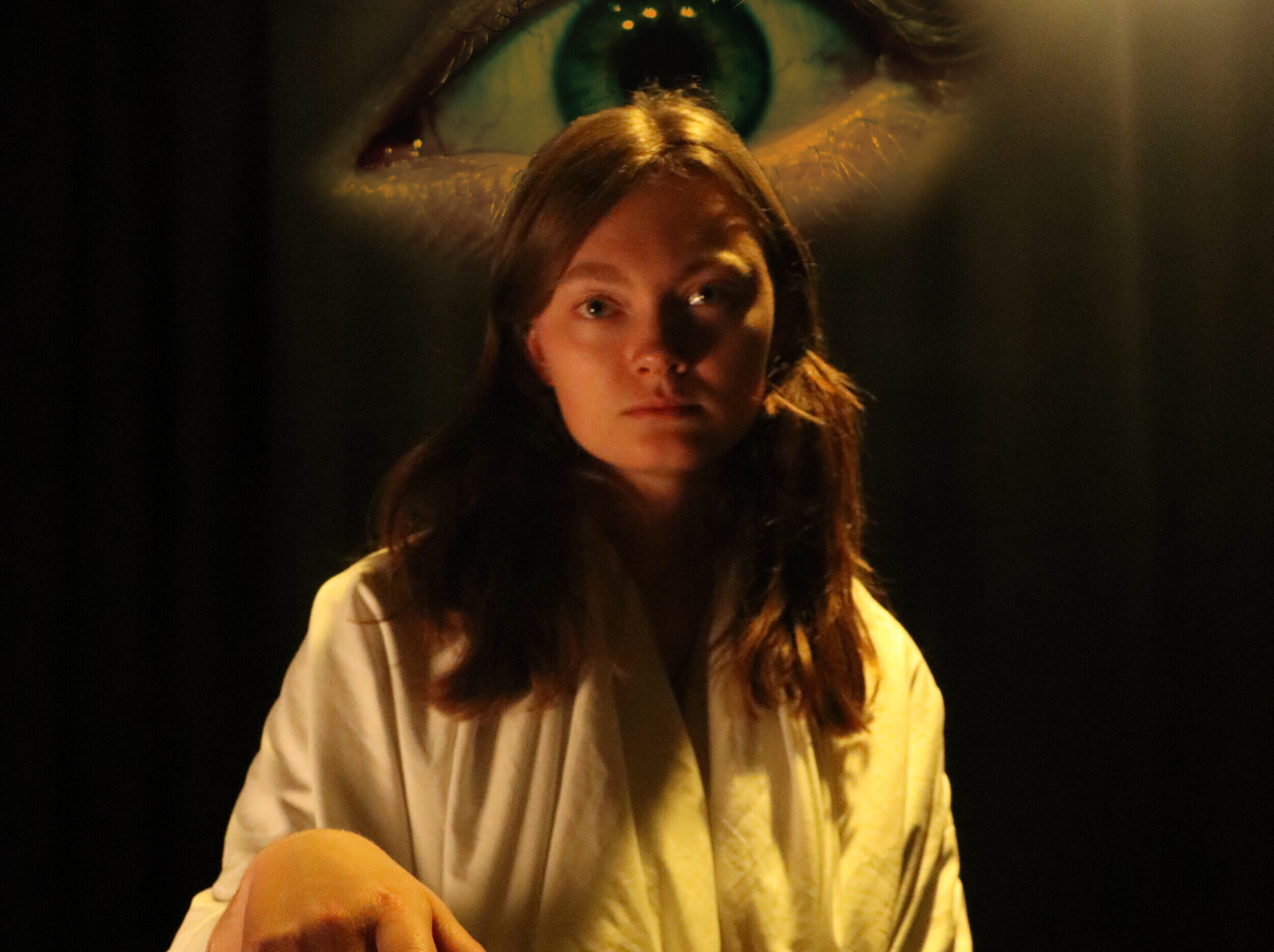
“A lot of people believe photography to be a very neutral ground, and something that only perpetuates truth,” she said. “But even before the digital camera, we had photographic manipulation,” such as 19th-century spirit photography that used double exposure to create a ghostly image. “It brings into question this idea that we want to believe in this objective source of truth, but is it really there?”
During the photography course that inspired her, Flory became interested in questions about photography, surveillance and religious institutions. One focus of her summer research is how one’s identity intersects with larger concepts of being “looked after” or “watched over,” and how these parallel notions inform our sense of how we interact with the world around us.
As part of her research, Flory has spent much of her summer exploring Richmond and snapping photos on film, including images that capture people, technologies and the tensions between them.
“There are two sides of it,” she said. “I’ve got this experimental, playful side of things – like, ‘Oh, what can I do with just the camera as is?’ – and then there’s that other part of playing with double exposures, playing with these different methods.”
Flory takes her rolls of film to the Visual Arts Center of Richmond to begin the methodical process of developing them. Each roll requires precision and patience, from carefully using chemicals to develop and fix an image to enlarging and printing the photo in the red-tinted darkroom.
Individual prints take up to 20 minutes to develop, but Flory is passionate about the process.
“Art is one of the few things that [gives us] full rein on building something new. It’s the one thing that gives humans full access to themselves,” she said. “Whether you have that perfect final image or not, the process of creation builds who you are in a way that I don’t think anything else on this planet does, and I think it’d be really unfortunate if we weren’t able to explore ourselves and experiment in those ways.”
Though Flory only recently discovered her passion for photography, she has always been enthusiastic about art. Growing up, she and her three siblings were encouraged by their mother to spend time crafting, and Flory’s interests ranged from drawing and painting to ceramics and wire sculpting.
That longtime love of art is what brought Flory to VCU; she transferred in 2025 from Northern Virginia Community College.
“When you’re a kid in Virginia, VCU is the art school,” Flory said. “I wanted to be a part of that.”
After she graduates this spring, she hopes to enroll in a master’s program with a focus on ceramics, inspired in part by lessons learned from her photography summer research project.
“The biggest takeaway that I’ve had from this experience … is this idea of slowing down and going through a specific process in order to create something,” Flory said. “Not so much looking for that final product, but playing with those steps.”
Subscribe to VCU News
Subscribe to VCU News at newsletter.vcu.edu and receive a selection of stories, videos, photos, news clips and event listings in your inbox.