April 28, 2009
VCU’s Nuclear Engineering Program 'most complete … in the commonwealth of Virginia'
Share this story
In an age where constant change is part of the culture, a quick response can be all the difference between opportunity found and opportunity lost.
The VCU School of Engineering’s response to an inquiry by Dominion three years ago about the possibility of creating a nuclear engineering program from scratch – and in a hurry! – shows what can be accomplished when opportunity calls and all hands are willing.
“We now have the most complete offering of nuclear engineering education in the commonwealth of Virginia,” said Russell D. Jamison, Ph.D., dean of the School of Engineering, speaking of the school’s unprecedented rapid rollout of nuclear engineering studies.
The growing number of programs now encompasses an undergraduate track in nuclear engineering that begins this fall, as well a new curriculum leading to a master’s degree in mechanical and nuclear engineering. Further expansion of the curriculum is anticipated, along with growing student demand.
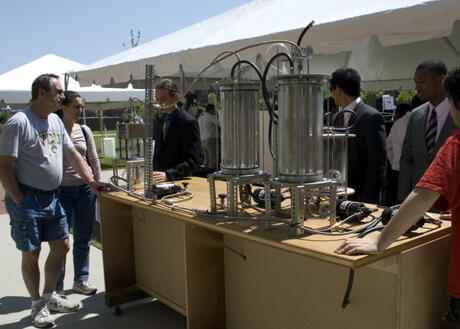
Three mechanical engineering senior design teams have, with Dominion's help, fabricated a "see-through" reactor for hands-on experience.
Perfectly safe, the reactor has an electrical core instead of a nuclear one. But in all other aspects it functions as a nuclear reactor and provides VCU students with an extraordinary new learning tool.
In a down economy, the jobs prospects for nuclear engineers are better than they have been in 30 years. The American Nuclear Society has estimated that 700 nuclear engineers need to graduate every year to support the potential demand, as current nuclear engineers retire and more nuclear power stations are built.
That message has already hit home resoundingly with VCU engineering students.
When the School of Engineering sampled its freshman class in mechanical engineering and asked how many would join if a nuclear engineering degree program were offered in the fall of 2009, it was stunned by the response.
“Forty percent said they would join,” remarked Mohamed Gad-el-Hak, Ph.D., chair of the Department of Mechanical Engineering.
No one yet knows how many students will actually appear this fall, but School of Engineering officials are setting modest enrollment goals.
“We say 10 will join this year, 15 the year after that, then 20 … growth will be slow. We’re hopeful it eventually will grow to 100 students,” Gad-el-Hak said.
To facilitate the growth of its nuclear engineering programs, VCU is hiring two nuclear engineers this year. Plans call for hiring an additional two next year, and then one more after that.
Meanwhile, Dominion – VCU’s partner in creating nuclear studies programs – has already enrolled employees from three different sites in the current master’s track in nuclear engineering.
Dominion employee Ross Anderson, who holds a Ph.D. in nuclear engineering and is among the teachers in the nuclear studies program, said about half of the students enrolled in the master’s track program are at remote locations and attend class through a video hook-up. Engineering School officials say more than 30 students are enrolled in the evening nuclear graduate program.
Matthew Heartwell, who has worked for Dominion for two years in project design, is among VCU’s new nuclear engineering students.
“I think nuclear is going to solve our energy crisis,” Heartwell said.
He and the other participating Dominion employees want to be among the first in line when their company begins expanding in the nuclear field. Dominion already is one of the nation’s largest nuclear operators with seven nuclear units in three states, including two units each at the North Anna and Surry power stations in Virginia.
Dominion has applied to the U.S. Nuclear Regulatory Commission to build an additional unit at North Anna. Although nothing is certain, if Dominion does build an additional nuclear unit at North Anna about 750 positions will be created, according to a Dominion spokesman.
In 2008, nuclear power stations at Surry and North Anna accounted for 41 percent of the electricity consumed by Dominion customers in Virginia. Nationally, about 20 percent of electricity comes from nuclear power.
A recent article in the Richmond Times-Dispatch noted that officials in the administration of Virginia Gov. Timothy M. Kaine consider nuclear power green, largely because nuclear power plants don’t release greenhouse gases.
Kaine was more emphatic about his position in heralding a recent partnership between AREVA, a mammoth French nuclear company, and Northrop Grumman Shipbuilding to invest $363 million and create 540 jobs at a new 368,000-square-foot nuclear reactor manufacturing plant in Newport News.
“Emission-free nuclear energy produced in the United States is a positive step toward reducing greenhouse gases and reducing our dependence on foreign oil,” Kaine said.
Gad-el-Hak said the governor’s support of nuclear power – combined with the support of VCU President Eugene P. Trani and other university officials – energizes School of Engineering faculty members who have been guiding the development of nuclear engineering studies.
“It’s a fire in our bellies,” Gad-el-Hak said.
Subscribe to VCU News
Subscribe to VCU News at newsletter.vcu.edu and receive a selection of stories, videos, photos, news clips and event listings in your inbox.