Oct. 28, 2011
Alumni Star Speaks to Medical Students About Global Health
Share this story
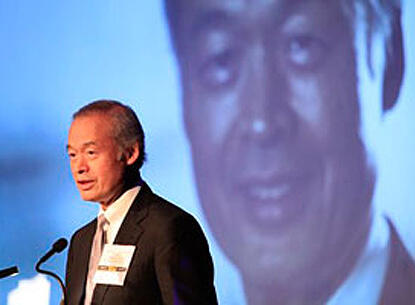
Dr. Tadataka "Tachi" Yamada, who completed his residency in internal medicine at VCU in 1974, returned to campus last week to connect with current students and to discuss his passion for global health.
Yamada, who was in Richmond to be honored as one VCU’s newest Alumni Stars, told School of Medicine students, internal medicine residents and faculty that he was happy to return to the MCV Campus, where, he said, he learned to be a physician. He praised the great discoveries that have been made at VCU, though he noted that many of those advances are not available to much of the developing world.
And with that, Yamada, the past president of the Bill & Melinda Gates Foundation Global Health Program, launched into a discussion of how students can apply their medical educations to solve global health concerns.
"We have to have great advances in science, systems and thinking, and you have to be the engine that drives the innovation in health care," Yamada said.
In addition to encouraging students to develop innovative solutions, Yamada shared four key lessons he learned from leading the Gates Global Health Foundation that students can apply to build successful medical careers.
First, he said, health care professionals must work with a sense of urgency for curing global health epidemics.
"Seven million children under the age of 7 die each year from preventable illnesses. The sense of urgency is very real," he said.
He used the example of the Gates Foundation recognizing the 350 million people who suffer from malaria and setting a goal to eradicate the disease. Though other scientists have created mathematical models to show that it is impossible to eliminate malaria completely, the Gates Foundation believed differently. The foundation invested $1.5 billion in a vaccine, and the 14-year-old organization is already saving millions of lives.
"We can create ambitious goals," Yamada told students, encouraging them to look for solutions that improve the lives of patients worldwide.
Second, Yamada told students, doctors and scientists can't resolve problems the traditional way. He called for revolutionary innovation, which he described as thinking about something completely differently than the traditional way.
To inspire what he calls an ecosystem that supports innovation, the Gates Foundation provided grants to scientists looking for new ways to eliminate malaria. One submission included an idea to create an electrical field between two posts that kills mosquitos by lasers. "I saw it," Yamada said, telling students of the innovation. "I've got to say that there's nothing so satisfying as watching a mosquito explode in midair."
Third, Yamada explained, measurement in global health is essential to success. He told the students a former colleague was fond of saying, "If you're not keeping score, you're just practicing." Yamada said doctors and scientists are not making the right kind of impact when they are not tracking the success of their work.
Fourth, doctors must work in partnerships to make great accomplishments. Yamada told a personal story of his involvement in stopping the spread of meningitis in central Africa, where it causes painful deaths for thousands of Africans each year. Yamada went to Burkina Faso to be part of the launch of a vaccine to prevent meningitis and witnessed the great partnership between several organizations that brought the vaccine to reality.
"I gave a 7-year-old girl a shot, and she had a big smile on her face,” Yamada said. “I thought, 'That's why I wanted to go into medicine.' The young girl was excited about preserving her health and creating a future for herself."
Yamada, who completed residency training on the MCV Campus, is now executive vice president of Takeda Pharmaceutical Co. Ltd.
Subscribe to VCU News
Subscribe to VCU News at newsletter.vcu.edu and receive a selection of stories, videos, photos, news clips and event listings in your inbox.