Sept. 26, 2007
Ancient art of Maya weaving comes to the Anderson Gallery
Share this story
University News Services
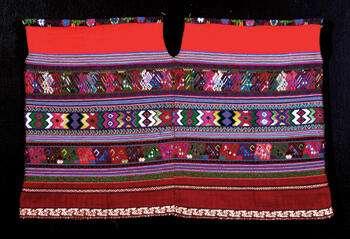
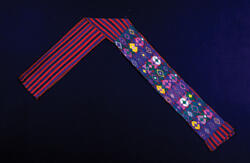
The fall exhibition at the VCUarts Anderson Gallery, “Ixchel’s Thread: Maya Weavings from the Bowdler Collection,” showcases the ancient art of Maya weaving as it has been practiced in Guatemala for centuries and still perseveres today.
The exhibition opens with a reception from 5-7 p.m. on Sept. 28 at the Anderson Gallery and continues until Dec. 9. Prior to the reception, Ann Pollard Rowe, curator of Western Hemisphere Collections at the Textile Museum in Washington, D.C., will deliver a lecture at 4 p.m. at the Grace Street Theater, 934 W. Grace Street, on “Weaving Lives and Destinies: Women’s Costumes from Chimaltenango, Guatemala.” The presentation traces the changes in indigenous women’s costumes over the past century. Both the reception and lecture are free and open to the public.
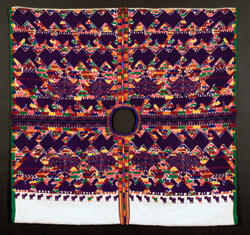
The centerpiece of the Anderson Gallery exhibition is a selection of the Maya textiles donated to the Anderson Gallery in 2000 by William and Peggy Bowdler. The Bowdler Textile Collection includes an impressive array of textiles ranging from belts and sashes to complete outfits. The pieces, which William Bowdler amassed during his tenure as U.S. Ambassador to Guatemala, combine techniques and designs from traditional Maya, Spanish colonial and modern Latin American cultures. Among them are approximately 35 elaborately woven and decorated huipils, the classic Maya women’s formal wear.
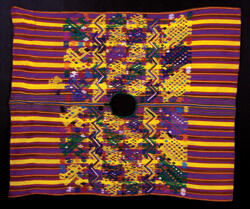
“The beauty of some of this work is just unbelievable,” said Linda Lee, an assistant professor in the VCU Department of Fashion Design & Merchandising and one of the co-curators of the exhibition. “I hope it is something that really captures everyone’s imagination.”
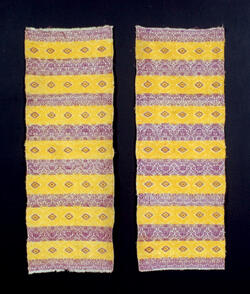
The exhibition focuses on the historic legacy of weaving and textiles in ancient and contemporary Maya communities, and the significant role that Maya women have historically played in sustaining this deeply rooted tradition. Exhibited items reflect artistic and technical practices and influences that can be traced back at least 2,000 years in the Maya past and are still used in contemporary Maya weavings.
Also featured in the exhibition is the work of VCU fashion and merchandising students participating in the “Darla Luz” project. Led by Lee, the students are working directly with Maya artisan weavers to develop a clothing line to market in the U.S. VCU TV/HD has produced a film documenting the students’ experience during their two-week trip this summer to Guatemala for the project. The film will be shown as part of the exhibition.
In addition, Domitila Curuchich, a master weaver from Guatemala, will demonstrate ancestral weaving techniques in the gallery during the month of October and will produce a garment on site with traditional designs still used in modern fashion design.
The co-curators of the exhibition are Lee, James Farmer, associate professor and chair of the VCU Department of Art History, and R. McKenna Brown, professor and director of the VCU School of World Studies.
VCUarts Anderson Gallery is free and open to the public. Gallery hours are: Monday-Friday, 10 a.m.-5 p.m., and Saturday-Sunday, 1-5 p.m. For more information, call 804-828-1522 or visit http://www.vcu.edu/arts/gallery.
Subscribe to VCU News
Subscribe to VCU News at newsletter.vcu.edu and receive a selection of stories, videos, photos, news clips and event listings in your inbox.