Feb. 19, 2003
Bowlin gets grants to continue work on tissue engineering
Share this story
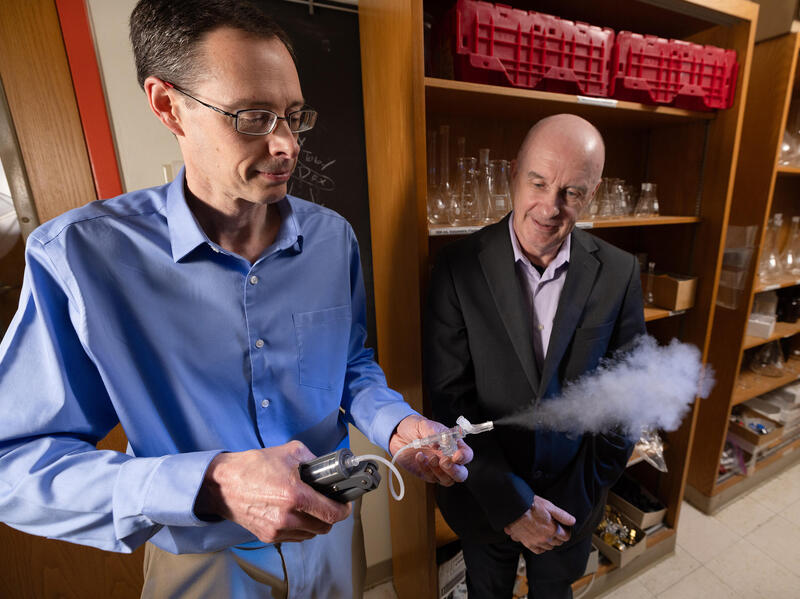
Gary L. Bowlin, Ph.D., associate professor of biomedical engineering, has received grants totaling more than $100,000 to continue his innovative research into the electrospinning of collagen nanofibers and other components that one day could be used to replace damaged blood vessels and other tissues and organs in the human body.
Bowlin received $80,000 from the Whitaker Foundation for his research project, "Biomimicking, Small Caliber Vascular Construct Engineering." The latest award brings to almost $300,000 the amount that the Whitaker Foundation has invested over the past three years to support Bowlin's research into technology to produce a natural human blood vessel grown around a scaffold, or tube, made of the human protein, collagen. Unlike current synthetic blood vessels made of plastic, collagen is a natural component of the body which gives strength and flexibility to tissues and organs. Cells tend to grow on the surface of collagen tubes, limiting rejection common with plastic blood vessels.
The Whitaker Foundation, headquartered in Arlington, VA, was established by Pennsylvania engineer U.A. Whitaker to support biomedical engineering research. Whitaker was the founder and CEO of AMP Inc., the world's leading brand of electrical and electronic connectors.
Bowlin also received a $25,000 grant from the Jeffress Memorial Trust for his research on electrospinning elastin, another natural protein found in the body that gives elasticity to tissues and organs. Elastin is found predominantly in the walls of arteries, lungs intestines and skin. It functions in connective tissue in partnership with collagen.
The Jeffress Memorial Trust was established under the will of Richmond business executive and philanthropist Robert M. Jeffress to support scientific research in Virginia, primarily in the areas of chemistry, physics, biology, biochemistry and microbiology.
Subscribe to VCU News
Subscribe to VCU News at newsletter.vcu.edu and receive a selection of stories, videos, photos, news clips and event listings in your inbox.