July 30, 2012
VCU chemistry department offers research opportunity for undergraduates from China
Share this story
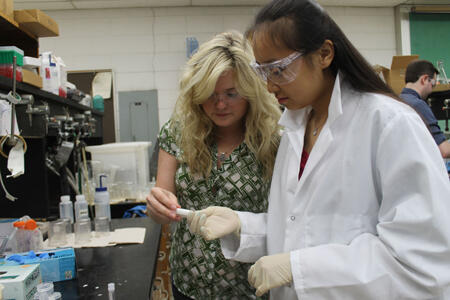
Virginia Commonwealth University’s Department of Chemistry is hosting four undergraduate students from Fudan University to participate in research related to nanoscience, material science and chemical biology as part of the VCU-Fudan Summer Chemistry Program.
The program is part of VCU’s ongoing strategic partnership with Fudan University and aims to provide undergraduate students with a firsthand perspective of how research is conducted in an American lab and to compare that to research conducted in China.
The students were selected through a competitive process and received financial support to conduct lab research at VCU.
“We know that Fudan University wants to provide unique opportunities to its students at the undergraduate level and this program does that,” said Nick Farrell, Ph.D., professor of chemistry in the College of Humanities and Sciences and program coordinator. “The experience of being in an American lab can increase their ability to get into graduate school in China and may even influence whether they decide to pursue graduate study in the U.S., in China, or at all.”
M. Samy El-Shall, Ph.D., professor of chemistry in the College of Humanities and Sciences and Jefferson Science Fellow with the U.S. State Department, is supervising two of the students’ research.
“As undergraduates, these students are very impressive,” said El-Shall. “They are functioning almost as graduate students and this is obvious in their research.”
The students are currently conducting research that focuses on innovative ways to create nanoparticle catalysts, materials that can be useful in such applications as removal of contaminants from air and water.
Hani El-Kaderi, Ph.D., assistant professor of chemistry at VCU, and his exchange student are working to design new generation materials for energy storage and carbon dioxide capture, and Ashton Cropp, Ph.D., associate professor of chemistry, and his student are working on site specific incorporation of isotopically labeled amino acids to probe small molecule binding sites on proteins.
“The biggest difference is what we are able to study,” said Sen Ye, one of the exchange students.
“I’ve studied the creation of catalysts when I was in China, but here, we’re studying a whole new method of making these nanoparticles.”
Another difference cited by the students is the emphasis that U.S. labs place on safety.
“We went through an entire week of safety training before we were allowed to begin research,” said Fang Di, one of the exchange students.
The students will spend eight weeks in the U.S. before returning to China. This is the second year that undergraduate students have participated in the summer program.
About VCU and the VCU Medical Center: Virginia Commonwealth University is a major, urban public research university with national and international rankings in sponsored research. Located in downtown Richmond, VCU enrolls more than 31,000 students in 222 degree and certificate programs in the arts, sciences and humanities. Sixty-six of the programs are unique in Virginia, many of them crossing the disciplines of VCU’s 13 schools and one college. MCV Hospitals and the health sciences schools of Virginia Commonwealth University compose the VCU Medical Center, one of the nation’s leading academic medical centers. For more, see www.vcu.edu
Subscribe to VCU News
Subscribe to VCU News at newsletter.vcu.edu and receive a selection of stories, videos, photos, news clips and event listings in your inbox.