Oct. 9, 2002
Fenn charms well-wishers at Trani Center event
Share this story
John B. Fenn says there’s a very simple reason why he left Yale University and came to VCU in 1994 to continue the revolutionary research on analyzing biomolecules that earned him the 2002 Nobel Prize in chemistry.
“VCU gave me a laboratory when Yale wouldn’t,” Fenn, Ph.D., told a cheering crowd of faculty, students, VCU board members and others at a news conference celebrating his award at the Trani Center for Life Sciences. “I’m very grateful to the institution.”
Fenn, 85, said he still was asleep today (Oct. 9, 2002) when his wife answered a ringing telephone at 5:30 a.m.
“Here’s the telephone,” Fenn said she told him. “It’s Stockholm calling.”
The Royal Swedish Academy of Sciences calls Nobel Prize winners early on the day awards are given.
A humble, yet clearly delighted Fenn said it was easy to describe his reaction to news that he had been chosen to share this year’s chemistry prize with two chemists from Japan and Switzerland: “Shock. Disbelief. I still find it hard to believe. Look at how many good scientists there are in the world, and lightning strikes in very few places. I still think I’m going to wake up from this. “
Fenn was honored for his work on a method that allows researchers to “weigh” large biological molecules, such as proteins, by extracting protein ions from charged droplets of protein solution and causing the ions to move. The first results of his work were evident in 1983 and published five years later while he was a professor of chemical engineering at Yale. “In 1988, we showed that you could make big molecules have wings and fly – equivalent to making an elephant fly,” he said.
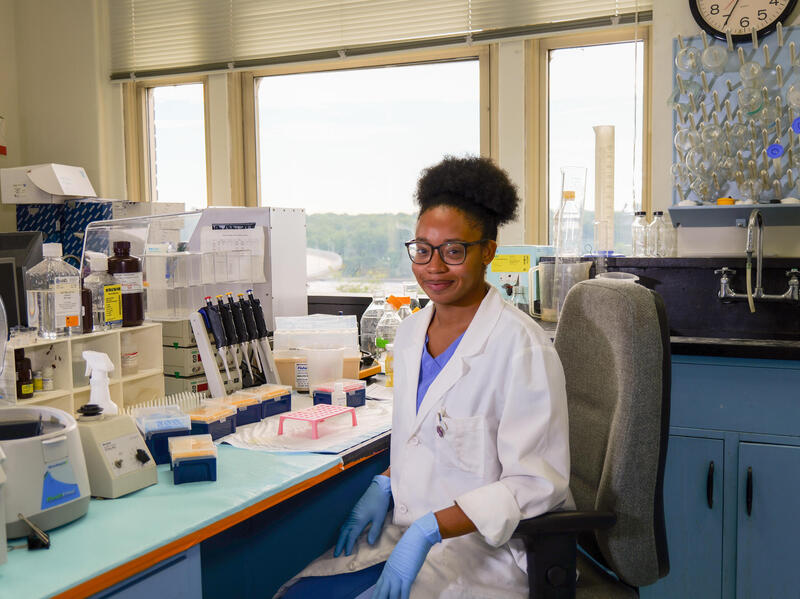
Fenn has continued his research at VCU since 1994, using a modest laboratory on the third floor of Oliver Hall on the Academic Campus and working closely with graduate students.
VCU’s Department of Chemistry took only a few hours to find him lab space eight years ago when he casually told a former colleague and VCU faculty member one morning that he had been asked to leave his lab space at Yale and wondered whether VCU had any labs available for him. “By the afternoon she had talked to the department and said, “When can you come?”
“I always found it (Department of Chemistry) to be a very collegial group,” Fenn said.
Fenn was effusive in his thanks to the capacity crowd at the Trani Center for sharing his good news. He was especially appreciative of the students.
“It’s been a great joy for me to come down here every day and work with young people,” said Fenn, who usually rides a bicycle to VCU from his Richmond home and easily takes the stairs to his lab. “We old people are like vampires. We come down here and suck the blood of young students. It’s how we go on!”
VCU President Eugene P. Trani, Ph.D., thanked Fenn for his contributions to VCU. “We’re all gratified with the recognition by the Nobel Prize committee. It’s a great honor that he’s a member of the faculty at Virginia Commonwealth University.”
About the VCU Department of Chemistry
VCU research professor Dr. John Fenn is the recipient of the 2002 Nobel Prize for Chemistry. He represents a faculty with active, funded programs that stretch traditional research and course offerings to cover an exciting array of interdisciplinary research areas including the synthesis and characterization of novel materials, nanostructures and clusters, forensic science, environmental science, and the university-wide initiative in the Life Sciences. Active collaborations between research groups in this department and The Massey Cancer Center, Basic Health Science Departments in the VCU School of Medicine, the School of Engineering, the School of Pharmacy, and the Center for Environmental Studies enrich the research opportunities of our graduate students. The faculty and students of this department provide a diverse cultural, racial, and ethnic mix that enhances the inclusive climate of this department.
Subscribe to VCU News
Subscribe to VCU News at newsletter.vcu.edu and receive a selection of stories, videos, photos, news clips and event listings in your inbox.