Jan. 25, 2006
Forensic science/biology professor wins forensic DNA research and development grant
Share this story
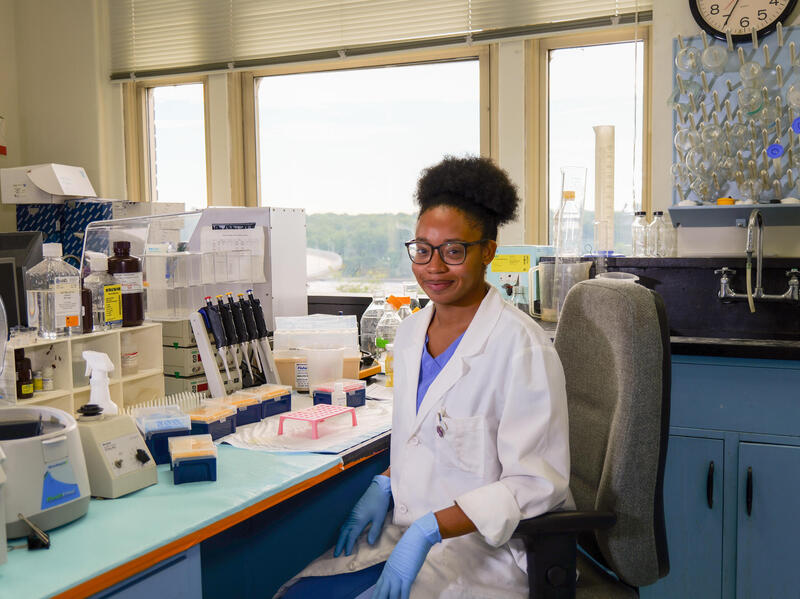
A VCU professor with a joint appointment to the departments of forensic science and biology has received a grant from the National Institute of Justice — the research and development arm of the U.S. Department of Justice — to study forensic DNA.
Tracey Dawson Cruz, Ph.D., will use the funds to research ways to improve techniques for evaluating low-level DNA samples.
“We call it trace DNA or touch DNA,” Dawson Cruz said, explaining that low-level samples are used to create a partial DNA profile of a subject. Such partial profiles can be particularly useful at crime scenes that lack tangible clues.
“Normally, on a crime scene, you’re thinking there’s some kind of obvious biological fluid” such as blood or semen, Dawson Cruz said. But such palpable clues often are not so forthcoming.
Dawson Cruz described a scenario where trace DNA can be useful: “Here they have been in a room and touched a desk. They have not left any overt fluids behind. But [people] shed cells all the time. Those shed cells — there’s not something obvious on the scene, but you suspect the person came in touch with something peripherally.”
Unfortunately, in many criminal cases, if there’s not enough DNA to give a full profile of a suspect, there’s not enough information for a jury to convict.
“The existing technologies are OK in some cases – but not enough,” Dawson Cruz said. And that’s where her project, “Development and Evaluation of a Whole Genome Amplification Method for Accurate Multiplex STR Genotyping of Compromised Forensic Casework Samples,” comes into play. “The grant is for working on optimization; getting them — these techniques — to work well enough on these samples,” she said.
The two-year, $225,000 award, which is the forensic science department’s first grant, represents a coup for both the university and department, which was officially formed in 2005.
“It shows that the Department of Forensic Science is maturing into a full department,” said William Eggleston Jr., Ph.D., department chairman. “It’s another opportunity to train students in forensic science on campus.”
That research will build on the strong relationship that the forensic science department has always had a with the Virginia Department of Forensic Science — the state’s crime lab.
“For the first time, there’s a formal research collaboration between this university and the state labs,” Dawson Cruz said. “The missing link was the research link and now we have that.”
Subscribe to VCU News
Subscribe to VCU News at newsletter.vcu.edu and receive a selection of stories, videos, photos, news clips and event listings in your inbox.