Jan. 23, 2026
Former Pamunkey Chief Robert Gray shares experience in new VCU residency
Share this story
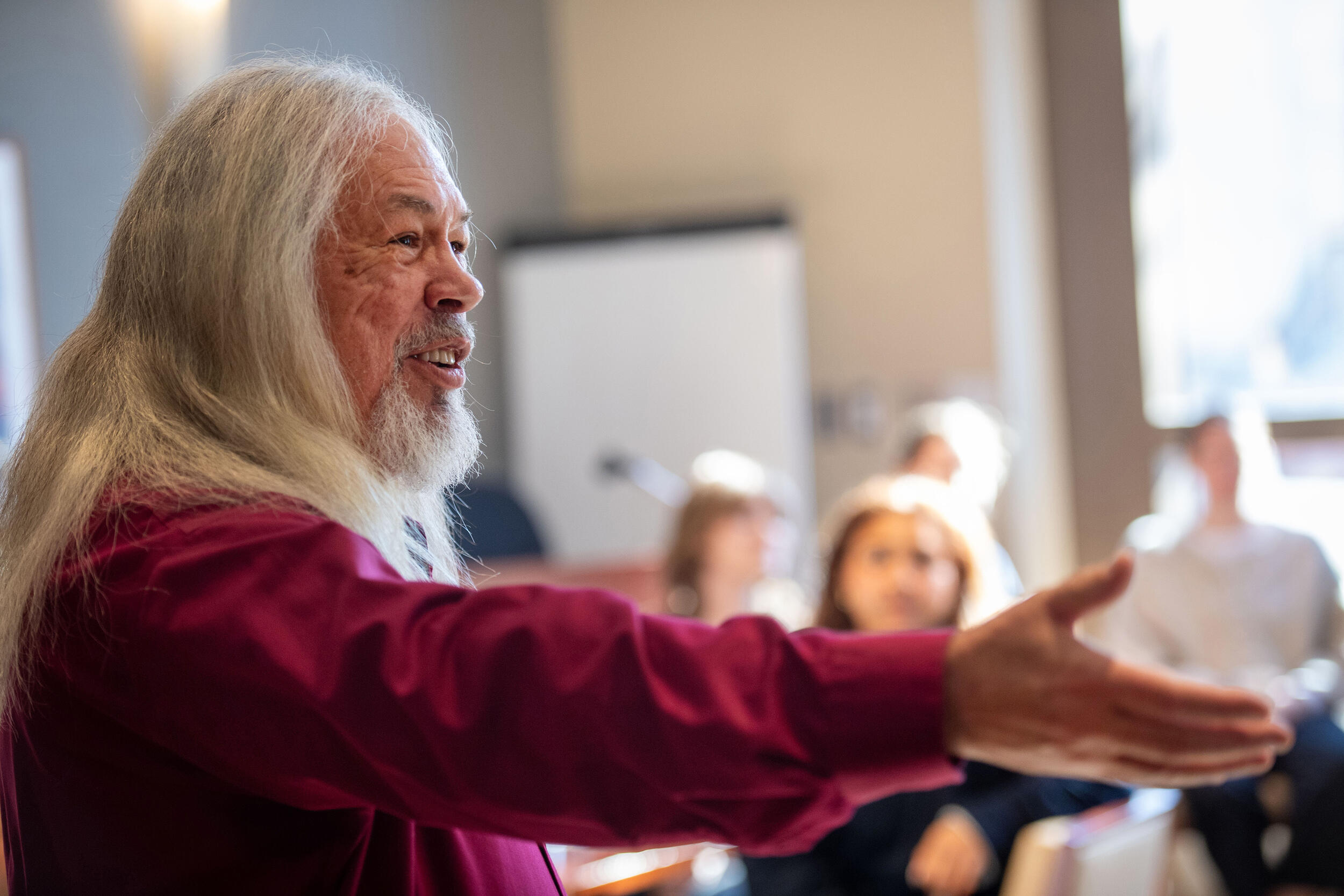
Virginia Commonwealth University recently welcomed former Pamunkey Indian Tribe Chief Robert Gray to campus as part of a new residency program that spotlights Indigenous knowledge.
Gray, who was chief of the Virginia tribe from 2015 to 2024, is VCU’s first Indigenous Elder in Residence, a program from the Humanities Research Center as part of its On Native Ground initiative. In 2021, the initiative was launched to put Indigenous histories into focus and to work with local tribes in establishing a network for Native communities and scholarship at VCU.
Each spring semester, the residency will bring nationally renowned Indigenous elders to VCU to create “a unique space where Indigenous knowledge systems and traditions can be learned alongside Western academic approaches,” said Cristina Stanciu, Ph.D., director of the HRC and professor in the Department of English in the College of Humanities and Sciences.
“By centering the wisdom and life experiences of Indigenous elders, we’re facilitating conversations about critical topics including Indigenous traditions, arts, storytelling, federal recognition, sovereignty, health and well-being, and the ongoing impacts of colonization,” she said.
For almost 40 years, Gray has lived with his family on the Pamunkey Indian Reservation, located along the Pamunkey River adjacent to King William County, about 40 miles east of Richmond.
He said coming to VCU is an opportunity to “[share] ideas and experiences that can benefit everyone, including me. I may be an elder, but I can still learn from VCU students, and I want that opportunity.”
In addition to serving the tribe in a number of roles, Gray spent six years in the Air Force, later taking a position with the Richmond-based Virginia Air National Guard. After 32 years of military service, he retired at the Air Force’s highest enlisted rank of chief master sergeant. Following his retirement, he worked in the Air Force Civilian Service at Joint Base Langley-Eustis in Hampton, followed by a stint at the National Guard Bureau at Joint Base Andrews in Maryland.
The residency kicked off Jan. 21 with a welcome reception hosted by the Department of History in the College of Humanities and Sciences. At the gathering, Gray answered questions and shared his desire to dispel stereotypes about Indigenous people.
Throughout his time on campus, Gray will visit classrooms; meet with students, faculty and staff individually and in group settings; and deliver a public talk. He considers the residency an opportunity to build a mutually beneficial relationship between Virginia Native Americans and VCU, one he would like to see other universities emulate.
“This is a rare chance to learn directly from someone with deep cultural knowledge and lived experience,” Stanciu said. “Students should approach these interactions with respect, asking thoughtful questions and being willing to listen and reflect. Those interested in Indigenous studies, community engagement, health and environmental issues will find particularly rich connections, but the program is designed to benefit the entire campus community.”
In 2022, the One VCU Land Acknowledgement Task Force was created in part to identify ways to build meaningful relationships with all 11 state-recognized tribal nations. Among its suggestions was a universitywide land acknowledgement, which was formally adopted by the Board of Visitors in 2024. The acknowledgement highlights the centrality of Indigenous peoples, their contributions and their ongoing presence on the land VCU calls home.
In 2025, the HRC and the College of Humanities and Sciences partnered to expand VCU's Indigenous humanities efforts through development of the Indigenous Humanities Lab. Supported by an 18-month, $150,000 grant from the Mellon Foundation, the lab has three co-directors, including Stanciu, Christina Davis, M.Ed., an academic advisor and instructor in the Interdisciplinary Studies Program in University College, and Sarah Montoya, Ph.D., a Mellon postdoctoral fellow at the HRC. The grant was written by Stanciu and Catherine Ingrassia, Ph.D., dean of the college.
Subscribe to VCU News
Subscribe to VCU News at newsletter.vcu.edu and receive a selection of stories, videos, photos, news clips and event listings in your inbox.