Nov. 12, 2003
High School students enjoy front row seat during surgery
Share this story
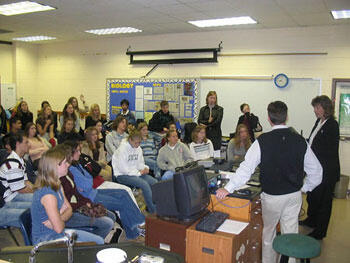
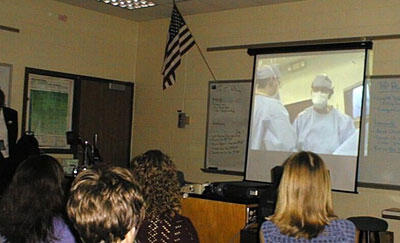
About 40 Chesterfield County math and science students recently had a doctor's-eye view during a gall bladder surgery at the VCU Medical Center...but they were nowhere near the operating room. Thanks to a high-speed Internet connection and some fancy equipment provided by VCU's Medical Informatics and Technology Application Consortium (MITAC), the students were able to view the surgery from their science classroom at Clover Hill High School, some 20 miles away.
Not only did students have a clear view of the operation as Dr. Ronald Merrell, a general surgeon at VCU and director of MITAC, removed the gall bladder, the two-way connection also enabled them to ask Merrell questions as he worked.
"They [the students] even clapped when the gall bladder came out," said Debbie Justis, clinical coordinator of the telemedicine program at VCU. "They really got into it."
Telemedicine is used for teaching and long-distance patient care. In recent years, VCU has set up telemedicine links across the globe in places like Ecuador and Russia, but the demonstration for students at Clover Hill this month marked the first time the technology has been taken into a school.
"Showing off the latest medical communication technology and surgical techniques to the next generation of doctors, nurses and computer professionals provided a great introduction to the variety of careers available in medicine," said Justis who, as a nurse, is always quick to share her role in telemedicine with people who think a career in nursing doesn't offer access to technology.
During the 20-minute operation, students sat in a darkened room watching projected images of the surgery dance in real-time on a pull-down screen. Following the surgery, Justis and Brett Harnett, director of experimental information technology with the NASA Research Partnership Center at VCU answered questions for almost an hour.

They asked great questions," said Harnett. "One of my favorites was whether this technology would one day replace doctors...not likely. The goal is to improve capability and ultimately health care for more people."
The entire demonstration would not have been possible, however, without the help of freshman, Elizabeth Peek, who interned with Justis this summer.
"I told my science teacher about my internship and how they [the telemedicine staff] were wanting to set up a demonstration in a school. No text book can capture what we saw today," said Peek, who hopes to become a physician or biomedical engineer.
As the surgery concluded, Merrell urged students to come take his place.
"I'll be retiring in a few years and this can be your operating room
one day," he said.
Subscribe to VCU News
Subscribe to VCU News at newsletter.vcu.edu and receive a selection of stories, videos, photos, news clips and event listings in your inbox.