July 28, 2006
Husband-wife faculty members return from rocket-riddled Israeli city
Share this story
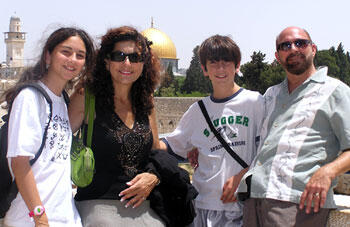
Michael Van Slyck and his family's departure from one of the world's most conflict-filled regions was quite timely.
Van Slyck, a Virginia Commonwealth University psychology associate professor, spent an educational leave of absence in Haifa, Israel, working to renew a study-abroad relationship between VCU and Israeli universities, including the University of Haifa.
He pursued the opportunity with his wife, Marilyn Stern, a VCU psychology professor with a joint appointment in pediatrics, who took a research leave of absence for a Fulbright Fellowship to study in Israel. While at the University of Haifa, Stern conducted research on adolescent cancer patients. The couple lived in Haifa for the six-month period with their children.
They arrived in January and were set to depart July 12. Since their early flight required them to leave about 4 a.m., Van Slyck stayed up all night packing.
"I had one of the cable news networks on and the windows open and all of a sudden I heard boom. Boom, boom, boom, boom! And I just knew this wasn't fireworks," he said.
They left Israel without knowing what was happening. It was only after arriving in London that they learned the explosions were part of the Hezbollah incursion and Israeli military response.
Van Slyck and Stern, who have followed the conflict closely since returning home, said watching network correspondents report from areas where they have lived and worked is surreal.
"We are frankly in a state of shock over what is happening. The idea that rockets have landed in Haifa — where we just spent six months with our two children — is still hard to believe," Stern said.
Her husband agreed.
"It's impossible to describe the feeling," he said. "You were there and know all of these people and places and you wonder what it would be like being there now. And there is a lingering sense of guilt."
While the family is unwavering in its support of Israel, it opposes the loss of innocent life on either side of the conflict, Van Slyck said.
This was the couple's fifth professional trip to Israel in 12 years. Their trips allow Van Slyck to research social conflict and conflict management in an area of the world that has seen more than its share of both.
Van Slyck met with University of Haifa leaders to promote VCU's Summer Study Abroad Program, which would allow VCU students to earn credit through summer courses in Israel.
"I was working to set the stage — to find out if it is possible," Van Slyck said, adding that he and Stern would like to teach some of the courses as part of this program.
"My course would be on conflict, focusing on the impact of living in, and growing up in, an area of ongoing conflict." He envisions a program where academic training, including lectures and seminars in the classroom, would be supplemented with field experience.
"I would take the students out into the cities and towns across Israel to actually see the people who are living in conflict," he said.
Stern, meanwhile, is developing a similar blend of academics and field experience in a course about disparities in health care.
During the most recent trip, Van Slyck worked on a project that will allow him to study attitudes toward conflict across international and cultural boundaries. A survey he developed to gauge opinions on conflict can help people understand conflict and come up with better ways to solve disagreements. He would like to use his surveys as a teaching tool.
"I'd like to survey students at the beginning and end of the course to measure how much their views on conflict have changed and grown," he said. "I want my work to have practical value."
Subscribe to VCU News
Subscribe to VCU News at newsletter.vcu.edu and receive a selection of stories, videos, photos, news clips and event listings in your inbox.