April 17, 2008
Interior Design Department preparing students for professional success
Share this story
A new visitor to a lab in VCU’s Department of Interior Design is briefly met with polite smiles before the rows of faces return to their computer monitors. Nobody is surfing the Internet or e-mailing friends. Each student is simply locked into the latest project on their screen.
Sharran Parkinson, Ph.D., chair of Interior Design at
VCU, uses words like “rigorous” and “demanding” to describe the
curriculum in the Interior Design program. The hard work has paid off.
The department was ranked in three categories this year in
DesignIntelligence’s annual publication, America’s Best Architecture
and Design Schools. The graduate interior design program was ranked No.
4 by regional firms of schools in the South and No. 6 by national
firms, and the undergraduate program was ranked No. 5 by regional firms
in the South.
Parkinson said the recognition was rewarding,
particularly coming from professional design firms. She said it
illustrated the department’s success in teaching students professional
skills and in integrating high-tech advances in design with the
traditional hand-drawn techniques that have long been in favor.

Parkinson
said the department is blessed with dedicated faculty members that put
an emphasis on the academic aspect of the study of interior design, but
who also keep students focused on the practical implications of their
work.
“We expect our students to be just as devoted as we are,”
Parkinson said. “And the students here are very serious and very
engaged in what they do. If you don’t want to be challenged, it’s not a
good place to be.”
Zach Becker, a junior, said he appreciates
his instructors’ desire to push their students. He points to one of the
first classes he took in the department, a drafting class taught by
Camden Whitehead, an associate professor of interior design, as an
inspiration for him – a difficult but fulfilling experience that
convinced him to pursue an interior design degree.
“He really
made us think hard about things in a way that I hadn’t had to think
before,” Becker said. “He made a point of taking us out of our comfort
zone, and I really liked that.”
Parkinson and her colleagues
have made it a priority to help students acquire more professional
experience during their time in college, whether it’s working directly
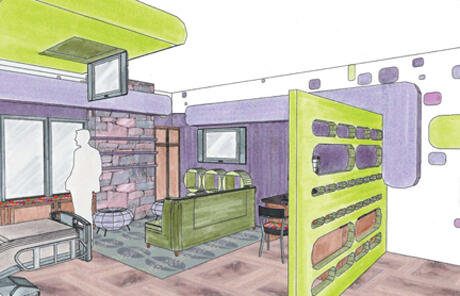
with firms or designing projects for competitions. The projects cover a
wide range, including such contrasting settings as a hospital patient’s
room and a toll booth.
“It’s an important way for students to
understand the potential of the field,” Parkinson said. “It gives them
a lot of self-confidence and really teaches them how to be
professionals. It’s critical for that transition from college.”
It helps that faculty members have connections in the design community and that many are still active in professional design.

“They
don’t sugarcoat what the real world is like,” said Philippe Raoust, a
sophomore. “They prepare you for it. I think you get a good sense of
what it’s going to be like because so many of the faculty are still
attached to it.”
A particular program that has provided students
with professional opportunities is Inverse Function, an internship
collaboration with professional firms in the Northern
Virginia/Washington, D.C., area. Students serve internships at the
firms during the day, actively contributing to projects, and then stay
for lessons taught in the evening by professionals at the firms.
“Teaching
the students relieves the normal daily stress the professionals are
used to and gets them to have some fun again with design,” said Kevin
Wyllie, assistant professor of interior design, who coordinates Inverse
Function. “And, of course, it’s great for the students. It changes
their perception of the professional design world. They learn more
about the realities of the work – things like deadlines and the cost of
production.”
The ultimate goal with both real-world and academic
lessons is to steel students to be unbowed by difficult assignments,
eager to confront complexities instead of looking to avoid them.
“Interior
design is about looking at the world and recognizing what the problems
are and then working to decide how to fix them,” Parkinson said. “It’s
really about solving problems. Our students understand that.”
Subscribe to VCU News
Subscribe to VCU News at newsletter.vcu.edu and receive a selection of stories, videos, photos, news clips and event listings in your inbox.