March 2, 2007
Local leaders discuss globalization at 13th Annual International Business Forum
Share this story
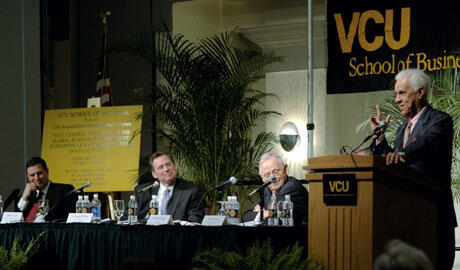
Last year, Mark Cross, senior vice president for strategic marketing and international business development at MeadWestvaco, met with Richmond Mayor Douglas Wilder about the relocation of his company’s corporate headquarters to downtown Richmond. Cross had recently taken a business trip to India and he soon learned that Wilder had just returned from a visit to the same country with Virginia Commonwealth University President Eugene Trani.
The idea that three people from Richmond had traveled at about the same time to a country approximately 8,000 miles away for the same purpose – to develop relationships – would have seemed fanciful just a few years ago, Cross said this week during the 13th Annual International Business Forum at VCU. But in today’s “flat” interconnected global marketplace it made perfect sense.
“What begins in Richmond now spreads around the world,” Cross said.
Cross, Wilder, Trani and James Weigand, global business director of Advanced Fiber Systems at DuPont, examined the ways globalization has impacted the Central Virginia community and laid out plans for meeting the challenges of a rapidly developing global marketplace during the International Business Forum, which was held Feb. 27. The VCU School of Business established the forum in 1994 in conjunction with a number of Richmond organizations. Universal Corporation is the longtime major sponsor.
This year’s forum, titled “VCU, Central Virginia and the Global Business Environment: Sustaining our Competitiveness in a Flat World,” offered an opportunity for a revealing look both inward and abroad. More than 500 students, faculty and community members attended the event, filling the Commonwealth Ballrooms of VCU Student Commons.
Van Wood, professor of international marketing and Philip Morris Endowed Chair in International Business at VCU, moderated the event. He set the tone for the discussion with opening remarks that included a vivid parade of facts detailing the world’s almost frantic growth and the United States’ place in the new economy, particularly alongside India and China. The business climate is changing so swiftly, Wood said, that at VCU and other universities students are being prepared for jobs that do not yet exist and are being taught to solve problems that do not yet have answers.
Wood said globalization was not a choice for businesses but a basic fact of operating. He and the forum’s panelists emphasized the need to embrace the new challenges and opportunities the global marketplace provides – or to risk being relegated to the role of mere spectator.
“It’s not enough to just think globally anymore,” Cross said. “We must act globally, too.”
Cross and Weigand highlighted that message by simply laying out their respective companies’ extensive international presences. MeadWestvaco, a packaging business that makes such products as DVD cases, disposable coffee cups and toothpaste containers, has operations in 30 countries around the world. Forty percent of the company’s products are sold overseas, according to Cross. Meanwhile, DuPont has operations in 80 countries and 50 percent of its revenue and work force comes from outside the United States, Weigand said.
Weigand said he was “constantly amazed” at the different ways that different cultures utilize such DuPont products as Kevlar, illustrating that even as economic walls are broken down between countries some stark differences remain. Businesses looking to take advantage of globalization must understand the need to adapt within each market, Weigand said.
“While the world is flat, it is also multidimensional,” Weigand said.
Cross called the new economic reality “business at the speed of light.” To highlight how abruptly dramatic change occurs, he said each month a population of Chinese equal to the population of Washington, D.C., migrates from rural areas to the cities, and, in making that move, graduates from the 19th century to the 21st century.
In addition to social and economic consequences, Trani said globalization also has considerable impact on international politics. He argued that the United States’ high-profile, and tumultuous, relationships with Afghanistan and Iraq will not be as critical to the country’s future as its relationships with such large, financially influential nations as Brazil, Russia, India and China, because of the close ties that economic interaction can create.
Although panelists extolled the virtues of the global economy, they also warned against possible traps for businesses. For instance, Cross said MeadWestvaco strived to ensure it was not sacrificing “sustainability,” such as with environmental issues, in order to keep pace with the demands of globalization. Noting the pollution problems in many emerging markets, Cross said MeadWestvaco wanted to help improve conditions in those countries.
“We think we can help governments address (those pollution problems), particularly in the paper industry,” Cross said.
Cross said MeadWestvaco chose Richmond for its new corporate headquarters over 75 contending municipalities in part because the city was poised to effectively compete on the global stage.
“What distinguished Richmond was our desire to be part of a community that has a plan for the future that we can contribute to in a meaningful way,” Cross said.
Wilder referred to two areas in which the city and region could improve its efforts to succeed in the global marketplace. The city and surrounding counties need to strengthen their regional planning efforts, he said, arguing that the lack of coordination between communities has hindered attempts to attract businesses.
Also, Wilder said Richmond’s educational system had room for progress. Wilder said he has frequently been impressed during his travels abroad at the eagerness and aptitude of the young people he has encountered, saying they often seem “hungry” for an education. He said that the students in Richmond’s public schools were at risk of being left behind because of an inadequate education. Wilder said the city needed to do more to help its students be competitive, particularly improving their preparation in math and science.
Trani highlighted VCU’s international efforts, including the exponential growth in international education that the school has achieved in years. For instance, the number of international students on visas at VCU has jumped from 676 to 1,128 since 2003, even though overall there have been a declining number of international students in U.S. higher education. Also, the number of VCU students taking advantage of study abroad programs has leaped from 236 to 467 over the same period.
VCU has collaborations with 15 universities around the world, including 11 institutions that have medical centers. Representatives from one of those universities, the University of Guadelaraja in Mexico, sat in the front row during the forum, highlighting the university’s international connections.
Trani said VCU will continue to be ambitious in its efforts to engage globally and to take advantage of international opportunities.
“There’s no question that we must internationalize,” Trani said.
Subscribe to VCU News
Subscribe to VCU News at newsletter.vcu.edu and receive a selection of stories, videos, photos, news clips and event listings in your inbox.