May 18, 2009
Management courses give students the tools they need to build their own businesses
Share this story
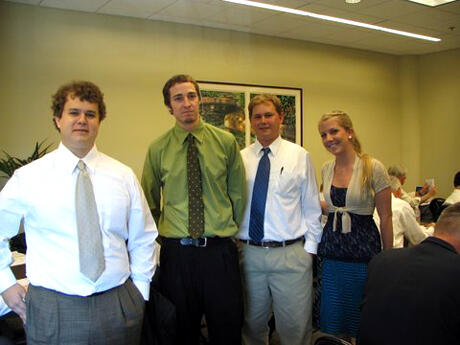
Bassel Sibay graduates from VCU this spring with a clear view of his future as a business owner. He knows where he wants to be in six years and how he will get there. He already has a business plan created through extensive study, consideration and research – a plan that has been scrutinized by seasoned entrepreneurs and finance experts. He has pursued inspiration into dead ends, but he has also followed it into the kind of breakthroughs from which sturdy, successful businesses are born.
“I’m prepared,” said Sibay, who majored in business administration and management at VCU with a concentration on entrepreneurship and small business. “I have my business plan now and I know where I need to be and what I need to do to get there to make it work.”
Sibay gained this precision of purpose during the past academic year in the two-semester MGMT 435-436 course taught by Matthew Rutherford, associate professor of management, in the VCU School of Business. The courses, which focus on new venture strategy and initiation, aim to provide entrepreneurship students with the tools they need to build their own businesses.
MGMT 436, which is taught in the spring semester, concludes with the VCU/Association for Corporate Growth Business Plan Competition. In the competition, students from the class present business plans to Richmond-area financiers and other professionals, including some entrepreneurs. The development of the business plans, which is done in teams or individually, is an intense process, according to students, but one that leaves participants confident and focused. The winning team or student receives $1,000 that can be used for pursuing their business idea.
Joshua Kruger, who graduated from VCU School of Business this month, says the MGMT 435-436 courses, especially the development of the business plan, serve to crystallize and deepen lessons from numerous other classes students take during their time in the VCU School of Business.
“The experience is so complete,” Kruger said. “It takes the principles from a bunch of other classes and applies them to a real situation.”
Rutherford said that the business plan opens the students’ eyes to the complexity of entrepreneurship. The breadth of study necessary to build a business – even simply to conceive of one – can be surprising even after studying small business concepts in the classroom. The exacting level of research required – information that Kruger says “you can’t just find through Google” – demands a level of discipline and persistence that surprises many students. In addition to researching raw data, students must interview customers, potential competitors and others.
“Before they develop a business plan I don’t think they understand what ‘details’ really means,” Rutherford said. “They do now. You put together a business plan and you see how all of the elements – management, accounting, finance, operations – connect.”
Students had to be particularly aware of broad economic conditions this year, Rutherford said, addressing the potential impact the global financial turmoil could have on their start-ups. They had to ask what if the economy did not improve. Some students, he noted, dreamed up businesses that might capitalize on a struggling economy.
Kruger said he is much more likely to start his own business because of the class experience. Before taking MGMT 435-436, Kruger said, the idea of life as a small business owner seemed “out of range, out of my league.” However, after spending 150 to 200 hours developing a business plan with his teammates, Kruger has the confidence in himself and his abilities to consider taking that step.
Both Sibay and Kruger said the advice and positive feedback they received from judges was critical. Most of the approximately 30 judges who participated were members of the Association for Corporate Growth, which donated money to the competition. The final round of judging took place at the corporate headquarters of Hirschler Fleischer Attorneys at Law.
Kruger said some judges passed along their contact information and told him to get in touch with them for advice if he pursued his class business plan or another one in the future. Sibay said the judges’ enthusiasm for his plan and assertion that it would work made him believe that it was feasible.
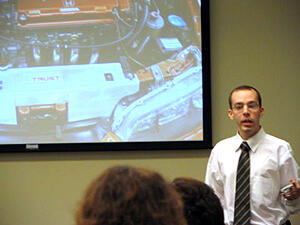
Rutherford encourages students to build on ideas that interest them – business plans this spring ranged from a CPA firm to a firm producing allergen-free baby food. Some projects had modest aspirations, while others were “shoot for the stars” big, Rutherford said. Kruger and his teammates developed an idea for a hunting and fishing guide service, while Sibay envisioned a shop for customized cars.
“I think it’s important that you have an idea that you’re passionate about,” Sibay said. “A lot of us started with projects that were already hobbies.”
Rutherford said he was impressed with the students’ work this semester and believes that several of the students will develop their own businesses, perhaps even continuing with ideas borne out of the class.
Sibay, for one, hopes to start his business customizing cars in six years after he has raised the necessary funds – he already has a dollar figure – and has spent additional time studying the industry. He said he graduates from VCU much closer to his goal than he imagined he would be.
Subscribe to VCU News
Subscribe to VCU News at newsletter.vcu.edu and receive a selection of stories, videos, photos, news clips and event listings in your inbox.