April 24, 2013
MFA Exhibitions Spotlight Emerging Artists
Share this story
When Claire Krueger was a child, she lived near a modest patch of woods. Sometimes she found herself stuck playing on the far side of the trees when night fell, needing to hustle through them to return to her house. She knew the woods well, knew how close they were to the safety and security of her house, yet she would grow anxious and scared as she rushed home in the dark – her breath growing short, her heart beating through her chest, her mind battling a tingling uncertainty of what might be lurking around her.
That sense of heightened tension animates Krueger’s vivid new art installation, which will be on view at the Anderson Gallery from May 3 to May 12 as part of the gallery’s Part II of its MFA Thesis Exhibitions. Part I is currently on view through April 28.
The exhibitions serve as the culmination of the graduate school tenures of master of fine arts students in the departments of craft and material studies, interior design, kinetic imaging, painting and printmaking, photography and film, and sculpture and extended media – all part of the VCU School of the Arts, the top-ranked graduate public arts program in the United States. More than 30 students are represented in this year's exhibitions. The works offer insight into the talent and hard work of the students. They also demonstrate the gains the students have made during their time at VCU – a point they frequently note when discussing their exhibition pieces.
For instance, Krueger, a photography and film student, arrived at VCU with a background tightly focused on still photography. However, her piece for the exhibition extends well beyond those borders, employing moving imagery, sound and even real trees to provide the viewer with an immersive experience. The central component to the piece is a precisely framed video of a hypnotic, wandering flashlight in a pitch-black forest – the flashlight’s thin blade of light providing the only hint of its surroundings.
Krueger said she wanted to draw out the suspense we’re accustomed to experiencing in movies until the piece was cut down to a concentrated, nerve-wracking sense of foreboding. She offers no gasping payoff or relieving context to release the tension, instead forcing viewers to live with the unease until it becomes meditative.
Krueger said the piece’s interdisciplinary components – her skilled use of video, her inventive soundscape – grew directly out of advances she has made as an artist at VCU, where she took advantage of opportunities inside and outside of her department.
“I think I had no idea what I would do when I came here,” Krueger said. “But I’ve learned a lot about how to figure things out, how to think critically. It’s been nice working with a lot of different professors who could guide me in new directions.”
Similarly, Mariam Eqbal, a graduate student in kinetic imaging, said the range of viewpoints and interests on the VCU campus has been a boon to her work. In particular, she’s taken advantage of her newfound access to science-based research. Eqbal’s work involves her obsessive interest in the relationship between objects, time and space, and she’s used resources at the university, such as the Center for the Study of Biological Complexity, part of VCU Life Sciences, to fan that interest.
“My time here has really been serendipitous for me in that it truly has allowed me to articulate my thoughts and ideas,” Eqbal said. “It’s allowed me to weave my work between different disciplines. I didn’t feel limited in the arts. I was able to branch out in ways that could inform my work.”
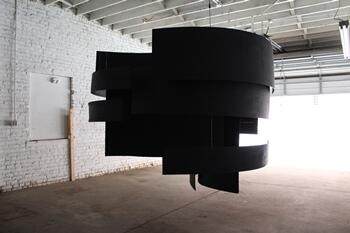
Eqbal’s piece that will appear in the Carriage House during Part II of the MFA Exhibitions exemplifies her fascination with seemingly complex objects that have deceptively simple constructions. The work comprises 30 panels of black curved wood suspended from the ceiling in an arrangement that makes them appear at first glance to be a single piece. The work is viewed in the dark with a single light glimmering from within the piece, and a single-channel speaker providing a static-y sound – a recording of Eqbal’s voice, reduced until it’s merely resonance.
Eqbal’s two previous versions of the piece involved nine panels and 15 panels, respectively. She’s excited to see how the arrangement of panels will develop on a larger scale when she installs the work in the Carriage House space. She’s produced careful designs and plans in preparation for installing the work, but she’s keen for the moments of discovery that occur once the piece becomes part of the space – a process she likens to the way stacked rocks of uneven shapes will always fall, but never the same way. “There’s always a difference in nuance of the fall,” she said. “Just like there’s a difference in the nuance of the piece.”
“Both times I’ve done it before I’ve totally surprised myself,” Eqbal said. “Or I should say it’s totally surprised me.”
Openness to surprise is also central to the work of Alex Hayden, an M.F.A. candidate in the Department of Craft and Material Studies, whose mixed media installations in the past have included video, sculpture, sound and even live performers. His newest work, which will be included in Part II of the exhibitions, will use walls he constructs to direct viewers and divide the piece into two rooms. A video projection with two tongues maneuvering in close proximity to each other, a sound installation and a piano covered in autobody paint are focal elements, among several others.
Hayden said he likes to put disparate elements together to create unusual juxtapositions. His use of a wide range of media is traced to his desire “to control the environment and all of the little pieces of it. You can create your own world that way.” That sense of control includes an attempt to architecturally influence the way viewers experience his pieces – the order in which they view the elements, where they stop the longest.
Hayden said a key lesson he’s learned at VCU is to subtract from his pieces, instead of indulging an urge to “put out there everything that’s in my head.” That refining process often occurs during the time Hayden installs a piece.
“I’ll find out that some pieces aren’t talking to each other, while other parts are talking to each other that before weren’t having a conversation at all,” Hayden said.
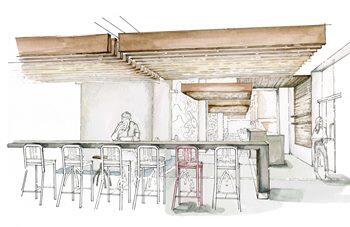
Annie Thompson, one of seven interior design M.F.A. candidates with pieces in Part I of the exhibitions, traces her growth at VCU in explicit terms in her exhibition space. It appears in the form of a redesigned clock on display alongside her thesis design.
Before Thompson’s very first day of class in the program, Camden Whitehead, an associate professor in the Department of Interior Design, instructed Thompson and her fellow students to bring along a device with at least 50 components to it. Thompson selected a clock. At Whitehead’s instruction, Thompson broke the clock down to its pieces and then reassembled it, providing it a new design that demonstrated its most essential elements.
The clock and the lesson it provided has accompanied Thompson throughout her two years, ultimately serving as part of her inspiration for her thesis design project – the renovation of the Richmond Kickers building on West Main Street into a craft brewery. The project satisfied Thompson’s interest in historical buildings – a portion of the building dates to the 1920s – and adaptive reuse.
It also challenged her to preserve and showcase the brewery’s “monumental elements,” particularly the equipment essential to the brewing process, while creating a pleasant environment for customers to visit to sample the beers. As with the clock, Thompson deconstructed the elements of a brewery and reassembled them, considering how the space could tell visitors its purpose and story.
Thompson and her interior design classmates showcase their work on the third floor of the Anderson Gallery. The students worked together to give the space a cohesive feel, guided by their collective theme of “Turning the Corner,” while partitioning the space in a way that each student could present her particular work on its own terms.
Thompson said the arrangement of the projects is a suitable one. Each project, though distinctive and unique, was borne out of a collaborative atmosphere among the students that allowed them to turn to each other for feedback and occasional advice.
“(My classmates) were really like my family for the past two years,” Thompson said. “They all pushed me to be a better designer, and I hope I did the same for them.”
The VCU School of the Arts Anderson Gallery is located at 907 ½ W. Franklin St. Its hours for the MFA Exhibitions are Monday through Friday, 10 a.m. to 5 p.m., and Saturday and Sunday, noon to 5 p.m. The gallery is free and open to the public.
The gallery previously hosted the Juried Fine Arts, Design and Kinetic Imaging Exhibitions from March 28 to April 14, showcasing undergraduate work.
Other remaining opportunities to see undergraduate and graduate student art work include the Department of Graphic Design’s MFA Show from May 1 to May 4 at Gallery A, located in Shockoe Bottom, 114-A Virginia St., with a reception on May 3 from 5 p.m. to 8 p.m., and the Department of Fashion Design and Merchandising annual Fashion Show at the Virginia Museum of Fine Arts on May 5 at 7:30 and 9 p.m.
For information about upcoming shows through the VCU School of the Arts, visit http://esterknows.com/archives/category/shows.
Subscribe for free to the weekly VCU News email newsletter at http://newsletter.news.vcu.edu/ and receive a selection of stories, videos, photos, news clips and event listings in your inbox every Thursday.
Subscribe to VCU News
Subscribe to VCU News at newsletter.vcu.edu and receive a selection of stories, videos, photos, news clips and event listings in your inbox.