Sept. 10, 2010
NASCAR Drive for Diversity Drivers Visit VCU Business Class
Share this story
Two young, talented drivers with their sights set on NASCAR stardom visited a VCU School of Business classroom this week to talk about their headlong pursuit of a stock car racing career – and their burgeoning on-screen fame.
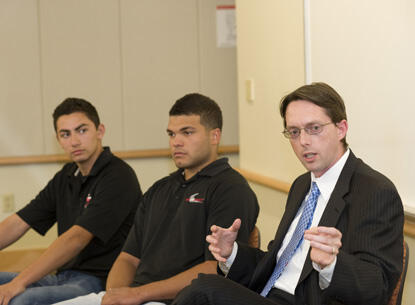
Sergio Pena, 17, and Ryan Gifford, 21, attended the “Business of NASCAR” class taught by management professors Jon Ackley and Michael Pitts a day after the most recent airing of “Changing Lanes,” a reality show airing on BET that follows Pena, Gifford and eight other drivers in the NASCAR Drive for Diversity program as they train and race. The appearance also came the week Richmond International Raceway hosts NASCAR races in the Nationwide and Sprint Cup series.
NASCAR diversity affairs account executives Alejandra Diaz-Calderon and Jill Picaut joined Gifford and Pena, along with Dustin Long, a veteran NASCAR writer for Landmark Communications, to provide a far-reaching explanation of NASCAR’s diversity efforts both on and off the track.
Those efforts include a weekend mentorship program that allows college students to shadow NASCAR business officials during races. Four VCU students are participating in the program this weekend at RIR. Those students are Dawn Lyons and Sequoia Ray, who are both senior mass communications majors, and William Allen, a junior business major, and Tyrone Powell, a graduate student in the Center for Sport Leadership.
Pena and Gifford each began racing at the age of 8, driving go-karts in local races. Pena was based in Winchester, Va., and Gifford in Winchester, Tenn. They gradually moved into larger vehicles and older competitive ranks. Both now drive in the K&N Pro Series East, a sort of NASCAR minor league. Each has shown glimpses of promising talent, such as when Pena finished second to NASCAR Sprint Cup driver Joey Logano at the 2010 Toyota All-Star Showdown and when Gifford won the pole at a June 6 race in Martinsville, becoming the first black driver to ever win a pole in the K&N Series.
Through the Drive for Diversity program, Pena and Gifford have received training and resources that help them improve and gain confidence. They expressed an eagerness to be part of a new wave of drivers that expand NASCAR’s audience and talent pool.
“Hopefully we’ll have something to bring to NASCAR other than just being some more drivers,” Pena said.
Gifford added, “I’m hoping that there is a new generation of kids that see us and take (stock car racing) seriously.”
Gifford said he believes NASCAR has begun to attract a more diverse group of fans and drivers.
“I think the sport is definitely changing,” Gifford said. “You’re seeing more different types of people in the stands, though it’s still not enough of them.”
Pena and Gifford detailed the financial requirements of competing at a high level in stock car racing and both said their families had sacrificed to help boost their careers. The necessity of sufficient funding to be competitive on the track prompted Ackley to say that stock car driving “was one day of racing and six days of business” for racing teams.
Gifford took some grief before class for a scene from the previous night’s episode of “Changing Lanes.” He had struggled during a training run, and Ed Grier, dean of the VCU School of Business, wanted to know if the course had involved a lot of left turns – the direction NASCAR drivers head on oval tracks. Both drivers said the experience of being followed around by cameras had been unnerving initially – “when you wake up in the morning it’s because the camera woke you up,” Gifford said – but they had grown accustomed to it.
“It’s taught me to be more composed in front of cameras,” Pena said.
Long pointed out that the reality-show experience could prove invaluable to the drivers as their careers progressed. Drivers today have to be actors, too, according to Long, who recently wrote an article about NASCAR drivers’ lives as product pitchmen. Sponsorship dollars play a critical role in a driver’s ability to compete and a driver that is polished will attract more of that pool of funding.
“Being a good driver takes a lot more than driving,” Long said. “It also involves how well you can promote a product.”
Diaz-Calderon and Picaut spoke to the class about the different avenues that people involved in the business side of NASCAR have taken to join the industry, using themselves as examples. Diaz-Calderon had almost no knowledge of the sport when she was hired following a stint with the Orlando Magic, while Picaut has attended races for as long as she can remember, falling asleep in the stands when she was little. Both promoted NASCAR’s 10-week summer internship program for minority college students that includes open stints at NASCAR business offices located around the country.
Subscribe to VCU News
Subscribe to VCU News at newsletter.vcu.edu and receive a selection of stories, videos, photos, news clips and event listings in your inbox.