July 20, 2011
New Interns Learned to Walk-the-Walk for Safety and Patient-Centered Care
Share this story
When you’re the new kid on the block, there’s a lot to learn about your new community. That’s especially true when you’re a newly minted doctor making the transition from student-observer to the increased responsibilities of a physician-in-training. To ease that transition, on June 23 and 24, the School of Medicine hosted its second annual Walk-the-Walk conference for the medical center’s newest 137 interns.
“This conference is intended to immerse these young physicians into the VCU Medical Center culture that puts safety at the center of their clinical responsibilities,” said Mary Alice O’Donnell, Ph.D., associate dean of the medical school’s Graduate Medical Education office. “Incorporating this curriculum into intern orientation is a meaningful step forward on our journey to become America’s safest health system.”
After completing four years of medical school to earn their degree, new doctors must complete residencies in their chosen specialties under the supervision of experienced physicians. First-year residents, also known as interns, mark an important milestone as they make a transition from their relatively passive roles as medical students to proactive providers with more direct responsibilities for patient care. Because residents are coming from more than 55 medical schools across the country, the program’s creators wanted to be sure the trainees know what’s expected of them at the VCU Health System.
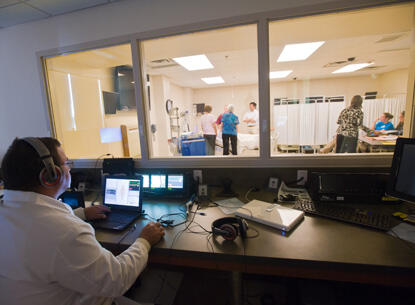
O’Donnell along with her co-creators Stephanie A. Call, M.D., M.P.H., director of the Internal Medicine Training Program, and Shawna J. Perry, M.D., director for Patient Safety Systems Engineering, worked with residency program directors from different specialties to identify key concepts and behaviors that are fundamental for safe medical practice. Through case-based discussions, debates in multi-disciplinary small groups, team activities and simulation, the interns became familiar with the expectations for core behaviors related to professionalism and informed consent as well as consultation and functioning as part of a team of health care providers.
During the two-day conference, first-year residents worked in teams consisting of senior residents, faculty and nurses. “It takes a village to take care of one patient,” O’Donnell said of the need for the team-based activities that are an illustration of the collegiality that is a hallmark of the VCU Medical Center.
Medical researchers have debunked the urban myth of the “July effect” – a claim that a new crop of residents makes July a bad time to be hospitalized. Nevertheless, many academic medical centers recognize that focusing attention on patient-centered care and safety must include meaningful training for interns. The VCU Health System’s Walk-the-Walk conference is one of few in the country to promote better teamwork by integrating all interns in a single conference rather than putting them in silos by discipline. 2010’s pilot conference was well-received by interns who endorsed that approach.
###
Editor's Note: Residents come to the VCU Health System from more than 55 medical schools across the U.S. as well international schools. To see from where our residents hail, visit http://www.medschool.vcu.edu/gme/documents/MatchData2011-USMap.pdf.
Subscribe to VCU News
Subscribe to VCU News at newsletter.vcu.edu and receive a selection of stories, videos, photos, news clips and event listings in your inbox.