July 12, 2006
Not your typical summer vacation
Share this story
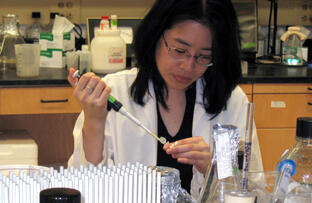
Virginia Commonwealth University’s Bioinformatics and Bioengineering Summer Institute has received federal funding to continue its intensive, two-year research program aimed at undergraduate students from around the United States.
The institute, which operates within the VCU Life Sciences’ Center for the Study of Biological Complexity, received renewed funding for $500,000 over three years from the National Institutes of Health and the National Science Foundation.
Touted as “not your typical summer vacation,” the institute brings together students — mostly rising juniors and seniors from across the country — who are interested in careers in bioinformatics or bioengineering. It is led by director Jeff Elhai.
“We try to identify students who will benefit from an exposure to real research,” said Greg Buck, Ph.D., director of the Center for the Study of Biological Complexity and principal investigator for the institute. “The students spend some period in didactic learning, but for the most part work in labs with their VCU mentors.”
Now in its fourth year, the institute can fund 12 new spots and 12 returning spots. The 15-month program brings in students to begin a research project during their first summer at VCU. The project is continued at their home institution over the academic year, and students return to VCU a second summer to complete the project. Students integrate themselves into the research programs of their VCU mentors, working on projects they propose in consultation with their mentors and collaborating faculty members at their home institutions. Specialized research simulations accelerate the process by which they take responsibility over their projects and assume creative roles. Approximately 40 VCU faculty members mentor the students, who generally come from small liberal arts colleges that lack the resources for this type of work, Buck said.
Bioinformatics uses computers and information technology to solve biological problems. Represented by the Human Genome Project, bioinformatics is finding its way into many areas of life-science research. It relies on the development and application of elegant and powerful computing and mathematical tools that make it possible to create and analyze massive databases for research answers.
Bioengineering applies engineering principles to the study of medical and clinical problems and includes such topics as tissue engineering, orthopedic biomechanics and rehabilitation engineering.
The original four-year $750,000 award from the NIH and NSF ends this summer. The BBSI — one of nine original programs to receive the funding — was the only one to focus on both bioinformatics and bioengineering as well as having a two-year commitment. As a result, other institutes now are modeling their programs after VCU’s.
“It is telling of our success that several of the BBSI students have joined our graduate and professional programs,” Buck said. “Thus, VCU is gaining some outstanding students.”
Subscribe to VCU News
Subscribe to VCU News at newsletter.vcu.edu and receive a selection of stories, videos, photos, news clips and event listings in your inbox.