May 21, 2003
Philip Morris CEO advises VCU engineering graduates to solve their own problems
Share this story
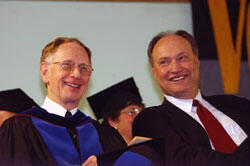
The head of one of the nation's largest corporations delivered his first-ever commencement speech to the fourth graduating class of VCU's School of Engineering. About 850 people attended the diploma awarding ceremony inside Richmond's Landmark Theater.
Michael E. Szymanczyk, chairman and CEO of Philip Morris U.S.A., chose not to offer direct advice to the 104 graduates on their life and careers. Instead, he shared a piece of his early career that still affects his leadership style today. He felt that graduates should determine their own life course and how to leave a meaningful legacy. "I feel you should discover that yourself...a few false starts are often the best learning you'll have."
He shared a personal story about a "small incident" in his 31-year business career that had a profound impact on his life and might help them as they embark on their own careers. As a unit manager for the Procter & Gamble Company in the early 1970s, Szymanczyk asked his supervisor to help him solve a significant problem with one of their biggest customers. "I don't remember the nature of the problem today. I do, however, recall the process by which it was solved," he said.
Szymanczyk described the problem and asked his supervisor, Ray Kimball, what he should do. But instead of offering possible solutions, Kimball told him to think about what he might do and then come back and discuss it with him. The next day, Szymanczyk returned to Kimball's office to share his ideas for fixing the problem. Kimball said "Well, that's good...but did you think about this?" Szymanczyk's reply was no. So Kimball again told him to think about those things and come back.
The following day, Szymanczyk offered his final solution. Kimball told him it sounded good and suggested he do it. He said the incident taught him four important lessons: solve your own problems, seek advice, ask questions, and take the time to help others. "In essence, make your life's work center on learning, doing and teaching, and at the end of your life I think you'll be able to say you made a difference in someone else's, and along the way enriched your own."
"Ray Kimball didn't have to take the time he took to help me think through this problem. He knew the answer, and it would have been easy for him to tell me what to do. The fact that he didn't do that - that he took the time to make me think through my problem my way - has influenced not only how I work with people in business, but how I've raised my children," Szymanczyk said.
Szymanczyk received a Bachelor of Science degree in finance from Indiana University in 1971. He currently serves on the board of trustees for the Virginia Foundation for Independent Colleges and is chairman of the Dean's Advisory Council for the Indiana University Kelley School of Business. He has also served as vice chairman and chairman of the Thurgood Marshall Scholarship Fund fundraising dinners and has established 20 scholarships at Philip Morris U.S.A. for minority students as a result of that association.
Philip Morris U.S.A. employee David Milby is a member of the School of Engineering Foundation Board of Trustees and Hector Alonso is a member of the VCU Mechanical Engineering Industrial Advisory Board. The company, which has production facilities in Richmond, has provided many scholarships, internships and jobs for engineering graduates.
Subscribe to VCU News
Subscribe to VCU News at newsletter.vcu.edu and receive a selection of stories, videos, photos, news clips and event listings in your inbox.