Nov. 15, 2002
President Trani gives lecture on First Cold War
Share this story
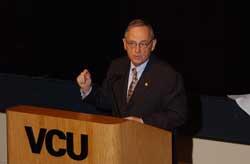
Continuing a series of lectures related to his new book, VCU President Eugene P. Trani, Ph.D., told a crowd of about 100 faculty members, students, staff and friends Thursday night that Woodrow Wilson’s attitudes toward Russia beginning in 1917 influenced U.S. Cold War policy for much of the 20th Century.
“You can draw a straight line from Wilson to George Bush,” Trani said during the lecture at the Grace Street Theater. “Wilsonians were the first Cold War warriors, and, in the era of Woodrow Wilson, the first Cold War began.”
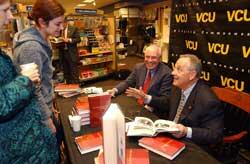
In “The First Cold War: The Legacy of Woodrow Wilson in U.S.-Soviet Relations,” Trani and co-author Donald E. Davis, Ph.D., professor of history at Illinois State University in Normal, review the Wilson administration’s attitudes toward Russia before, during and after the Bolshevik seizure of power. Relying on their research in at least 100 U.S. and Russian archives, Trani and Davis give a scholarly account beginning with Wilson’s early indecision on how to respond to Lenin’s assumption of power through Wilson’s decision to repudiate the Bolsheviks by imposing a diplomatic quarantine. Wilson’s quarantine laid the foundations for U.S. Cold War policy and the ultimate collapse of the Soviet Union in 1991, the authors argue.
“This book is really about the origins of America’s role in the world. It talks about what our preconceptions were and how we responded to an emerging Soviet Union,” Robert D. Holsworth, Ph.D., director of VCU’s Center for Public Policy, said during his introduction of the authors. “From all sides, the book is getting rave reviews. It’s based on a reconceptualization of when the Cold War began.”
Trani also lectured on “The First Cold War” on Nov. 8 at the Truman Presidential Museum & Library in Independence, MO. He is scheduled to be at the Woodrow Wilson Center for Scholars in Washington, D.C. on Dec. 16.
“The First Cold War” was published by The University of Missouri Press, and a Russian translation by Olma Press in Moscow. Both versions include an introduction by former Secretary of State Lawrence Eagleburger and Professor Vyacheslav Nikonov, Molotov’s grandson and President of the Polity Foundation in Russia.
Trani
and Davis recently signed a contract for their next book, which will review the
origins of the different U.S. views and policies toward the Soviet Union and
China.
Subscribe to VCU News
Subscribe to VCU News at newsletter.vcu.edu and receive a selection of stories, videos, photos, news clips and event listings in your inbox.