Jan. 18, 2013
Professor Examines American Retail Culture
Share this story
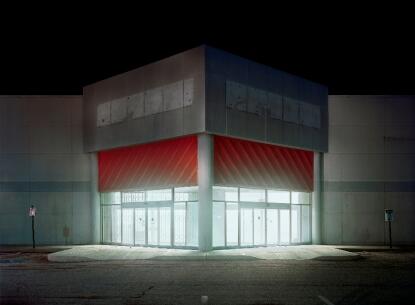
We all drive past abandoned big-box stores and malls from time to time, Brian Ulrich says. Large, empty buildings that once held paying customers and shelves groaning with goods, they are now stoic and bereft. They’re called “ghost boxes,” “dark stores” and “dead malls.” They are surprisingly prevalent, lining roads, occasionally perched at the end of vast, unpopulated parking lots, but we rarely do more than shake our heads and perhaps allow them a glancing thought, remembering when we were frequent customers, as we continue farther down the road to a store that has not yet suffered the same fate.
Photography, however, can stop us in our tracks, framing something familiar in a way that ensures we will see it in a different light. Ulrich’s powerful photos of abandoned stores are part of “Copia – Retail, Thrift and Dark Stores, 2001-2011,” an exhibition of the VCU professor’s retail-obsessed photos showing at the VCU School of the Arts Anderson Gallery from Jan. 18 to March 10. “Copia,” which is the Latin word for “plenty,” is divided into three parts, following the three phases of Ulrich’s photographic examination of the American retail landscape: “Retail,” which spans 2001 to 2006; “Thrift,” which covers 2005 to 2008; and “Dark Stores,” which includes images from 2008 to 2011.
An accompanying exhibition, “Close Out – Retail Relics and Ephemera,” features items from the large archive of retail artifacts Ulrich has collected in his research.
Ulrich, an assistant professor in the Department of Photography and Film in the VCU School of the Arts, has been chronicling the world of retail since 2001, attracting critical praise for his photographs, which the New York Times called “a quietly powerful statement about consumerism in America.” Both the New York Times and American Photo Magazine named “Is This Place Great or What,” a catalogue of his photos, as one of the best photo books of 2011. Ulrich’s work has been the subject of solo exhibitions at museums and galleries in New York, Cleveland, Milwaukee, Munich, San Francisco, Buffalo and Chicago, among others. He received a prestigious Guggenheim Fellowship in 2009.
In addition, prominent media outlets have enlisted Ulrich to take photographs around the country, including recent assignments related to the impact of the 2008 economic downturn. For instance, watch this mesmerizing time-lapse video of housing demolitions in Cleveland for Time magazine’s website.
Ulrich says retail interests him because of its powerful, pervasive effect on all corners of American society. He’s captivated by the status awarded “our ability to spend money on things that we do and don’t need.”
“It is so equated with our well-being that it’s scary to me,” Ulrich said.
Ulrich grew fascinated with the topic of American consumerism in the aftermath of the Sept. 11 terrorist attacks when some of the country’s leaders urged citizens to respond to the attacks by flooding stores and spending money. Shopping became an explicitly patriotic act. Ulrich soon began surreptitiously taking photos of shoppers in the aisles of stores eyeing their next purchase. Slate.com later labeled them “zombie shoppers,” a nod to the single-mindedness the subjects displayed. These photos, along with other images of in-store scenes, make up the “Retail” portion of “Copia.”
The “Thrift” project was a resulting spin-off effort. Through the time he spent in thrift stores, Ulrich gained new insights into the gamut of secondhand goods in the marketplace – a result, he said, of “planned obsolescence. New goods must be made and consumed at a faster and faster rate.” One particularly striking photo in the Anderson Gallery exhibit features a thrift store storage closet bursting with piles of sneakers.
“The amount of manufactured goods out there now is beyond human understanding,” Ulrich said. “You can’t make sense of it all.”
He found he was especially drawn to the thrift store workers who sort through, stock and sell mountains of items, castoffs from others who had more than they needed.
“There would be a sort of bewilderment in their gaze and their posture when they dealt with all of this stuff and tried to make sense of how much of it there was,” Ulrich said.
Ulrich has been concerned from the outset with ensuring that his photos do not play for slapstick or satire, especially pieces with human subjects in them. He’s not, he said, seeking to portray “a duped consumer.” After all, he’s a shopper himself, he points out, who spends in these stores and follows many of the same practices as his subjects.
“I’m part of this equation,” Ulrich said.
The “Dark Stores” project, which highlights the fallout of the 2008 economic crisis, sent Ulrich traveling around the country, searching out striking abandoned malls and stores. He said these old structures possess a “ghostly, haunted” presence. They also have an unpredictability that made Ulrich’s journeys adventurous.
At one Texas mall, he and a friend entered the dilapidated structure to discover a fire burning inside. They used water from a green, stagnant pool that had collected in the middle of a display floor to put the fire out. A photo of the pool, a bizarre, incongruous presence in its setting, is part of the Anderson Gallery exhibition.
For “Dark Stores,” Ulrich, who formerly lived in Chicago, made multiple visits to one especially infamous example of a dead mall, the Dixie Square Mall, in Harvey, Ill. The enclosed mall was in operation for just 13 years, closing in 1979. It enjoyed a brief revival as a thriving retail outlet for the movie, “The Blues Brothers” – it is the setting of a memorably destructive car chase – but it did not re-open for actual business, laying barren of commerce for decades until its demolition finally in 2012.
Ulrich treated the mall as an explorer might, traversing and climbing, digging for new discoveries. The mall created its own strange suburban wilderness. Ulrich encountered both a red fox and a coyote on the premises. He also found bills and letters in administrative offices that provided a history of the facility, detailing the mall’s ups and downs.
The bills and other papers represent part of the archive of retail artifacts that Ulrich has collected over the years. The “Close Out” exhibition at the Anderson Gallery features a treasure trove of old signs, advertisements, architect’s renderings and plans and photographs, including negatives of retail-related photos from various newspaper archives from the post-World War II years. Ulrich says the items help give his own work a useful context for viewers.
In particular, Ulrich said he wants those who engage with his photographs to understand the historical forces he sees at work. Ulrich traces the American embrace of consumerism to “the Great Prosperity,” the rapid expansion of the American middle class that occurred from the late 1940s to the mid-1970s.
“A very specific trajectory was built for this country right after World War II,” Ulrich said. “We built this intricate connection with consumerism so deeply into our psyche that anything that messes with it must be a kind of apocalypse.”
The organization and presentation of the artifacts has developed into a fourth stage of Ulrich’s now-decade-plus look at his subject. He said each part has suggested the next one, and he imagines he is far from finished with this topic.
“I sometimes think I should just shoot sunsets, something tranquil, that people can hang in their living rooms,” Ulrich said. “But I’ve stumbled into something that I think is important.”
“Copia” was organized by the Cleveland Museum of Art and made possible by the Fred and Laura Ruth Bidwell Foundation. It also will travel to the North Carolina Museum of Art in Raleigh (Sept. 29, 2013 to Jan. 5, 2014) and Marquette University’s Haggerty Museum of Art in Milwaukee next spring.
The Anderson Gallery, which is located at 907 ½ W. Franklin St. on the Monroe Park campus, is free and open to the public. Gallery hours are Tuesday through Friday, 10 a.m. to 5 p.m., and Saturday and Sunday, noon to 5 p.m. For more information, visit http://arts.vcu.edu/andersongallery/.
The opening reception for the winter exhibitions will be held on Jan. 18 from 5 p.m. to 7 p.m. Ulrich will hold a free gallery talk on Jan. 30 at 5 p.m.
Subscribe to the weekly VCU News email newsletter at http://newsletter.news.vcu.edu/ and receive a selection of stories, videos, photos, news clips and event listings in your inbox every Thursday.
Subscribe to VCU News
Subscribe to VCU News at newsletter.vcu.edu and receive a selection of stories, videos, photos, news clips and event listings in your inbox.