June 9, 2016
Recommendations on East Marshall Street Well Project discussed at final community meeting
Share this story
At the fifth and final community consultation of the East Marshall Street Well Project, the passing of famed athlete Muhammad Ali served as a poignant start for the reflection and conversation ahead.
“I am going to ask us all to give a moment of silence for Muhammad Ali. I think most of us know he passed last night,” said Don Edwards, senior facilitator and CEO of Justice & Sustainability Associates. “In my life he is iconic, and I suspect for many in the room he is that.”
After a moment of silence fell in the gymnasium, Edwards continued.
“I think it is important to do that because we are talking about ancestors, and he has joined the ranks of the ancestors. So it seemed to me that we should bring him into the room,” he said. “It helps us get our minds in the right place, because this has all been a process of putting ourselves in other people’s shoes.”
This has all been a process of putting ourselves in other people’s shoes.
The project aims to find appropriate ways to study, memorialize and conduct interment of human remains uncovered 22 years ago during construction of the Kontos Building on Virginia Commonwealth University’s MCV Campus. The remains are mainly of African descent and are believed to have been discarded in the well in the 19th century by medical staff.
“We’re basically here because of history and people we did not know, but we have tried to get to know,” Edwards said.
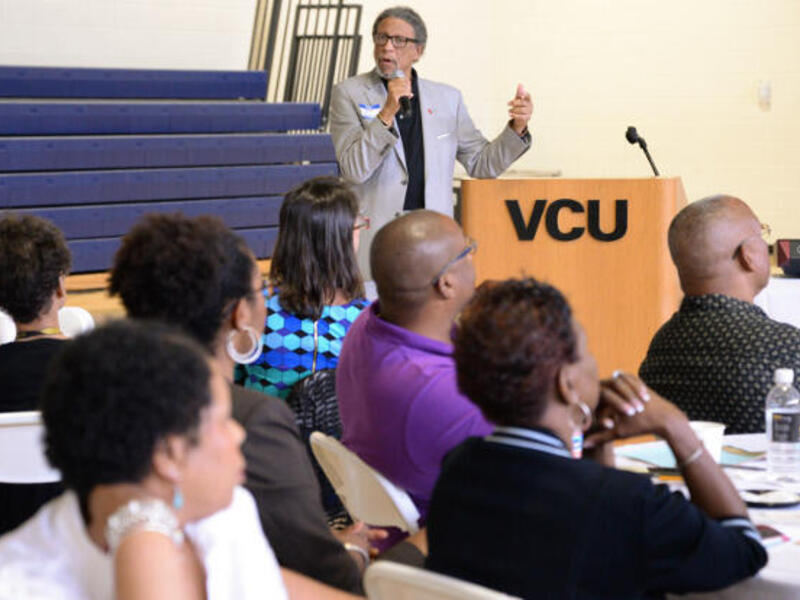
During the meeting, leaders of the Family Representative Council — a group formed to stand in as descendants of the people whose remains were found in the well — presented their recommendations.
“The members of these groups are incredibly distinguished and have taken on a notable challenge with great integrity, and it has been impressive to see the work that has been put into this process,” said Kevin Allison, Ph.D., senior assistant to the president of VCU.
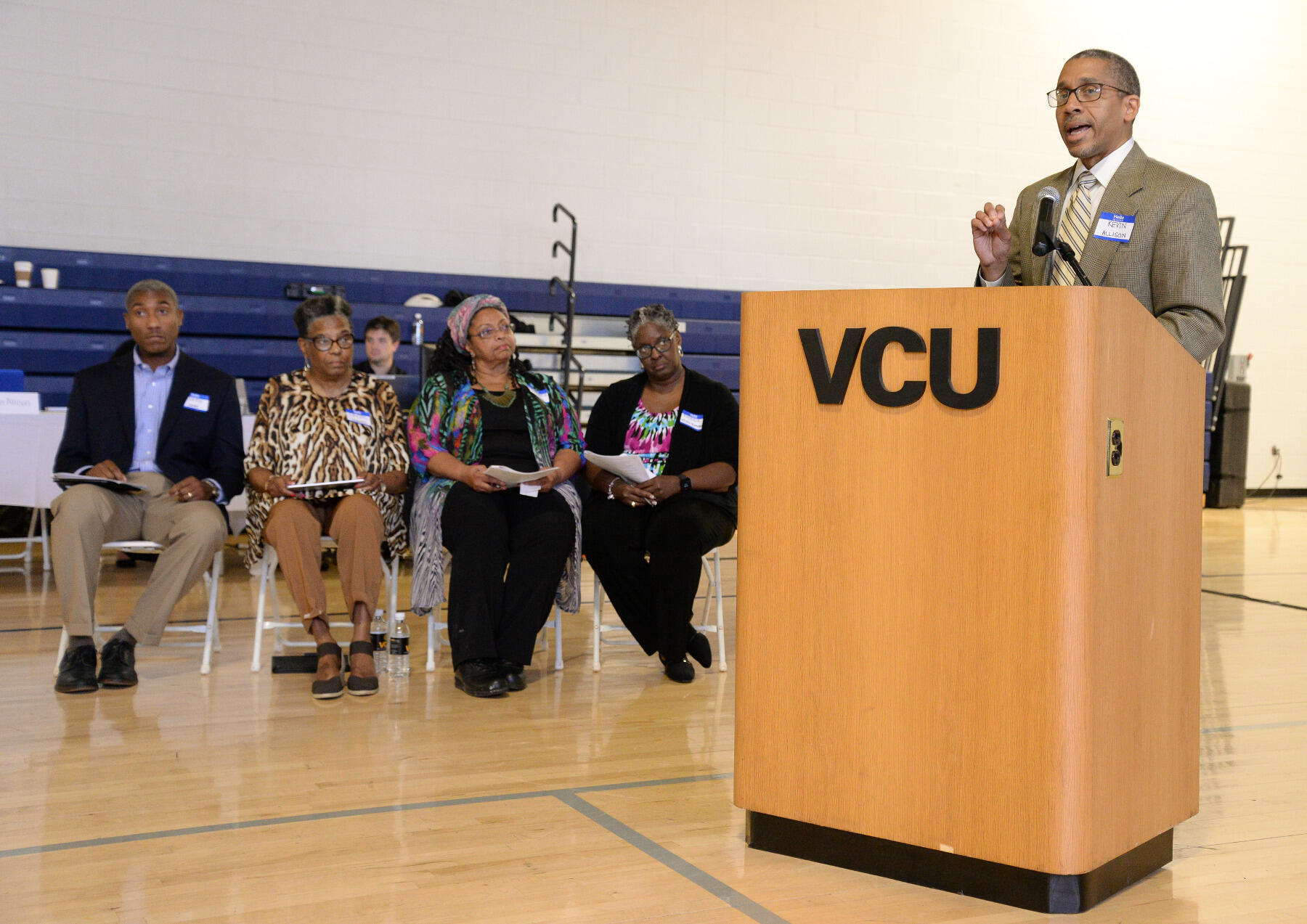
“Today we’re going to transition into the next stage,” he added.
The recommendations fell into the categories of research, memorialization and interment, said Joseph Jones, Ph.D., chair of the Family Representative Council and an assistant professor of anthropology at the College of William & Mary. The group visited relevant sites in Richmond and beyond, and hosted meetings with a variety of subject matter experts.
The research group seeks further study of the history of the well site in relation to the broader experiences of Africans and African-Americans in Richmond and how the site impacts contemporary African-American medical experiences; the use of DNA and microbial analysis to learn more about the remains, and potential ties to living people; and the establishment of a research advisory board to assist with project development and selection of future research proposals.
Memorialization recommendations include the development of memorial sites within or near the Kontos Building; construction of an appropriate memorial and an interactive learning center at the burial site; and an annual memorialization practice conducted by VCU School of Medicine students. It would be held “prior to their anatomy class to pay respect to those who are contributing, and have contributed, their remains for the benefit of their scientific learning,” said Stephanie Smith, a member of the memorialization working group.
The council recommends that the remains and related artifacts be interred at the African Burial Ground site near I-95, or if that site is unavailable, at Evergreen Cemetery; that a public, inclusive ceremony developed by experts in West African funeral traditions be held; and that the remains be placed in coffin boxes designed by West African artisans.
“Memorialization is a physical way we express respect and dignity,” Edwards said.
It is believed that the remains were originally taken from the African Burial Ground, but they could have been taken from other sources, he said.
A word cloud, formed from discussion topics at earlier meetings, was shown to the group.
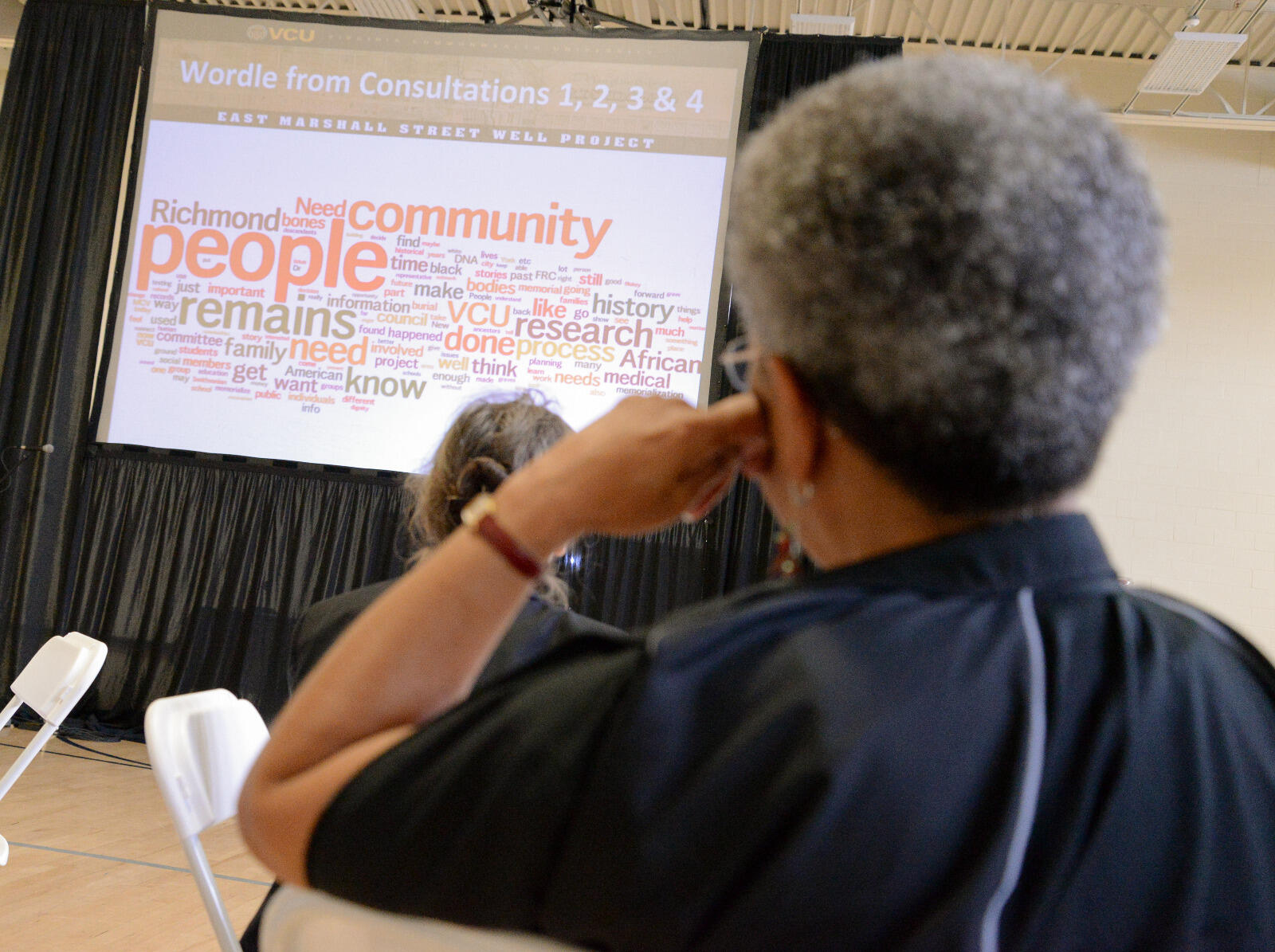
“What you see here is what was talked about, what you generated. You can see the larger the words, the more thematic they were for the participants. We’re happy about that. We see community, remains, research, family,” Edwards said.
Following the presentations, small groups worked with facilitators to offer suggestions and critiques of the recommendations.
Finding a new name for the project that better reflects the project’s goals was also a topic of discussion.
“How can you honor and describe the reality in a dignified way?” Edwards asked as the group discussed the day’s suggestions.
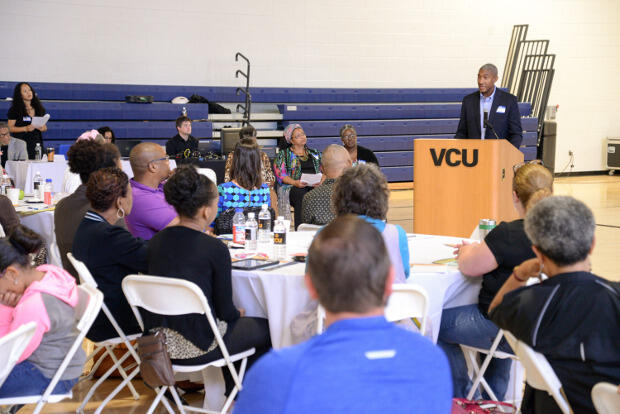
More than 75 people attended the meeting Saturday, June 4, a record crowd for the five community consultations held since April 2015. The event was held at Martin Luther King Jr. Middle School.
“My experience working as the chair was enriching, as it offered the opportunity to learn more about yet another dimension of the rich history of the city and the African-Americans within it,” Jones said.
Materials and video from Saturday’s meeting will be posted to emsw.vcu.edu in the coming weeks. The recommendations will be presented to VCU and VCU Health System leadership later this year, Allison said.
Subscribe for free to the weekly VCU News email newsletter at http://newsletter.news.vcu.edu/ and receive a selection of stories, videos, photos, news clips and event listings in your inbox every Thursday.
Subscribe to VCU News
Subscribe to VCU News at newsletter.vcu.edu and receive a selection of stories, videos, photos, news clips and event listings in your inbox.