Feb. 10, 2003
Richmond technologists score at Super Bowl XXXVII
Share this story
Most of us weren't lucky enough to spend Super Bowl Sunday in San Diego, watching the Tampa Bay Buccaneers overwhelm the Oakland Raiders. But an invitation to work behind the scenes got two Richmond technologists to Qualcomm Stadium - or at least outside the stadium.

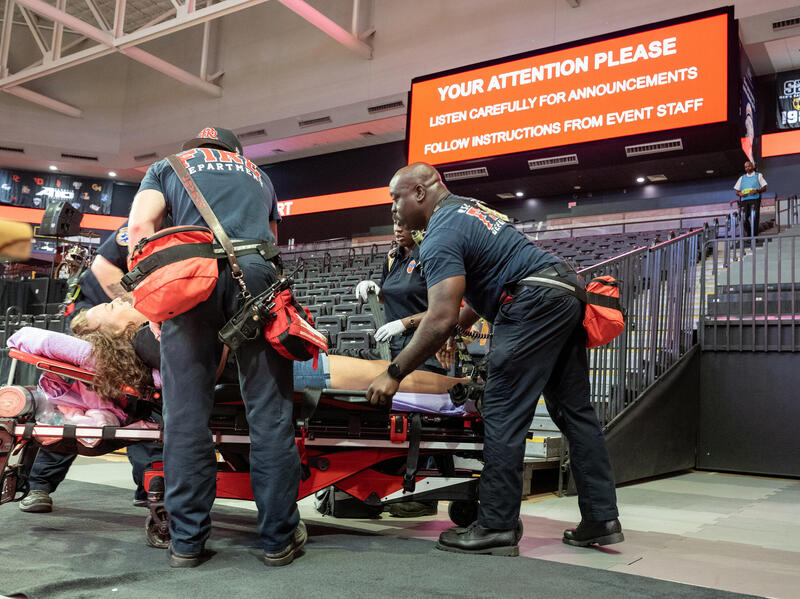
Brett Harnett, director of experimental information technology within the Department of Surgery at VCU, and Dr. John Barnett, president and CEO of REDD/MMMAD, a sensor development company at the Virginia Bio·Technology Research Park, were among the approximately 200 technologists, emergency workers, healthcare providers and others who participated in "Shadow Bowl," www.shadowbowl.org, a series of simulated mass casualty disasters in the San Diego area and other communities around the nation during Super Bowl weekend (Jan. 24-26). The exercise, designed to allow participating organizations to demonstrate rapid-response, on-demand services and expertise for a mass-casualty event, was coordinated by San Diego State University.
Harnett worked with Barnett; Mark Licata, president of BioTrack, LLC, www.bio-track.com, a biomedical product development company at the Bio·Tech Park, and Thomas Hopkins, president of Coderiver, LLC, www.coderiver.com, a professional programming company in Richmond, to modify a telemedicine technology used by the Medical Informatics and Technology Applications Consortium (MITAC), www.meditac.com, a NASA-sponsored research lab in VCU's Department of Surgery. The technology allows surgeons to track and instantly transmit a person's physiological information from anywhere in the world to VCU, essentially eliminating the geographic barriers of health care.
The modifications allowed the MITAC technology to measure the particulate mass of ambient air that might indicate the presence of pathogens. The result was a portable, battery-operated device capable of collecting real-time particulate measurements, logging them locally and transmitting the encrypted data over the Internet using standard digital cellular service to a web server at VCU. This graphed data was available to the command center at San Diego State University and to anyone on the World Wide Web.
What was most interesting in the system was the communication link redundancy, which surprisingly came into play on Super Bowl weekend.
The purpose of the redundancy was to test a fall-back satellite communications plan to replace or supplement the cellular link in case of catastrophic emergencies such as that which occurred in New York City on Sept. 11, 2001, after the attacks on the World Trade Center. Cellular services became overburdened that day and failed. The backup plan was to re-route the data to Iridium, the Low Earth Orbiting Satellite (LEOS) system.
It seems as if many football fans were on their cellular phones during the Super Bowl. The VCU team was unable to transmit data via cellular from Qualcomm Stadium. The air quality readings from the experimental sensor were then sent successfully via Iridium.
MITAC is a consortium comprised of partners from government, academic institutions and industry that have a commercial interest in products and technology related to telemedicine, medical informatics and medical technology. It is directed by Ronald Merrell, MD, chair of surgery at VCU. Merrell also is chief medical officer at OrbitalMed, LLC, a telemedicine company at the Bio·Tech Park that plans to license the modified technology.
Subscribe to VCU News
Subscribe to VCU News at newsletter.vcu.edu and receive a selection of stories, videos, photos, news clips and event listings in your inbox.