Jan. 13, 2010
Sculptors a Provocative Combination at the Anderson Gallery This Winter
Share this story
Amy Hauft, chair of the Department of Sculpture in the VCU School of the Arts, began to formulate the work that would become “Counter Re-formation,” a large-scale piece occupying the second floor of the VCUarts Anderson Gallery through Feb. 21, at an exhibition of model staircases made by French master-craftsmen of the 19th century. Francis Cape found inspiration for the three installation pieces he has at the Anderson Gallery this winter following his work as a disaster-relief worker in New Orleans after Hurricane Katrina decimated the city.
However different the origins and methods behind these two top-flight sculptors’ works, their pairing at the Anderson has proved to be “a provocative one,” according to Ashley Kistler, curator of the exhibition and director of the Anderson Gallery. Hauft’s piece offers grandeur and intimacy, contemporary techniques and antique references, while Cape’s installations of sculptures with architectural elements and photographs powerfully depict a stricken city. Both artists infuse their work with a look at modern society that can be cutting.
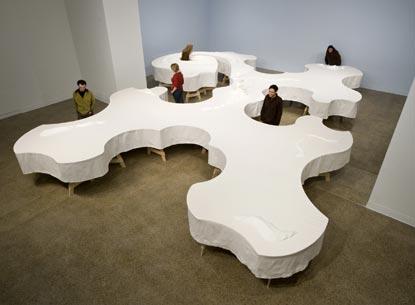
“Counter Re-formation,” which represents Hauft’s first showing in Richmond, is viewed from two wildly different perspectives that offer strikingly disparate experiences with the work. The piece consists of a 32-foot long, white, banquet-like table with serpentine flourishes. The table is largely empty except for a small spiral staircase made from sugar in the center of the table and a series of topographies that resemble snowdrifts or icebergs in most cases and a spiraling mountain in another.
At ground level, visitors can walk alongside and within the table, enjoying a sense of being part of a desolate, wintry landscape. Following one curling movement on the table to its end brings a visitor to feel trapped in chest-high snow.
At the first showing of “Counter-Reformation,” at Western Michigan University last year, visitors could view the piece from a balcony above. The Anderson Gallery facility does not afford that kind of experience, so Hauft has installed a spiral staircase in a corner of the exhibition space that allows for a bird’s-eye vantage point. Looking down on the piece a visitor will become aware of the layout of the table – both its regularity and its idiosyncrasies. She likens it to walking through a landscape and then flying above it.
“The abstraction of elevation almost helps it make more sense,” Hauft says.
Together the ground view and the overhead view force viewers of “Counter Re-formation” to encounter the piece physically – something Hauft says she aims to do with all of her works.
The small sugar sculpture in the middle of the table is a delicately impressive work of precision. Hauft learned the largely forgotten techniques used to create the piece from a culinary scholar in England. Sugar sculptures were created for monarchs in the 18th century as a demonstration of their great wealth. Sugar was imported to the European countries at “exorbitant fees,” according to Hauft, and top sculptors were enlisted to create painstaking pieces that would be set on the tables during feasts. Often, Hauft says, the expensive, ornate sugar pieces were eaten by partygoers – a sign of true decadence.
In its size, the staircase represents a departure for Hauft, who says she likes to work “on an architectural scale,” but the small touch accentuates the overall work’s theme of conspicuous consumption.
Hauft said “Counter Re-formation” started with her fascination with the obscure craft of sugar sculpting, but, as the work developed, she began to reflect on the thematic parallels that were evoked between the sculptures’ original setting – the extravagant feasts of regal banquet halls – and the outlandish displays of wealth seen during the financial bubble years of the past decade.
“I began thinking about this crazy excess that we were living in the middle of,” Hauft said. “This felt like our times.”
During an artist’s talk about his work at VCU in November, Cape said the “Home Front” pieces on display at the Anderson Gallery fit his succinct interpretation of an artist’s role – “we see, and we share that seeing.” In this case, Cape shares what he saw during his time in New Orleans.
“I’m interested in my peculiar response to these unsettled places,” Cape said.
Cape’s pieces in “Home Front” highlight his prevailing emphasis on the everyday – “my interest is in the ordinary,” Cape said – as well as his training as a woodcarver. Cape handled a great deal of restoration work in England as a young professional, and it was as a volunteer carpenter that he traveled to New Orleans in the aftermath of Katrina. He utilizes photographs, placed on the wall above his sculptures, as a way to comment on the pieces themselves and to serve, he said, as his “thought bubbles.” His piece, “Waterline,” most explicitly evokes New Orleans, using yellow paint and wainscoting to suggest a flooded room – much like rooms Cape saw in New Orleans with flood damage evident up the interior walls of houses.
In his artist’s talk at VCU, Cape emphasized the wreckage and sense of desolation that marked New Orleans, showing slides of a series of photographs of the scenes he witnessed – scenes he says revealed “radically different views of New Orleans than shown in the news media." The resulting installations respond not only to New Orleans but to Cape’s thoughts on the cycle of production and consumerism and on the lack of a contemporary link between design and social need.
Subscribe to VCU News
Subscribe to VCU News at newsletter.vcu.edu and receive a selection of stories, videos, photos, news clips and event listings in your inbox.